

On this page
Absolute value equations are a notorious trap in algebra. A 2024 study found that among 60 mathematics majors, most struggled with absolute value problems by simply removing the modulus bars and ignoring the negative cases.
When you are asked to solve x² − 5|x| + 6 = 0, taking the traditional approach of splitting it into "Case 1 (x ≥ 0)" and "Case 2 (x < 0)" creates twice the work and double the chance for a minus-sign error. Why do students struggle so much? The same study noted that many treat absolute value bars as regular parentheses, assuming they can just drop them and solve the remaining quadratic equation. This leads to missing roots or mathematically invalid answers.
By using a substitution method, you force yourself to respect the absolute value until the final step, at which point the physical meaning of distance on a number line makes the solution obvious.
How do you solve equations reducible to quadratic form?
The trick is to realise that the square of any real number is identical to the square of its absolute value. In algebra, x² = |x|².
This means you can rewrite the original equation: |x|² − 5|x| + 6 = 0
Now, replace the modulus entirely by introducing a temporary variable, let t = |x|. The equation becomes a standard quadratic: t² − 5t + 6 = 0
Factorising this gives: (t − 2)(t − 3) = 0
So, t = 2 or t = 3.
Because we set t = |x|, we now have two simple equations to solve: |x| = 2 |x| = 3
The absolute value of x is its distance from zero on the number line. A distance of 2 means x could be 2 units to the right (+2) or 2 units to the left (−2). Therefore: x = 2 or x = −2 x = 3 or x = −3
The four roots of the equation are ±2 and ±3.
How do you count real roots from the t-equation?
You do not always need to find the exact roots; exams like JEE Main often just ask how many real roots an equation has. By looking at the roots of your t-equation, you can quickly count the real roots of x.
Because t represents a distance, its value dictates the number of corresponding x values:
For every positive t, you get exactly two real roots of x (+t and −t).
For t = 0, you get exactly one real root (x = 0).
For every negative t, you get zero real roots, because the absolute value of a real number cannot be negative.
In our example of x² − 5|x| + 6 = 0, the substitution gave t = 2 and t = 3. Because both are positive, each yields two values for x, giving a total of four real roots.
What if the quadratic in t had different signs? Imagine an equation that factorises to (t − 4)(t + 1) = 0. The roots would be t = 4 and t = −1. The positive root gives x = ±4 (two real roots). The negative root gives |x| = −1, which has no real solution. The equation would therefore have only two real roots in total.
Why do the roots come in ± pairs?
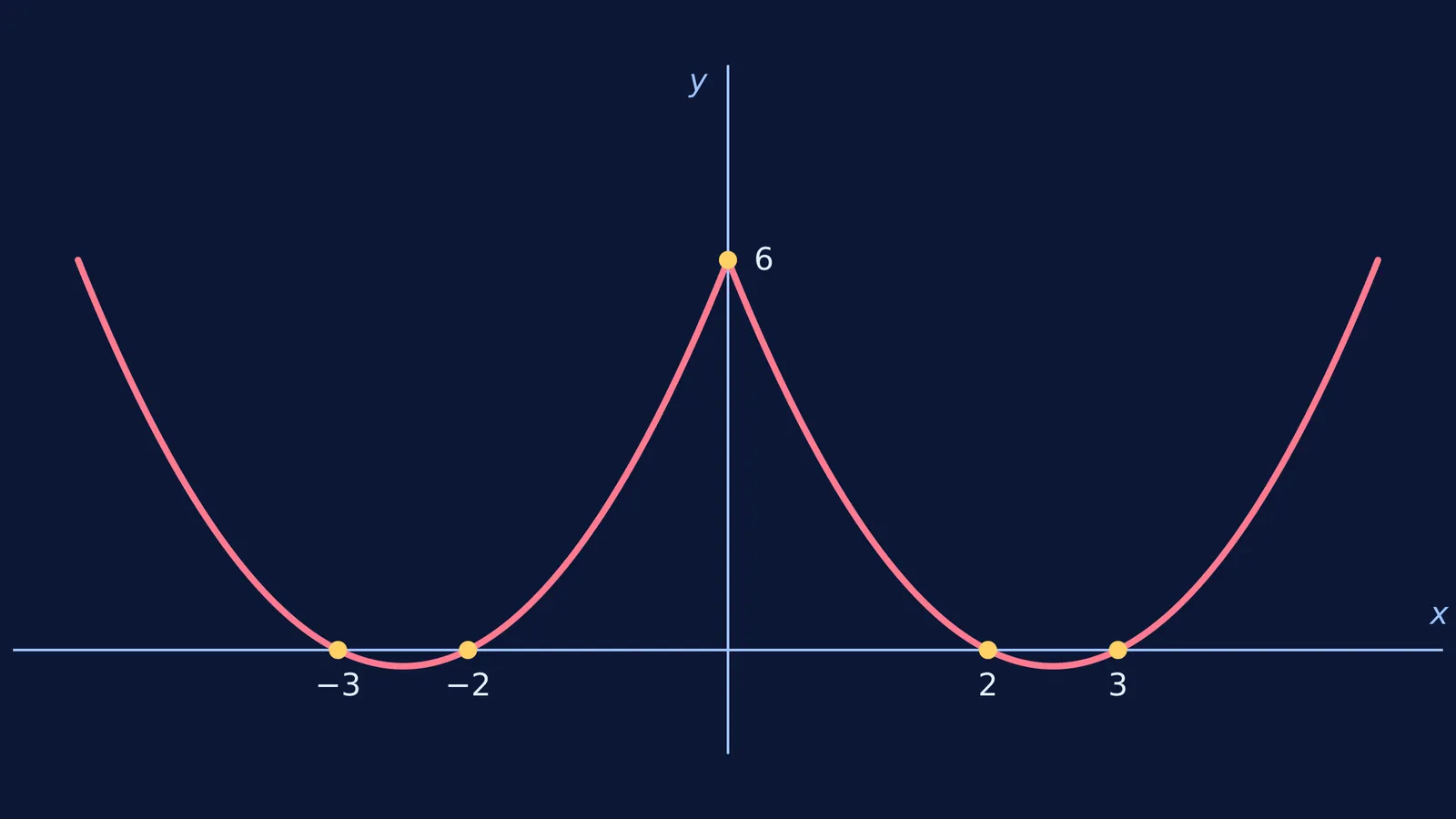
If you sketch the graph of y = x² − 5|x| + 6, you will see exactly why the roots appear as +2, −2, +3 and −3.
The absolute value function makes the overall equation symmetric. Whatever happens on the right side of the y-axis (where x is positive) is perfectly mirrored on the left side (where x is negative). In mathematical terms, replacing x with −x leaves the equation unchanged because |−x| = |x| and (−x)² = x². Functions with this property are called even functions.
Because the graph is symmetric across the y-axis, any root that appears at a positive distance from zero must have an identical twin at the same negative distance. When you set t = |x| and find that t = 3, you are finding the distance from the y-axis where the graph crosses zero. The symmetry guarantees it crosses at both x = 3 and x = −3.
If you struggle to remember when to split cases and when to substitute, the Fermi Concept Library holds every concept in physics, chemistry, biology, mathematics and computing, each with its own lesson and its place in the map.
How do you use the checklist for modulus quadratics?
When an equation mixes x² and |x|, follow this framework to avoid dropped roots:
Rewrite x² as |x|²: Make the squared variable match the modulus term.
Substitute t = |x|: Write the entire equation in terms of t.
Solve for t: Factorise or use the quadratic formula to find the roots of t.
Filter the t values: Discard any negative values of t.
Solve for x: For every valid t, write x = ±t to find your final paired roots.
When you practice problems like these, relying on memorised rules rather than the distance concept is where mistakes happen. The Fermi Problem Library has worked problems with a step-by-step solver that explains the reasoning rather than printing an answer.
For more on dealing with piecewise functions, read our guide to Equations and inequalities with modulus: the case-split method. If you are testing when a standard quadratic has real roots without solving it completely, revise When is ax² + bx + c positive for all x? The discriminant test.


