

On this page
Pyrrole, furan, and thiophene are five-membered aromatic rings that are much more reactive than benzene. Because their heteroatoms (nitrogen, oxygen, or sulfur) donate a lone pair into the ring's pi system, the rings are packed with electron density. When an electrophile comes looking for electrons, it has a choice of where to attack: the C2 position (next to the heteroatom) or the C3 position.
In almost all cases, the reaction happens at C2. To see why, you have to count the resonance structures of the intermediate formed in each path.
Why is C2 substitution preferred?
When the electrophile attacks C2, it breaks the double bond and leaves a positive charge on the ring. This intermediate carbocation is stabilized by delocalizing the charge.
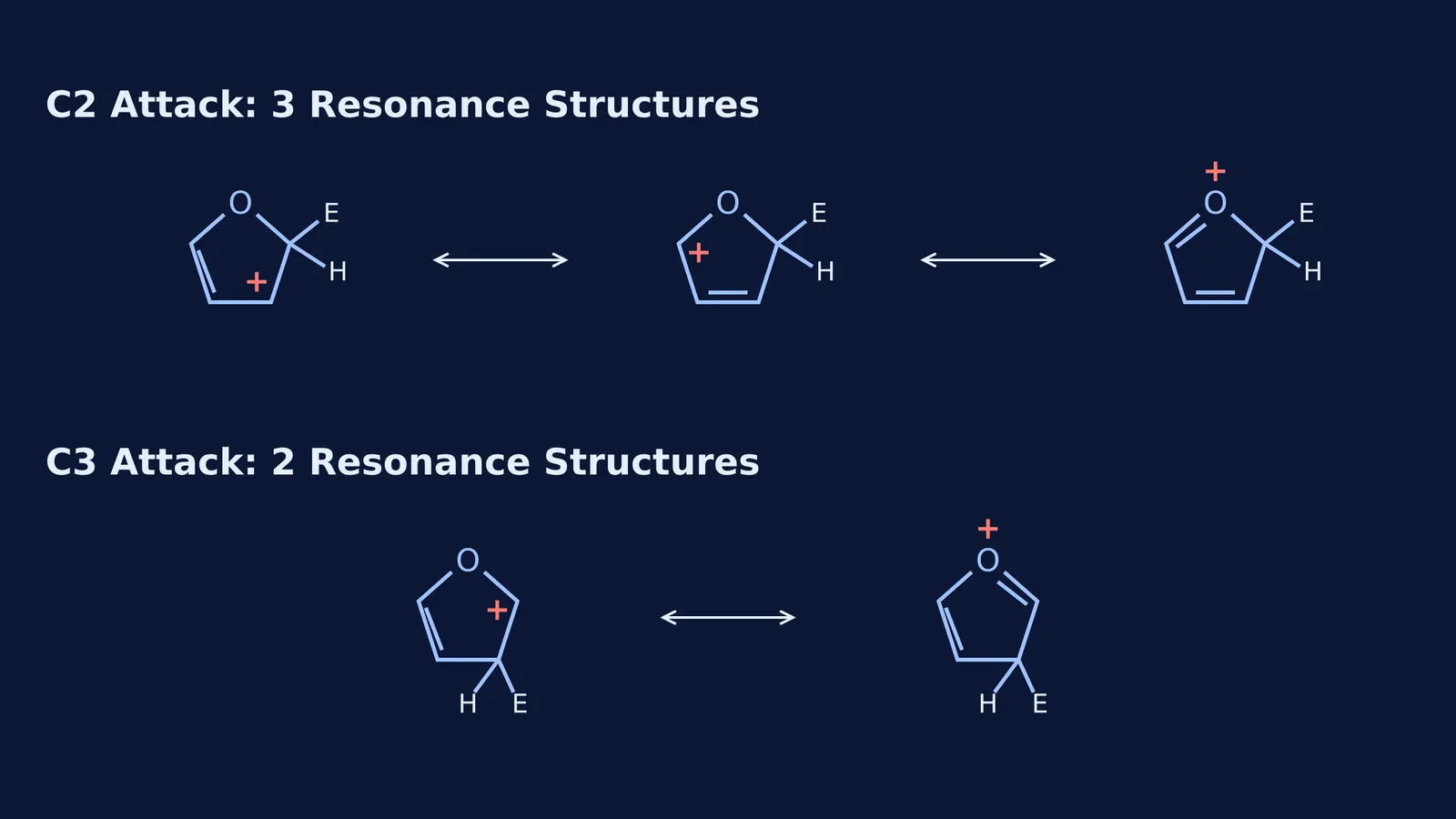
For a C2 attack, you can draw three valid resonance structures. First, the positive charge sits on C3. Second, the remaining double bond shifts, moving the positive charge to C5. Third, the heteroatom donates its lone pair, putting the positive charge on itself and completing the octets of all atoms.
Because this intermediate is spread over three structures, it is highly stable. As explained in the textbook Organic Chemistry/28%3A_Biomolecules_-_Heterocycles_and_Nucleic_Acids/28.03%3A_Reactions_of_Pyrrole_Furan_and_Thiophene), a more stable intermediate means a lower activation energy, making the C2 pathway much faster.
The connection between the stability of the intermediate and the speed of the reaction comes down to Hammond's postulate. In electrophilic aromatic substitution, the first step—the attack of the electrophile to form the carbocation intermediate—is the slow, rate-determining step. Hammond's postulate states that the transition state for an endothermic step resembles the intermediate that follows it. Since the intermediate from a C2 attack is more stable due to its three resonance structures, its corresponding transition state is also lower in energy. A lower transition state energy means a lower activation energy barrier, which allows the reaction to proceed much faster at the C2 position.
Furthermore, this difference in resonance stabilization dictates not just the reaction rate but also the product distribution. The overwhelming majority of the product formed will be the C2-substituted isomer because the kinetic pathway strongly favors it. While a small fraction of C3 substitution can occur under specific harsh conditions, or when the C2 positions are sterically hindered by bulky groups, the lower activation energy for C2 attack makes it the dominant, and often exclusive, pathway under standard laboratory reaction conditions.
What happens during a C3 attack?
If the electrophile attacks at C3 instead, the positive charge is left on C2.
This intermediate has fewer ways to stabilize itself. You can only draw two resonance structures: one with the positive charge on C2, and another where the heteroatom donates its lone pair to form a double bond, taking the positive charge itself. The charge cannot reach the other side of the ring without breaking the structural framework.
Two resonance forms are less stable than three, so the C3 pathway takes more energy and happens much slower. (You can see similar stability rules at play when comparing intermediate states in the Reimer-Tiemann and Kolbe reactions of phenol, step by step).
What is the reactivity order of the heterocycles?
All of these five-membered rings react faster than benzene, but they are not strictly equal. The order of reactivity is pyrrole > furan > thiophene.
Nitrogen in pyrrole is the least electronegative, so it most willingly shares its lone pair to stabilize the positive charge in the transition state. Oxygen in furan holds onto its electrons more tightly, making it slightly less reactive. (If you want to practice identifying how delocalization stabilizes molecules, try calculating the average bond order from resonance: nitrate, ozone and oxyanions).
Seeing the mechanism in action
When you are revising organic chemistry for exams, drawing out these intermediates by hand is the best way to prove the rule to yourself. If you are stuck on how the electrons shift during these reactions, Fermi's AI tutor works out what you already know, builds a plan for the session, and teaches through the mechanism step by step. You can also explore the complete map of aromatic reactions in the Fermi Concept Library, which covers every concept in physics, chemistry, biology, mathematics and computing, each with its own lesson and its place in the map.


