

On this page
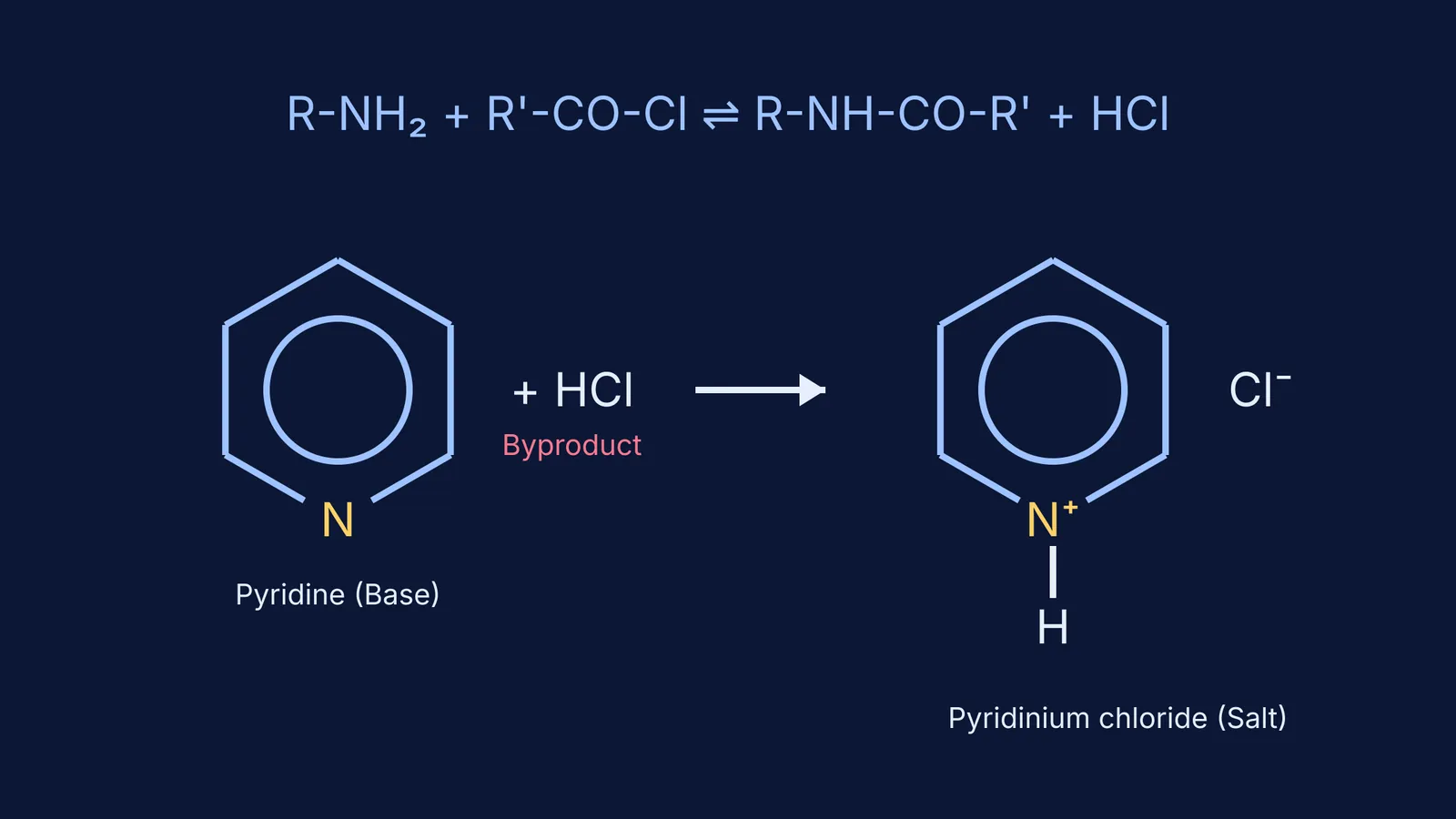
When you react a primary or secondary amine with an acid chloride to form an amide, or when you react an alcohol to form an ester, the reaction produces hydrogen chloride (HCl) as a byproduct. To keep this reaction running smoothly and ensure a high yield of your product, a base like pyridine is added to the reaction mixture.
Organic chemistry is full of reactions where managing byproducts is just as important as managing the main reactants. In acylation, handling the acidic byproduct is the key to preventing the reaction from stalling.
What is the role of pyridine in the acylation of amines and alcohols?
The primary role of pyridine is to act as an acid scavenger. According to the NCERT Class 12 Chemistry textbook, pyridine is a stronger base than the reactant amine, so it reacts with the HCl byproduct to form a salt.
Because the acylation reaction is reversible, allowing HCl to build up would push the reaction backwards. By neutralising the acid and removing it from the solution, pyridine shifts the equilibrium to the right-hand side. This is a classic application of Le Chatelier's principle: removing a product from an equilibrium system forces the system to produce more of that product, which in this case means producing more of your desired amide or ester.
What happens if pyridine is not added?
If you run the acylation without pyridine, the accumulating HCl will react with the unreacted starting amine. Because amines are basic, they readily accept protons from strong acids. This protonates the amine to form an ammonium salt, RNH₃⁺Cl⁻.
Once the amine is protonated, its nitrogen atom no longer has a free lone pair of electrons. It completely loses its nucleophilicity and cannot attack the carbonyl carbon of the acid chloride. This effectively stops the reaction halfway, severely limiting your yield. You would lose half of your carefully synthesised starting amine just to neutralise the byproduct.
For alcohols, the situation is slightly different but equally problematic. While alcohols are not as basic as amines, the buildup of a strong acid like HCl in the reaction mixture can lead to unwanted side reactions, such as the cleavage of sensitive protecting groups or the hydrolysis of the newly formed ester.
If you are struggling to track these reaction mechanisms or what each reagent does during your exam preparation, you can use the Concept Library to step through them. The AI tutor teaches rather than answers: it holds a line of reasoning, writes on a board, and draws the figure to help you understand why certain bases are preferred over others.
How does pyridine act as a catalyst?
While its role as an acid scavenger is the most famous, pyridine also acts as a nucleophilic catalyst. It actively participates in the reaction mechanism rather than just cleaning up the mess at the end.
Pyridine attacks the acid chloride to form a highly reactive *N*-acylpyridinium intermediate. Because the nitrogen atom in this intermediate carries a positive charge, it makes the attached carbonyl carbon much more electrophilic (electron-poor) than it was in the original acid chloride.
Your starting amine or alcohol can then attack this activated intermediate much faster than it could attack the original acid chloride. After the attack, pyridine is kicked out as a leaving group, ready to catalyse another cycle or neutralise a molecule of HCl. This dual action makes pyridine an exceptionally useful reagent in organic synthesis.
How do you write this mechanism in an exam?
When asked about this in a board exam or a competitive test like JEE or NEET, you need to clearly state the equilibrium shift and the prevention of salt formation. Here is a reliable framework to structure your answer:
State the general reaction: Show the amine and acid chloride reacting to form the amide and HCl.
Identify the problem: Mention that the reaction is reversible and that HCl is an acidic byproduct.
State the solution: Explain that pyridine is added as a base to neutralise the HCl.
Give the consequence: Conclude that removing HCl shifts the equilibrium forward and prevents the starting amine from forming an unreactive salt.
Understanding how to push chemical equilibria is a recurring theme in organic chemistry. You will see similar principles when studying the Fischer esterification: mechanism and how to push the equilibrium and in the Hofmann bromamide degradation: losing one carbon to an amine. You can also see how amine basics are applied in practical tests, such as the Carbylamine test: detecting primary amines by the isocyanide smell.


