

On this page
In quantum chemistry, understanding the difference between the wave function (ψ) and its square (ψ²) is essential to mastering atomic structure. The distinction separates the abstract mathematics of quantum mechanics from the physical reality of where an electron actually is.
What does ψ (psi) actually mean?
In 1926, Erwin Schrödinger formulated a wave equation to describe the behaviour of an electron in an atom. The solution to his equation is the wave function, denoted by the Greek letter ψ (psi).
However, the wave function ψ has no direct physical meaning [[1]](https://en.wikipedia.org/wiki/Wave_function). It is simply a mathematical function that represents the amplitude of the electron's matter wave. Because an amplitude can be positive, negative, or even an imaginary number, it cannot describe a real, measurable physical quantity. You cannot have a negative probability of finding an electron.
Why does ψ² (psi squared) matter?
The physical significance of the wave function was provided by the German physicist Max Born in July 1926 [[2]](https://en.wikipedia.org/wiki/Born_rule). He proposed that the square of the wave function, ψ² (or the squared modulus |ψ|² for complex functions), represents the probability density of an electron.
Because ψ² is a squared value, it is always a real, non-negative number. It tells you the likelihood of finding an electron at a given point around the nucleus. A high value of ψ² means the electron is very likely to be found there.
What happens when the probability density is zero?
As you move further away from the nucleus or look at different types of atomic orbitals, you will find specific regions where the probability density, ψ², is exactly zero. These regions are known as nodes.
Because ψ² is zero at a node, there is a 0% chance of finding an electron in that exact space. This can seem counterintuitive at first: if an electron can be found on either side of a node, how does it cross a region where it cannot exist? The answer lies in the wave nature of the electron. Just as a vibrating guitar string has stationary points that do not move, the electron's matter wave has points where its amplitude, ψ, and therefore its probability density, ψ², cross through zero.
Nodes come in two forms: radial nodes and angular nodes. A radial node is a spherical surface around the nucleus where the probability of finding the electron is zero. An angular node is typically a flat plane or a cone that slices through the orbital. The number of nodes an orbital has depends entirely on its quantum numbers. The total number of nodes is always equal to n − 1. Understanding where these zero-probability regions lie is a critical step in predicting how atoms will bond and interact with one another in chemical reactions.
From probability to orbital boundary surfaces
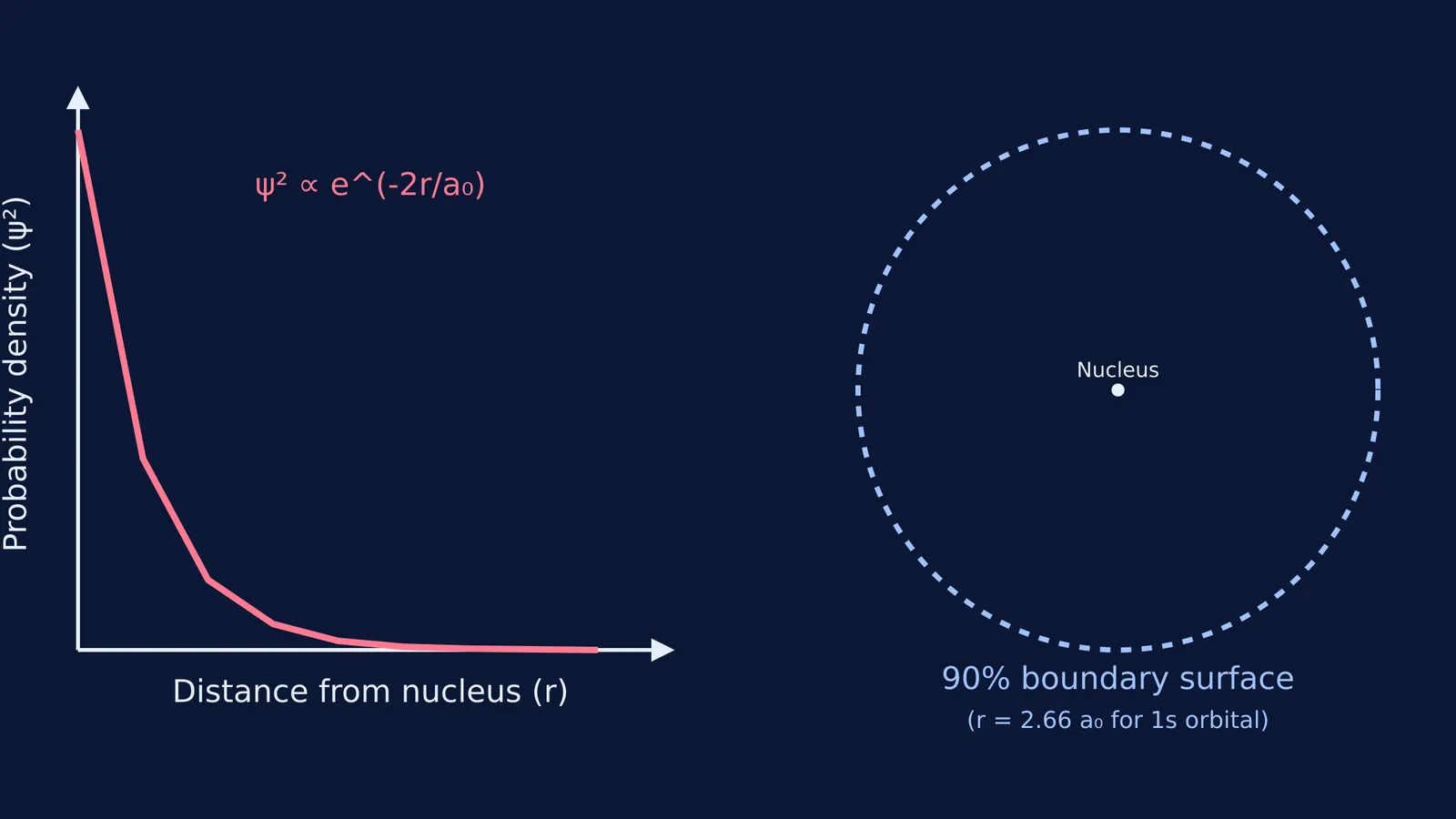
If you graph ψ² against the distance from the nucleus, the curve drops rapidly but mathematically never reaches zero. This implies that an electron has a tiny, but non-zero, chance of being found miles away from the atom.
Because we cannot draw an orbital that encloses a 100% probability, scientists use a threshold. A boundary surface diagram is drawn as a contour to enclose the region of space where there is a high probability—typically 90%—of finding the electron [[3]](https://en.wikipedia.org/wiki/Atomic_orbital).
This 90% boundary surface is what gives atomic orbitals their characteristic shapes. For instance, the boundary surface of an *s*-orbital is a sphere, while a *p*-orbital is shaped like a dumbbell.
Exam checklist: Answering questions on ψ and ψ²
If you are asked to explain these terms in a chemistry exam, use this simple framework to secure full marks:
State the names: ψ is the wave function; ψ² is the probability density.
Define the physical meaning: Explicitly write that ψ has no physical meaning, while ψ² represents the probability of finding the electron in a specific volume.
Explain the sign: Mention that ψ can be positive, negative, or imaginary, whereas ψ² is always a real, positive number (since probability cannot be negative).
Connect to orbitals: State that an atomic orbital is defined as the 3D boundary surface enclosing the region where the probability of finding the electron (ψ²) is 90%.
If you want to see how this fits into the wider rules of atomic structure, explore the Fermi Concept Library, or review Quantum numbers and electron configuration and the electron configuration of ions.


