

On this page
Inequalities such as eˣ ≥ 1 + x look like they need a clever trick. Most don't. Subtract one side from the other, differentiate, and read off where the new function rises or falls. Once you have the routine, a whole family of board and JEE problems becomes the same four lines.
What is the difference-function method?
The method rests on one theorem. In the words of OpenStax Calculus Volume 1, "If f′(x)>0 for all x∈(a,b), then f is an increasing function over [a,b]" (Corollary 3 of the mean value theorem, for f continuous on [a,b] and differentiable on (a,b)). The same section gives the matching result for f′(x) < 0 and decreasing functions.
To prove f(x) ≥ g(x) on an interval:
Define the difference function h(x) = f(x) − g(x).
Find h′(x) and work out its sign on the interval.
Find a point where you know h exactly, usually an endpoint or the place where h′(x) = 0.
Use "increasing" or "decreasing" to carry that value across the interval.
Step 3 is the one students skip. A function can be increasing and still be negative, so monotonicity only helps once you anchor it to a known value. If the theorem itself feels shaky, our guide to Rolle's theorem and the mean value theorem shows where it comes from.
How do you prove eˣ ≥ 1 + x using derivatives?
Let h(x) = eˣ − 1 − x for every real x. Then h′(x) = eˣ − 1.
For x < 0, eˣ < 1, so h′(x) < 0 and h is decreasing on (−∞, 0].
For x > 0, eˣ > 1, so h′(x) > 0 and h is increasing on [0, ∞).
So h has its smallest value at x = 0, and h(0) = 1 − 1 − 0 = 0.
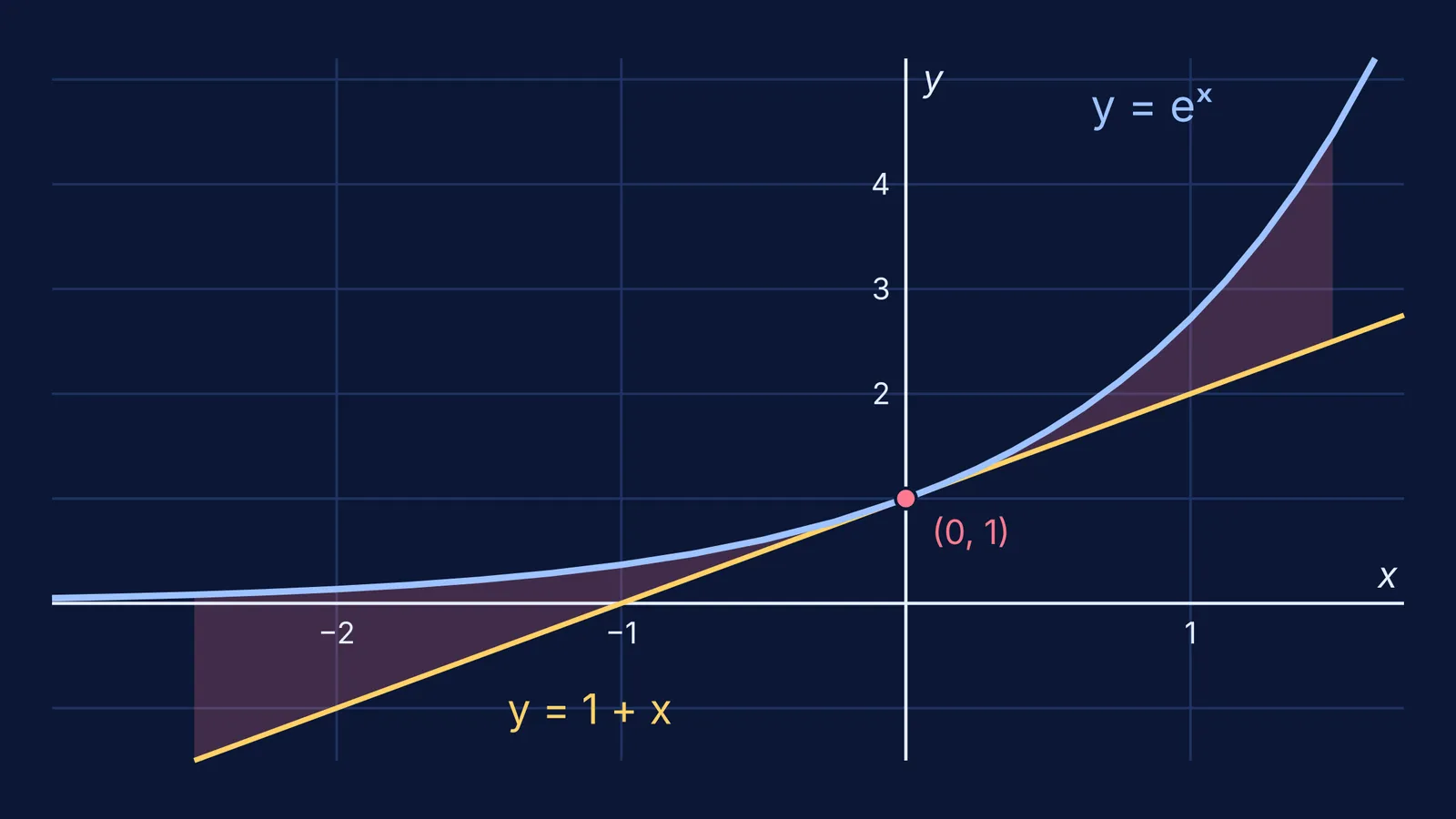
Therefore h(x) ≥ 0, which means eˣ ≥ 1 + x for all real x, with equality only at x = 0. Geometrically, y = 1 + x is the tangent to y = eˣ at (0, 1), and the curve stays above it.
How do you prove sin x < x for x > 0?
Let h(x) = x − sin x for x ≥ 0. Then h′(x) = 1 − cos x, which is never negative.
The subtle part: h′(x) = 0 at x = 0, 2π, 4π and so on. But it is zero only at isolated points, never across a whole interval, so h is still strictly increasing on [0, ∞). Write that sentence in your answer.
Since h(0) = 0 and h is strictly increasing, h(x) > 0 for every x > 0. So sin x < x for all x > 0.
Try the same template on ln(1 + x) < x for x > 0, anchoring at h(0) = 0.
Which is bigger, e^π or π^e?
A calculator gives e^π ≈ 23.14 and π^e ≈ 22.46 (ThatsMaths). In an exam you need a proof; Cut the Knot collects several, including the two below.
Proof 1: a function with a maximum at e. Take logs. Comparing e^π with π^e is the same as comparing π ln e with e ln π, or 1/e with (ln π)/π. So study f(x) = (ln x)/x for x > 0.
f′(x) = (1 − ln x)/x².
f′(x) > 0 for x < e and f′(x) < 0 for x > e, so f has its maximum at x = e.
Since π > e and f is decreasing there, f(π) < f(e), that is (ln π)/π < 1/e.
Multiply by eπ: e ln π < π, so π^e < e^π.
This is Steiner's problem in disguise: x^(1/x) has its maximum at x = e, where it equals e^(1/e) ≈ 1.4447 (Wolfram MathWorld). More on finding such maxima is in our guide to maxima, minima and rates of change.
Proof 2: reuse eˣ > 1 + x. Put x = π/e − 1, which is not zero. Then e^(π/e − 1) > π/e. Multiply by e to get e^(π/e) > π, and raise both sides to the power e: e^π > π^e. Your first inequality settles the famous comparison in three lines.
What should your answer include to earn full marks?
State h(x) and its domain in the first line.
Show h′(x) and give a reason for its sign, not just the sign.
Name the anchor value, such as h(0) = 0 or the maximum at x = e.
Say "strictly increasing" when h′ vanishes only at isolated points.
To compare a^b with b^a, take logs first.
Check whether the question wants ≥ or >, and say where equality holds.
Symmetric sums and products are often quicker with the AM-GM inequality.
If monotonicity itself is the gap, the Fermi Concept Library gives every concept in mathematics its own lesson. To practise the method, the Fermi Problem Library has worked problems with a step-by-step solver that explains the reasoning rather than printing an answer, so you can see where your sign argument or anchor went wrong.


