

On this page
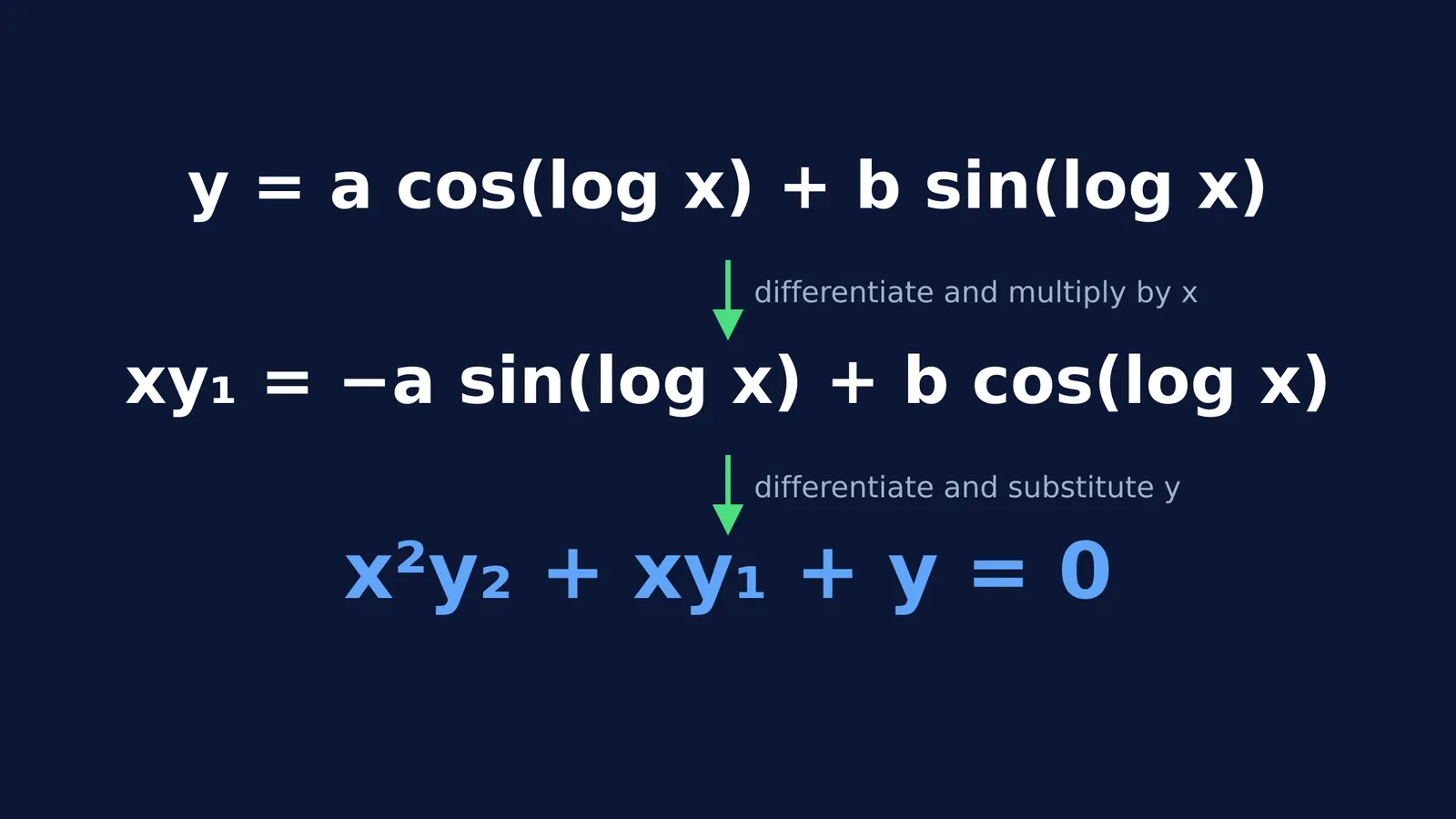
To prove a relation involving second-order derivatives, you start by taking the first derivative of the given function. Let us look at the standard form where y = a cos(log x) + b sin(log x).
In the CBSE Class 12 mathematics syllabus, the Calculus unit carries 35 out of 80 marks. In this curriculum, y₁ means the first derivative with respect to x (dy/dx), and y₂ means the second derivative (d²y/dx²). This shorthand saves time and keeps your algebra looking cleaner when writing out long equations.
Using the chain rule, you differentiate both sides with respect to x. The derivative of cos(log x) requires differentiating the outer cosine function and then multiplying it by the derivative of the inner logarithmic function.
y₁ = a × −sin(log x) × (1/x) + b × cos(log x) × (1/x)
This simplifies to: y₁ = (−a sin(log x) + b cos(log x)) / x
Why should you multiply by x before finding y₂?
A common mistake at this stage is to dive straight into finding the second derivative (y₂) using the quotient rule on the fraction above. While that method mathematically works, the algebra gets messy quickly and makes the final substitution much harder to see.
Instead, clear the fraction by multiplying both sides by x: x y₁ = −a sin(log x) + b cos(log x)
This rearranging step makes finding the second derivative much simpler. When you differentiate the left side now, you will use the product rule rather than the quotient rule, keeping the expression in a linear form. If you often get stuck deciding which method to use, the Fermi Problem Library has worked problems with a step-by-step solver that explains the reasoning rather than just printing an answer. By avoiding fractions, you lower the risk of sign errors and missed terms.
How do you prove the x²y₂ + xy₁ + y = 0 relation?
Now differentiate both sides of your rearranged equation with respect to x again.
On the left side, apply the product rule to the term x y₁. You treat x as the first function and y₁ as the second function.
Derivative of (x y₁) = x × (derivative of y₁) + y₁ × (derivative of x) = x y₂ + y₁ × 1 = x y₂ + y₁
On the right side, use the chain rule again just like you did in the first step: Derivative of [−a sin(log x) + b cos(log x)] = −a cos(log x) × (1/x) − b sin(log x) × (1/x)
Factor out the negative sign and the 1/x to see the structure clearly: = −(a cos(log x) + b sin(log x)) / x
Putting the two sides back together gives: x y₂ + y₁ = −(a cos(log x) + b sin(log x)) / x
Notice that the expression inside the bracket on the right side is exactly our original function y. You can now substitute y back into the equation.
x y₂ + y₁ = −y / x
Finally, multiply the entire equation by x again to clear the denominator. This brings the equation into the exact format required.
x (x y₂ + y₁) = −y x² y₂ + x y₁ = −y
Bringing −y to the left side gives the final proved relation: x² y₂ + x y₁ + y = 0
What are the common mistakes in this proof?
When tackling this problem in a high-pressure exam setting, students typically lose marks in three places:
Forgetting the chain rule: When differentiating cos(log x), it is easy to write −sin(log x) and forget to multiply by 1/x. This immediately throws off the rest of the proof.
Mishandling the product rule: When differentiating x y₁, students sometimes write x y₂ and forget the second part of the product rule (y₁ × 1).
Missing the substitution: If you do not recognize that a cos(log x) + b sin(log x) is equal to y, you can get stuck with a massive trigonometric expression and no clear way to reach the final answer.
Why is this differential equation significant?
In calculus, the equation x² y₂ + x y₁ + y = 0 is a specific case of a Cauchy-Euler differential equation. The substitution x = e^t transforms it into a standard linear equation with constant coefficients, which typically represents simple harmonic motion or oscillatory behavior. This explains why the solution y = a cos(log x) + b sin(log x) is a combination of sine and cosine waves.
When you practice these problems, you are not just manipulating symbols. You are verifying that a specific mathematical model behaves correctly under differentiation. Recognizing the connection between the logarithmic argument inside the trig function and the x and x² coefficients outside will help you spot patterns in more advanced differential equations.
How does this apply if y = a cos(log x) alone?
If your specific question only asks about y = a cos(log x) without the sine term, the steps remain identical. The constant b simply becomes zero.
First derivative: y₁ = (−a sin(log x)) / x x y₁ = −a sin(log x)
Second derivative: x y₂ + y₁ = −a cos(log x) × (1/x) x y₂ + y₁ = −y / x
Multiply by x: x² y₂ + x y₁ + y = 0
The structure of the proof is independent of the constants a and b, which is why the relation x² y₂ + x y₁ + y = 0 holds true whether the function is a pure cosine wave, a pure sine wave, or a combination of both. These methods apply whenever you are trying to build a differential equation from a known solution. For example, if your function involves a parameter t instead of a direct relation, you would first need the method for differentiating parametric functions before you can attempt similar proofs.


