

On this page
When you first learn arithmetic, it feels natural to swap numbers around or group them differently to make calculations easier. Adding 2 and 3 is the same as adding 3 and 2. But when negative numbers are introduced, applying these shortcuts blindly leads to dropped signs and wrong answers.
This is why we learn the closure, commutative, and associative properties of integers in Class 7. They are not just vocabulary words to memorise; they are the fundamental rules that tell you when you are allowed to change the order of a calculation and when you must leave it exactly as written.
What is the closure property of integers?
An operation is "closed" if applying it to two integers always results in another integer. Think of it as a closed room: if you combine two things inside the room, the result cannot escape into a different category of numbers, like fractions or decimals.
According to the official NCERT Class 7 curriculum, integers are closed under addition, subtraction, and multiplication. If you add, subtract, or multiply any two integers, your answer will always be an integer. For example, subtracting a larger positive number from a smaller one, like 5 − 8, gives −3, which is still an integer.
However, integers are not closed under division. If you divide −2 by −4, the result is 0.5. Because 0.5 is a decimal and not an integer, division breaks the closure property. If you want to see how these categories connect, the Fermi Concept Library maps out exactly how number systems expand from natural numbers to integers and beyond.
Are subtraction and division commutative?
The commutative property states that changing the order of the numbers does not change the final result. Addition and multiplication are commutative. You can calculate 4 × (−2) or (−2) × 4, and you will get −8 either way.
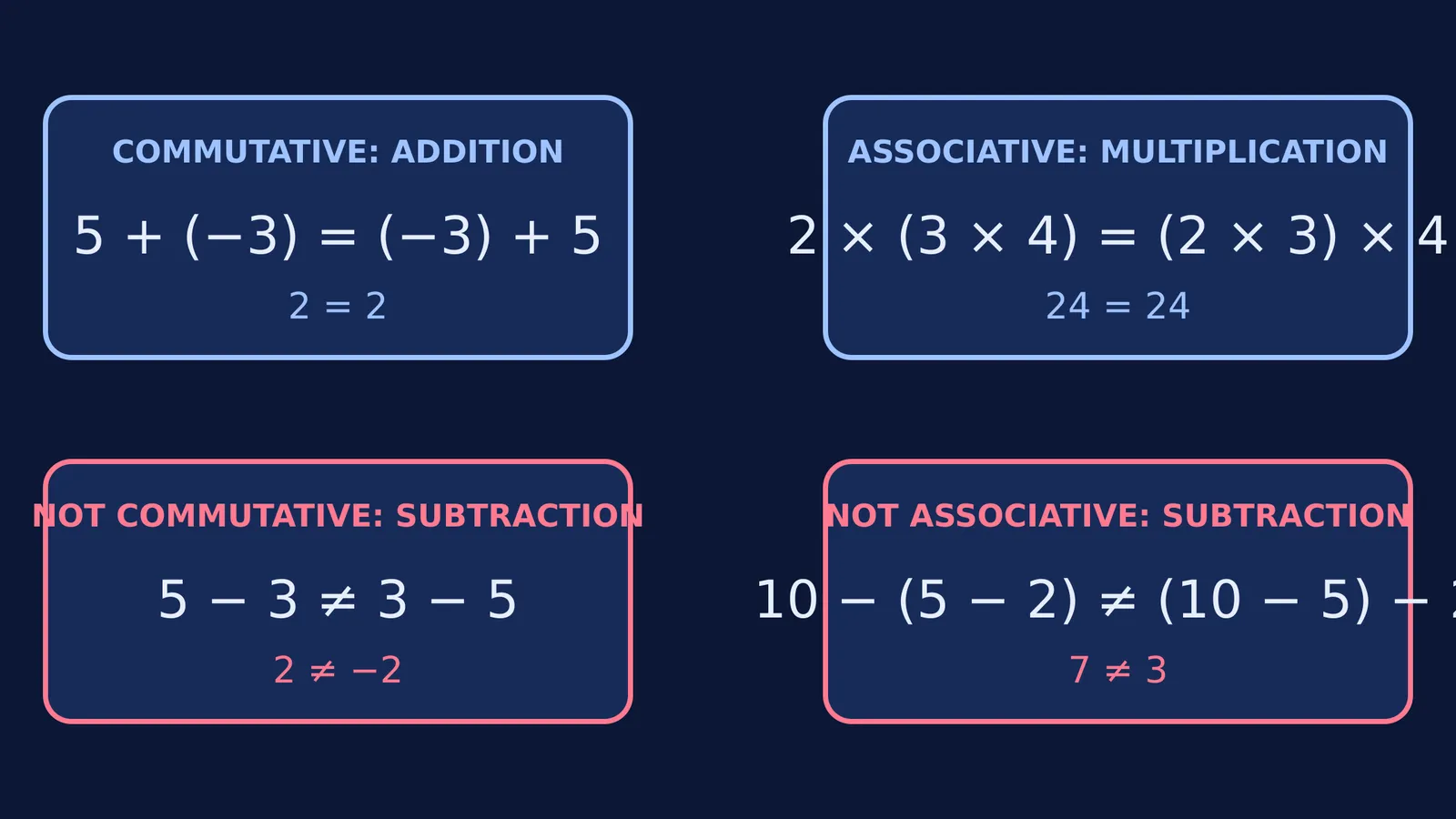
But subtraction and division are explicitly not commutative. If you swap the order of the numbers in a subtraction problem, you change the sign of the answer. For instance, 5 − 3 = 2, but 3 − 5 = −2. The numbers are the same, but the outcome is completely different.
Similarly, division fails the commutative test. Calculating 8 ÷ 2 gives 4, but reversing the order to 2 ÷ 8 gives 0.25.
How does the associative property work?
The associative property is about grouping. It states that changing where you place the brackets in a calculation involving three or more numbers does not change the result. Just like commutativity, addition and multiplication are associative. For example, in multiplication, 2 × (3 × 4) gives 24, and (2 × 3) × 4 also gives 24.
Subtraction and division are not associative. Shifting the brackets in a subtraction problem drastically alters the math. Let us look at 10 − (5 − 2). You must solve the brackets first, so this becomes 10 − 3, which equals 7. But if you group the first two numbers instead, like (10 − 5) − 2, you get 5 − 2, which equals 3. Because 7 does not equal 3, the property fails.
Losing track of brackets and breaking the associative rule is a very common source of errors. If you find yourself consistently getting the wrong sign in long calculations, Fermi's AI tutor can look at your working, hold a line of reasoning across the whole session, and point out the exact step where you shifted a bracket incorrectly.
A practical framework to test any property
You do not need to guess whether a rule applies to a new math concept. You can test it yourself using three simple steps:
Pick two small integers, making sure one is positive and one is negative (for example, 2 and −3).
Apply the operation one way, then swap the numbers. If the answers differ, the operation is not commutative.
Pick a third integer and shift the brackets. If the two groupings yield different results, it is not associative.
These properties are foundational to all higher mathematics. You will use the exact same logic later, whether you are solving modulus equations and inequalities where case-splits matter, or when you are exploring the rules for complex numbers. If a property fails just one test case, as subtraction does with commutativity, the rule is broken and you cannot rely on it.


