

On this page
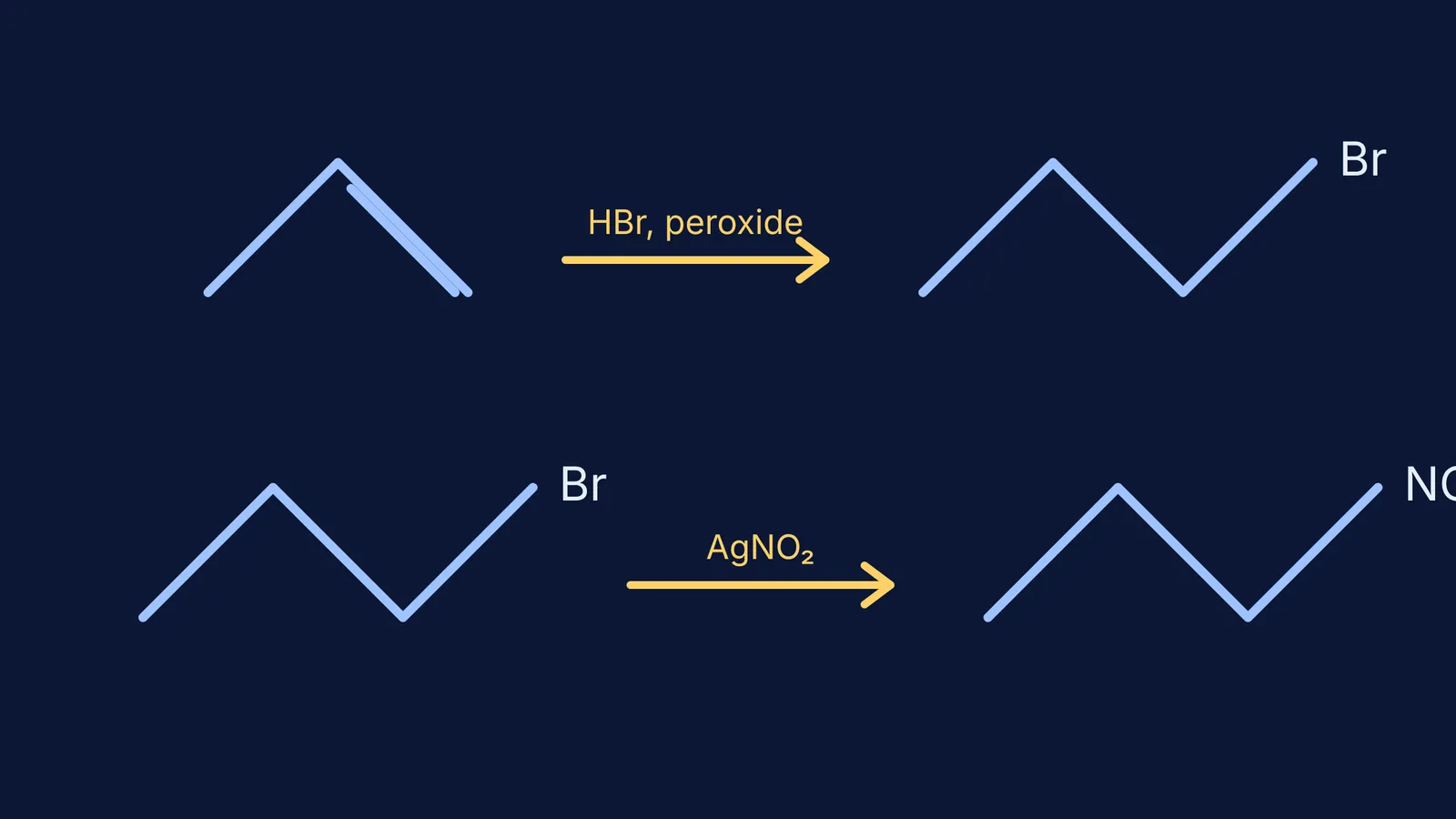
Converting propene to 1-nitropropane requires two steps because you cannot add a nitro group to an alkene in a single addition reaction. If you add hydrogen bromide directly to propene without any other reagents, Markovnikov's rule dictates that the bromine will attach to the middle carbon. This creates 2-bromopropane, which would eventually lead to 2-nitropropane. To place the functional group on the terminal carbon instead, you must first reverse the normal addition pattern, and then substitute the halogen with a nitro group.
How do you convert propene to 1-nitropropane?
The conversion from propene (CH₃–CH=CH₂) to 1-nitropropane (CH₃–CH₂–CH₂–NO₂) takes two distinct chemical steps:
Anti-Markovnikov addition: Propene is treated with hydrogen bromide (HBr) in the presence of an organic peroxide (such as benzoyl peroxide). The peroxide alters the reaction mechanism, ensuring the bromine atom attaches to the terminal carbon to form 1-bromopropane (CH₃–CH₂–CH₂–Br).
Nucleophilic substitution: The intermediate 1-bromopropane is then reacted with an ethanolic solution of silver nitrite (AgNO₂). The nitrogen atom of the nitrite ion attacks the terminal carbon, displacing the bromine to form 1-nitropropane.
Why use HBr and peroxide?
To build 1-nitropropane, you first need a good leaving group on the first carbon. Adding HBr to propene ordinarily places the bromine on the second carbon.
However, in 1933, M. S. Kharasch and Frank R. Mayo discovered that introducing trace amounts of peroxides forces the reaction to proceed via a free-radical mechanism, adding the bromine to the least substituted carbon (Kharasch & Mayo, 1933). This phenomenon, known as the peroxide effect or the Kharasch effect, only works with HBr.
The mechanism begins with the peroxide splitting into free radicals, which then strip a hydrogen atom from HBr to leave a bromine radical. This bromine radical attacks the alkene's double bond at the terminal carbon because doing so leaves the unpaired electron on the secondary carbon, which is far more stable than a primary radical. You can review the stability of these intermediates in our guide on addition to alkenes.
Why use silver nitrite instead of potassium nitrite?
Once you have isolated 1-bromopropane, you must swap the bromine for a nitro (−NO₂) group. The nitrite ion is an ambident nucleophile, meaning it has two different atoms—nitrogen and oxygen—that can attack the carbon chain.
If you were to use an ionic salt like potassium nitrite (KNO₂), the bond dissociates entirely in solution. This leaves the oxygen atom with a full negative charge. Because oxygen is highly electronegative, it acts as a strong nucleophile and attacks the carbon, forming propyl nitrite (an ester with a C–O–N linkage).
Silver nitrite (AgNO₂), by contrast, has a largely covalent silver–oxygen bond. This covalent character ties up the oxygen atom and leaves the nitrogen's lone pair free to act as the nucleophile. A classic 1954 study by Nathan Kornblum demonstrated that reacting primary alkyl halides with silver nitrite yields the nitroalkane as the major product, typically converting 70 to 80% of the starting material (Kornblum et al., 1954). For more examples of how the choice of metal ion changes the product, see our breakdown of ambident nucleophiles.
A checklist for organic conversions
When planning a multi-step organic conversion, follow this framework to avoid common mistakes:
Count the carbons: Propene has three carbons, and 1-nitropropane has three. You do not need a step that builds or breaks the carbon skeleton.
Check the position: The double bond is between carbon 1 and 2, but the final group must be exactly on carbon 1. This is the hallmark of an anti-Markovnikov addition.
Select the leaving group: Bromine is an excellent leaving group and the only halogen that reliably undergoes the peroxide effect, making HBr the mandatory choice for step one.
Pick the right reagent salt: To attach a carbon to a nitrogen instead of an oxygen, you need the covalent character of a silver salt rather than an alkali metal salt.
Organic conversions often test your ability to spot these subtle reagent choices. If you find yourself forgetting whether an ion will bond through oxygen or nitrogen, the Fermi Concept Library maps out every concept in chemistry. The AI tutor notices where a student is stuck and decides whether to explain, ask, or show, holding a line of reasoning across the whole session.


