

On this page
You toss a ball straight up in a train running at a steady 36 km/h. Does it land in your hand, behind you or ahead? It depends on one thing: whether the train's velocity changes while the ball is in the air. Below is the same throw in both frames, then the cases that trip up JEE and board students.
Where does a ball thrown up in a moving train land?
In a train moving at constant velocity, it lands back in your hand. Galileo made this argument with a ship in his 1632 *Dialogue Concerning the Two Chief World Systems*. His character Salviati says that if the ship moves "with what velocity you please, so long as the motion is uniform", you "shall not be able to discern the least alteration" in what happens inside the cabin. That includes throwing something to a friend (MacTutor's extract of the Dialogue).
The modern statement is short. The acceleration of a particle is the same as measured by two observers moving at a constant velocity relative to each other (OpenStax University Physics, section 4.5). The ball's only acceleration is g, straight down, in both frames. So in the train's frame, the ball does what it would do in a stationary room.
One caveat: in a closed coach the air moves with you, but on an open wagon the wind pushes the ball back. Textbook problems ignore air resistance unless they say otherwise.
Worked example: the same throw in two frames
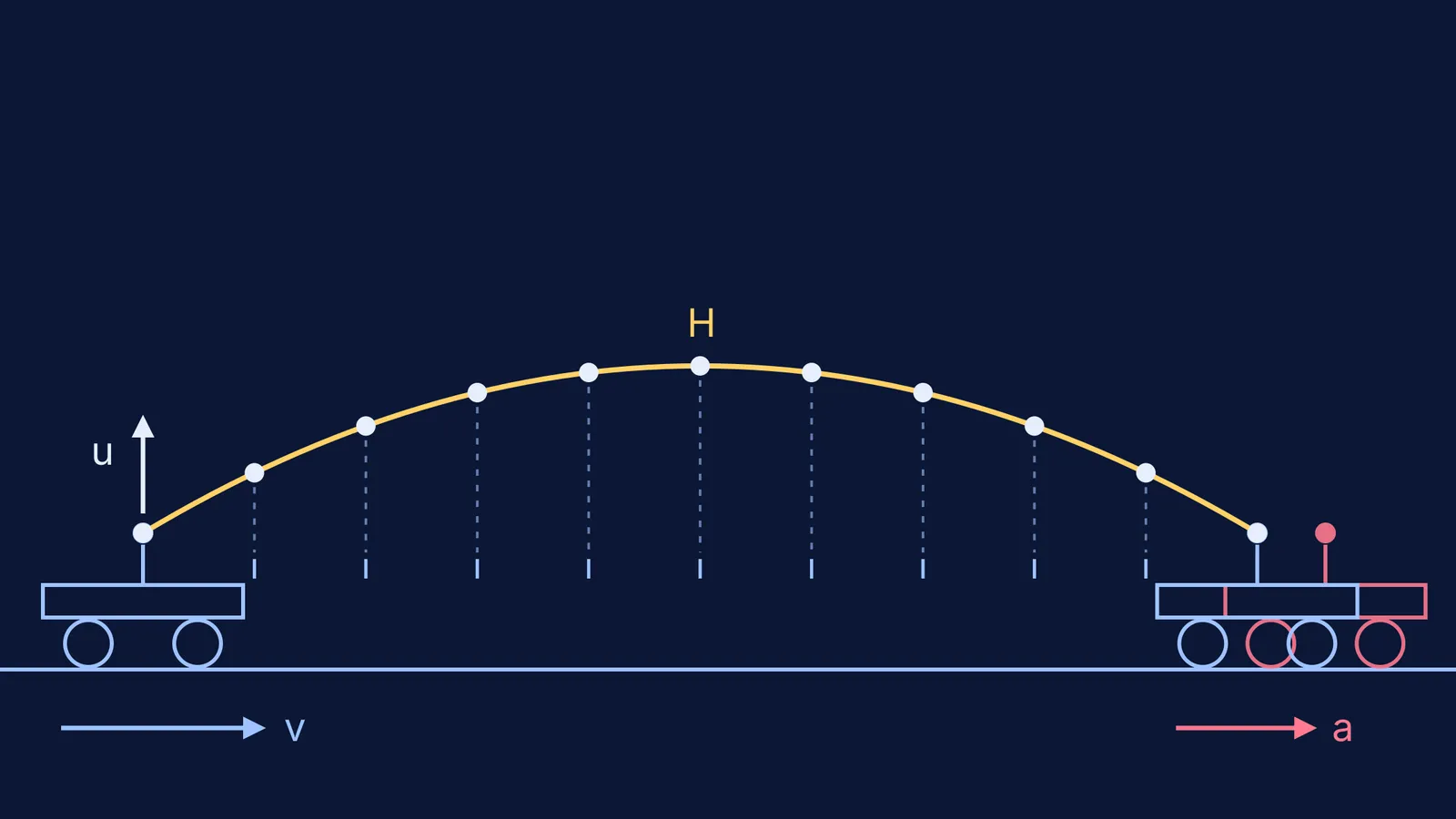
Take a train at v = 10 m/s. You throw the ball up at u = 6 m/s relative to yourself, and g = 9.8 m/s² (OpenStax, section 4.3).
In the train frame, the ball goes straight up and comes straight down. The time of flight for a projectile that lands at its launch height is T = 2u sin θ / g (OpenStax, section 4.3). With θ = 90°, T = 12/9.8 = 1.22 s. The maximum height is u²/2g = 1.84 m above your hand.
In the ground frame, the ball's velocity relative to the ground is its velocity relative to the train plus the train's velocity (OpenStax, section 4.5). So someone on the platform sees it leave at (10, 6) m/s: 11.7 m/s at about 31° above the horizontal.
Because horizontal and vertical motions are independent (OpenStax, section 4.3), the flight still lasts 1.22 s and peaks 1.84 m up. Meanwhile the ball moves 10 × 1.22 = 12.2 m forward, and so does your hand. The platform sees a parabola, you see a vertical line, and both are correct.
What if the train speeds up or brakes?
Say the train accelerates forward at a = 1 m/s² while the ball is in the air.
Ground frame: once released, the ball keeps its 10 m/s horizontal speed (OpenStax, section 4.3). The train covers 10T + ½aT². The gap is ½aT² = 0.5 × 1 × 1.22² ≈ 0.75 m, so the ball lands 0.75 m behind your hand.
Train frame: the train is now a noninertial frame, so you add a backward inertial force ma, one "having no physical origin" (OpenStax, section 6.3). The ball drifts back ½aT² = 0.75 m: the same answer.
If the train brakes, the ball lands ahead of you; on a curve, toward the outside of the bend. Our guide to pseudo forces in an accelerating frame covers the sign rules in more detail.
How does this work in a lift or on a cart?
In a lift at constant speed, the ball returns to your hand after T = 2u/g (OpenStax, section 4.3). If the lift accelerates upward at a, the relative acceleration is g + a, so T = 2u/(g + a): with u = 6 m/s and a = 2 m/s², T = 1.02 s instead of 1.22 s. Accelerating downward, use g − a. See more problems with a ball thrown inside a moving lift.
Carts give a reverse case. On a cart at 10 m/s, throw the ball 10 m/s backward and 6 m/s upward relative to you. From the ground it goes straight up and down; from the cart it lands 12.2 m behind you.
A four-step check for any moving-vehicle throw
Is the vehicle's velocity constant during the flight? Then solve in the vehicle frame as an ordinary projectile with g.
If not, pick one frame: ground (the ball keeps its release velocity) or vehicle (add an inertial force −ma). Never mix them.
For the ground-frame release velocity, add the vehicle's velocity to the throw, as in these relative velocity problems with rivers, rain and moving observers.
For where it lands relative to you, use the relative acceleration (g minus the vehicle's acceleration, as vectors) over the same T.
If you keep getting the direction of the inertial force wrong, practise in the Fermi Problem Library, where the step-by-step solver explains the reasoning rather than printing an answer.
On your next train ride, toss a coin up while the train cruises, then again as it pulls out of a station, and compare where it lands.


