

On this page
When you launch a ball at an angle θ across flat ground with initial speed u, it follows a parabolic arc. In textbook kinematics, its motion is governed by two independent components: constant horizontal velocity u cos θ and uniform downward acceleration g. Under these standard conditions, the projectile stays in the air for a total flight time T = 2u sin θ / g and achieves an unhindered horizontal range R = u² sin(2θ) / g (OpenStax University Physics).
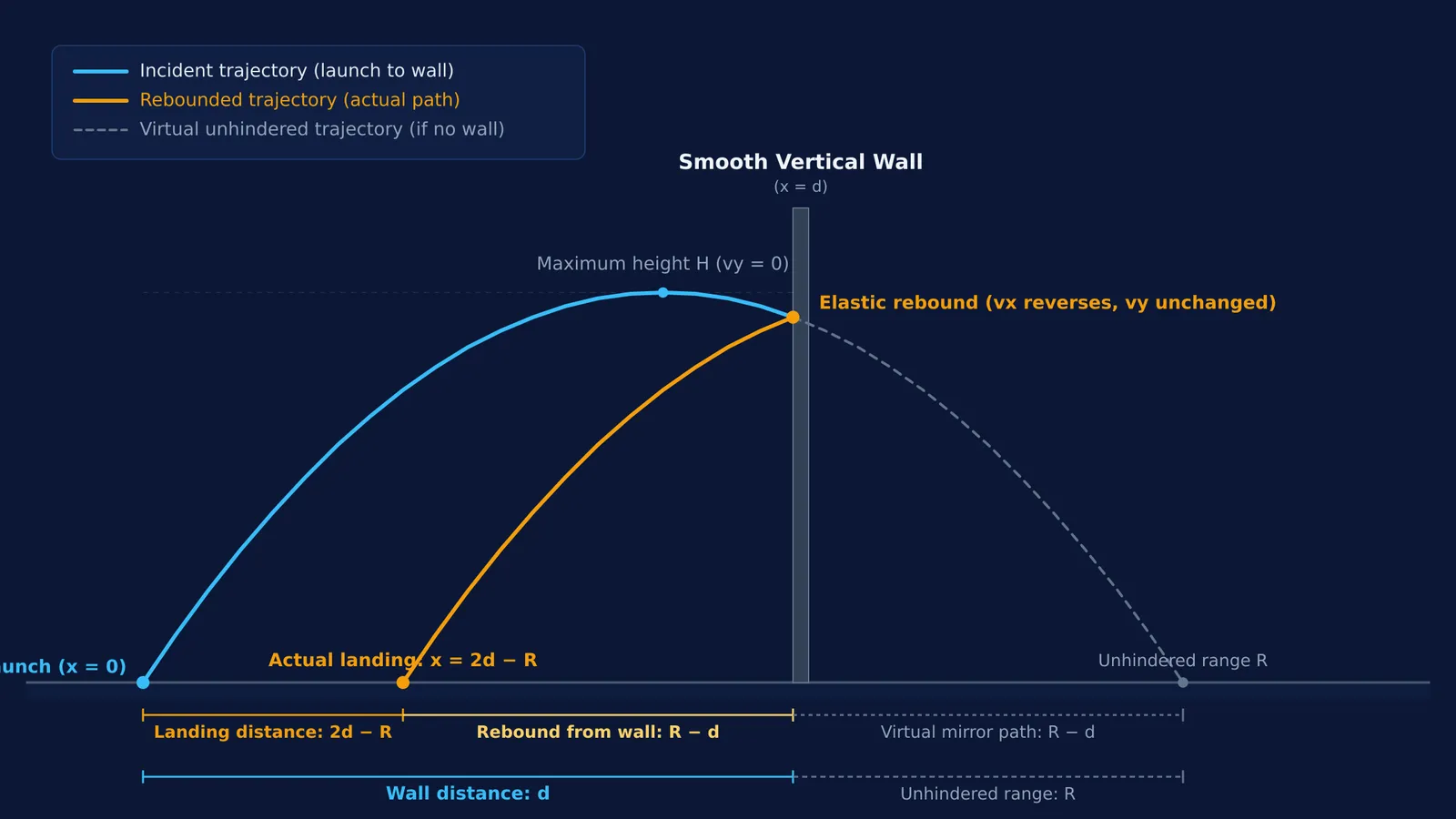
Placing a smooth vertical wall at a distance d from the launch point interrupts this unhindered flight. At first glance, finding where the projectile lands looks like a messy two-stage problem requiring you to compute the exact impact height, find the velocity vector at the wall, and restart the kinematic equations from scratch. But when the collision is elastic and the wall is frictionless, a powerful symmetry simplifies the entire problem: the motion after the rebound is simply the original trajectory folded back about the wall.
Why is vertical motion unaffected by the wall?
To track the rebound, you must look at the contact forces during the collision. When the projectile strikes a smooth vertical wall, the wall can only push normal to its surface—which points strictly in the horizontal direction.
Because a smooth wall produces zero vertical friction, the net vertical impulse acting on the object during the collision is zero. According to the impulse-momentum theorem (OpenStax University Physics), a zero net vertical impulse means the vertical velocity v_y is completely unchanged during impact. Whether the ball hits the wall while still rising or while falling, its vertical progress under gravity continues as if the wall were never there.
Because vertical motion governs when the object hits the floor, the total time of flight remains completely unchanged: T = 2u sin θ / g
Despite this mathematical simplicity, separating perpendicular axes remains a notorious conceptual hurdle. In physics education research published in the *American Journal of Physics*, researchers found that 83% of students holding common-sense beliefs about motion failed to recognize height symmetry during free fall and projectile flight (Halloun & Hestenes, 1985). If you want to strengthen your understanding of how orthogonal motions decouple in mechanics, the Fermi Concept Library covers every concept in physics, chemistry, biology, mathematics and computing, each with its own lesson and its place in the map.
How does the trajectory fold back after an elastic collision?
In an elastic collision with a fixed stationary wall, mechanical energy is conserved along the normal direction. The horizontal velocity component simply reverses sign, changing from +u cos θ to −u cos θ while keeping its exact magnitude.
Before hitting the wall, the projectile takes a time t₁ = d / (u cos θ) to cover the horizontal distance d. Because the total flight time T is fixed by gravity, the remaining time available for horizontal motion after the bounce is: Δt = T − t₁ = (R − d) / (u cos θ)
During this remaining time Δt, the ball travels backward toward the launch point at a constant horizontal speed of u cos θ. The horizontal distance covered backward from the wall is: Δx_back = (u cos θ) × Δt = R − d
This reveals the folded trajectory principle. If the wall were absent, the projectile would have traveled a distance R − d forward past the wall. Because the horizontal velocity has reversed while the vertical motion ticks forward identically, the path after the bounce is the exact geometric reflection of the unhindered path across the vertical plane x = d.
Where does the projectile land relative to the launch point?
Where the projectile touches down depends on where you measure:
Distance from the wall: The projectile lands at a distance of R − d from the base of the wall.
Distance from the launch point: Measuring from the origin (x = 0), the landing coordinate is x_landing = d − (R − d) = 2d − R.
This formula yields three distinct physical outcomes based on the wall's position relative to the apex of the unhindered flight (which occurs at R / 2):
Wall past the apex (d > R / 2): Here, 2d − R > 0. The projectile hits the wall after passing its peak, rebounds, and lands on the ground between the launch point and the wall.
Wall exactly at the apex (d = R / 2): Here, 2d − R = 0. The projectile hits the wall at maximum height and rebounds symmetrically to land precisely back at the launch point. This classic case appears in Chapter 3 of H.C. Verma's *Concepts of Physics*.
Wall before the apex (d < R / 2): Here, 2d − R < 0. The projectile strikes the wall while still rising and rebounds so vigorously that it flies past the launch point, landing at a distance of R − 2d behind the launcher (assuming level ground extends backward).
To explore related trajectory properties, review our guides on projectile motion on level ground and extracting initial velocity from the equation of trajectory.
Worked example: calculating the rebound point step by step
Applying the folding method to standard projectile equations solves textbook and exam questions in seconds without multi-stage trajectory integrals:
A projectile is fired from flat ground with initial speed u = 20 m/s at an angle θ = 45° to the horizontal. Take acceleration due to gravity g = 10 m/s². A smooth vertical wall stands at a horizontal distance d = 25 m from the launch point.
Calculate unhindered range and flight time:
R = u² sin(2θ) / g = (20² × sin 90°) / 10 = 400 / 10 = 40 m. T = 2u sin θ / g = (2 × 20 × sin 45°) / 10 = 40 × 0.7071 / 10 ≈ 2.83 s. The unhindered apex occurs at R / 2 = 20 m.
Confirm wall collision:
Since d = 25 m is less than the unobstructed range R = 40 m, the projectile strikes the wall while descending.
Determine the landing position:
Distance rebounded from the wall: Δx_back = R − d = 40 − 25 = 15 m. Landing coordinate relative to launch point: x_landing = 2d − R = 2(25) − 40 = 10 m.
The ball rebounds 15 metres from the wall and lands on the ground 10 metres in front of the launch point.
When practicing multi-concept mechanics problems, the Fermi Problem Library provides worked problems with a step-by-step solver that explains the reasoning rather than printing an answer.
What happens if the collision is inelastic?
In realistic collisions, some kinetic energy is dissipated into heat and deformation. If the wall has a coefficient of restitution e (where 0 < e ≤ 1) in inelastic collisions, the horizontal velocity after impact drops to e u cos θ.
Because the wall remains frictionless, the vertical motion is still completely unaffected, meaning the remaining time in the air is still Δt = (R − d) / (u cos θ). The horizontal distance traveled backward from the wall becomes: Δx_back = (e u cos θ) × Δt = e (R − d)
The landing coordinate measured from the launch point is therefore: x_landing = d − e (R − d) = d(1 + e) − e R
If a question asks under what condition the projectile returns exactly to the launch point (x_landing = 0), setting d(1 + e) − e R = 0 gives: R = d(1 + 1/e)
When e = 1, this reduces directly to R = 2d (or d = R / 2). For more problem-solving frameworks involving restitution and impulse, read our breakdown of collisions and momentum problems.


