

On this page
In Class 11 physics, projectile motion problems usually ask you to find the maximum horizontal range. If there is no ceiling, you simply throw the ball at an angle of 45° OpenStax. But what if the ball is thrown indoors? The ceiling caps the maximum height, forcing you to choose a flatter angle.
A classic textbook problem asks for the maximum horizontal distance a ball thrown at 40 m/s can go in a hall with a 25 m ceiling Testbook. The horizontal and vertical motions of a projectile are completely independent of each other. The vertical motion determines how much time the projectile spends in the air, while the horizontal motion dictates how far it travels during that time.
Let's look at the physics of the constraint, how to find the optimal angle, and how to calculate the final range step by step.
Why does the ceiling matter?
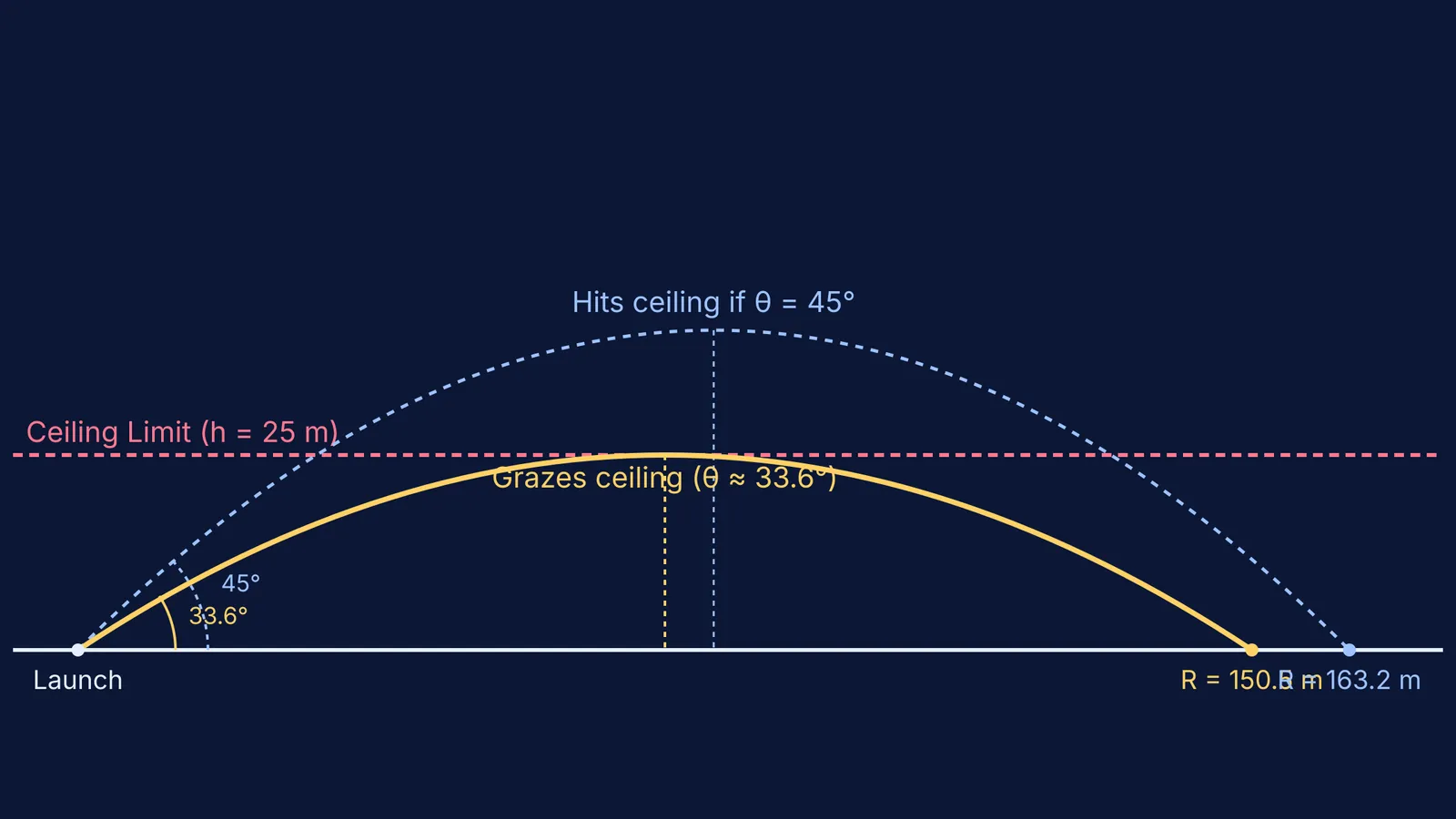
In an unrestricted space, a projectile's maximum horizontal range R occurs at a launch angle of 45° OpenStax. For a ball thrown at 40 m/s (with g = 9.8 m/s²), this unrestricted range would be 163.2 m.
However, the maximum height H reached by a projectile depends on the initial velocity u and the launch angle θ: H = u² sin² θ / 2g
If we throw the ball at 45°, the maximum height would be (40² × sin² 45°) / (2 × 9.8) = 40.8 m. Since 40.8 m is greater than the 25 m ceiling, the ball would hit the roof long before it completes its parabolic journey. To prevent this collision, the vertical component of the velocity must be capped, which is achieved by lowering the angle of projection.
How do you find the optimal angle?
To maximize the range without hitting the ceiling, you must throw the ball at the largest possible angle that just grazes the roof. A larger angle would result in a collision, while a smaller angle would reduce the time of flight and shorten the range. This means setting the maximum height H strictly equal to the ceiling height h.
For a 25 m ceiling, we set H = 25 m: 25 = (40² sin² θ) / (2 × 9.8)
Solving for sin² θ: 25 = 1600 sin² θ / 19.6 sin² θ = (25 × 19.6) / 1600 = 0.30625 sin θ = √0.30625 ≈ 0.5534
This gives an angle of projection θ ≈ 33.6° Testbook. By flattening the throw from the unrestricted 45° to a safer 33.6°, the ball stays just under the ceiling throughout its flight.
What is the maximum range formula?
Once you have the optimal angle, you can find the horizontal range using the standard formula: R = u² sin 2θ / g
Using the trigonometric identity sin 2θ = 2 sin θ cos θ, and knowing sin θ ≈ 0.5534, you can find the cosine of the angle. Since cos θ = √(1 − sin² θ), we calculate it as √(1 − 0.30625) ≈ 0.8329: R = 40² × (2 × 0.5534 × 0.8329) / 9.8 R = 1600 × 0.9218 / 9.8 ≈ 150.5 m
The maximum horizontal distance the ball can travel in the hall is 150.5 metres Testbook. This represents a small reduction from the unrestricted range, but it ensures the projectile safely clears the ceiling limit.
If you prefer to solve algebraically rather than finding the angle first, you can substitute sin θ = √(2gh/u²) directly into the range equation. This yields a single formula for the maximum range under a ceiling: R_max = 4√(h(u²/2g − h))
You can use the Fermi Problem Library to explore this and other constraints. Fermi's AI tutor does not just print the final number; it works out what you already know and builds a plan for the session. If you are struggling with the equation of trajectory of a projectile or the time of flight of a horizontal projectile from a cliff, the tutor teaches through the steps, drawing the figure and checking your understanding as it goes.
If you are stuck on a similar problem, map out the unrestricted path first, then apply the height constraint to find the new angle.


