

On this page
Many algebra and exam questions ask about the roots of (x - a)(x - b) = k. If k were 0, the solutions would simply be x = a and x = b. But when k ≠ 0, you cannot simply say x - a = k or x - b = k.
How do you find the roots of (x - a)(x - b) = k?
To find the new roots, expand the left side to get a standard quadratic equation (Wikipedia): x² - ax - bx + ab = k x² - (a + b)x + (ab - k) = 0
Now you can read off the sum and product of the new roots directly from the coefficients.
What are the new sum and product of roots?
Let the new roots be α and β. From our expanded equation x² - (a + b)x + (ab - k) = 0, we apply Vieta's formulas:
Sum of the roots: α + β = a + b
Product of the roots: αβ = ab - k
This tells us that shifting the product by k does not change the sum of the roots. The new roots α and β balance each other around the same midpoint as a and b.
If you get stuck on questions that ask you to relate new roots to old ones without solving the equation directly, the Fermi Problem Library provides worked problems with a step-by-step solver that explains the reasoning.
Where are the roots located for k > 0?
What happens to the locations of the roots when k is positive? This is a frequent test on JEE and olympiad papers, often formatted as multiple-choice questions asking you to pick the correct interval for the roots.
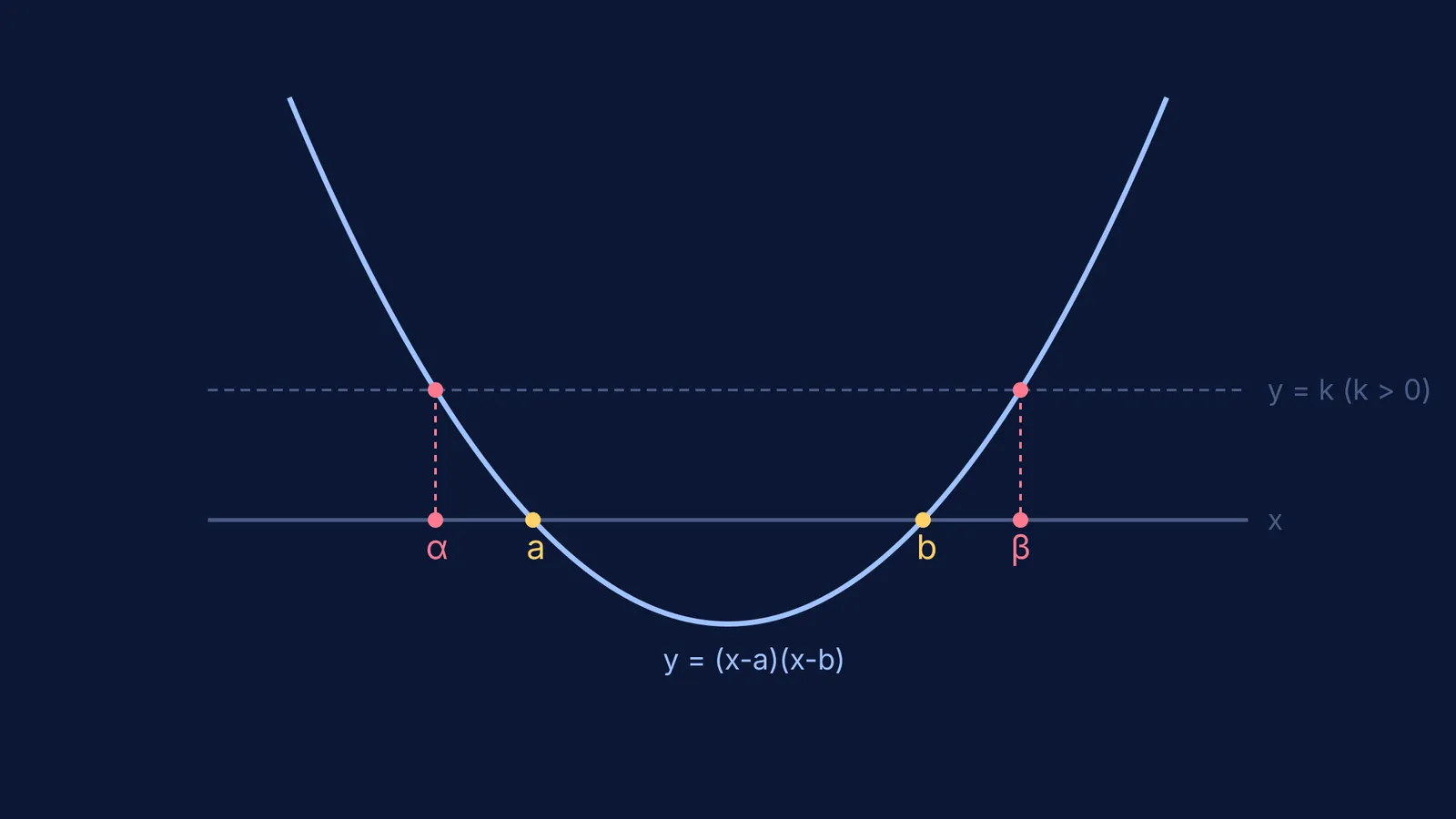
Let a < b. The graph of y = (x - a)(x - b) is an upward-opening parabola that crosses the x-axis at a and b. When we solve (x - a)(x - b) = k, we are looking for the points where this parabola intersects the horizontal line y = k.
Because the parabola opens upwards and crosses y = 0 at a and b, the values of the function are negative strictly between a and b. The vertex, which is the minimum point of the parabola, lies halfway between a and b. As the curve rises above the x-axis, it extends outward towards infinity in both the positive and negative directions. Therefore, to reach a positive height k, the x-values must lie entirely outside the interval [a, b].
If the new roots are α and β (with α < β), they must satisfy: α < a < b < β
The roots interleave. The new roots are separated by a and b, meaning that one root is strictly less than a, and the other is strictly greater than b. This fact is useful because it allows you to eliminate incorrect answer choices instantly without performing complex calculations.
What are the roots of (x - α)(x - β) + k = 0?
Because the relationship is symmetric, you can reverse it. If α and β are the roots of (x - a)(x - b) = k, we can write: (x - a)(x - b) - k = (x - α)(x - β)
Adding k to both sides gives: (x - α)(x - β) + k = (x - a)(x - b)
This identity means that the roots of (x - α)(x - β) + k = 0 are exactly a and b. You don't need to re-expand or solve anything to arrive at this answer. The shift undoes itself. Visualising this relationship helps (just as it does when solving equations and inequalities with modulus), which is why the Fermi Concept Library gives every concept in mathematics its own lesson and its place in the map.
How does this look in a worked example?
Question: If the roots of the equation (x - 2)(x - 5) = 4 are α and β, what is the value of α² + β²? Additionally, verify the location of the roots.
Step 1: Expand the equation to standard quadratic form. x² - 5x - 2x + 10 = 4 x² - 7x + 10 = 4 x² - 7x + 6 = 0
Step 2: Write down the sum and product of the new roots. Using Vieta's formulas, we find: α + β = -(-7) = 7 αβ = 6
Step 3: Use the algebraic identity for the sum of squares. You do not need to solve for α and β to find α² + β². Use the relation: α² + β² = (α + β)² - 2αβ α² + β² = (7)² - 2(6) α² + β² = 49 - 12 = 37
Step 4: Verify the root locations. In this specific example, the original roots were a = 2 and b = 5, and k = 4 (which is positive). We can factor x² - 7x + 6 = 0 as (x - 1)(x - 6) = 0. The new roots are α = 1 and β = 6. Checking the order: 1 < 2 < 5 < 6. This perfectly matches our rule that α < a < b < β.


