

On this page
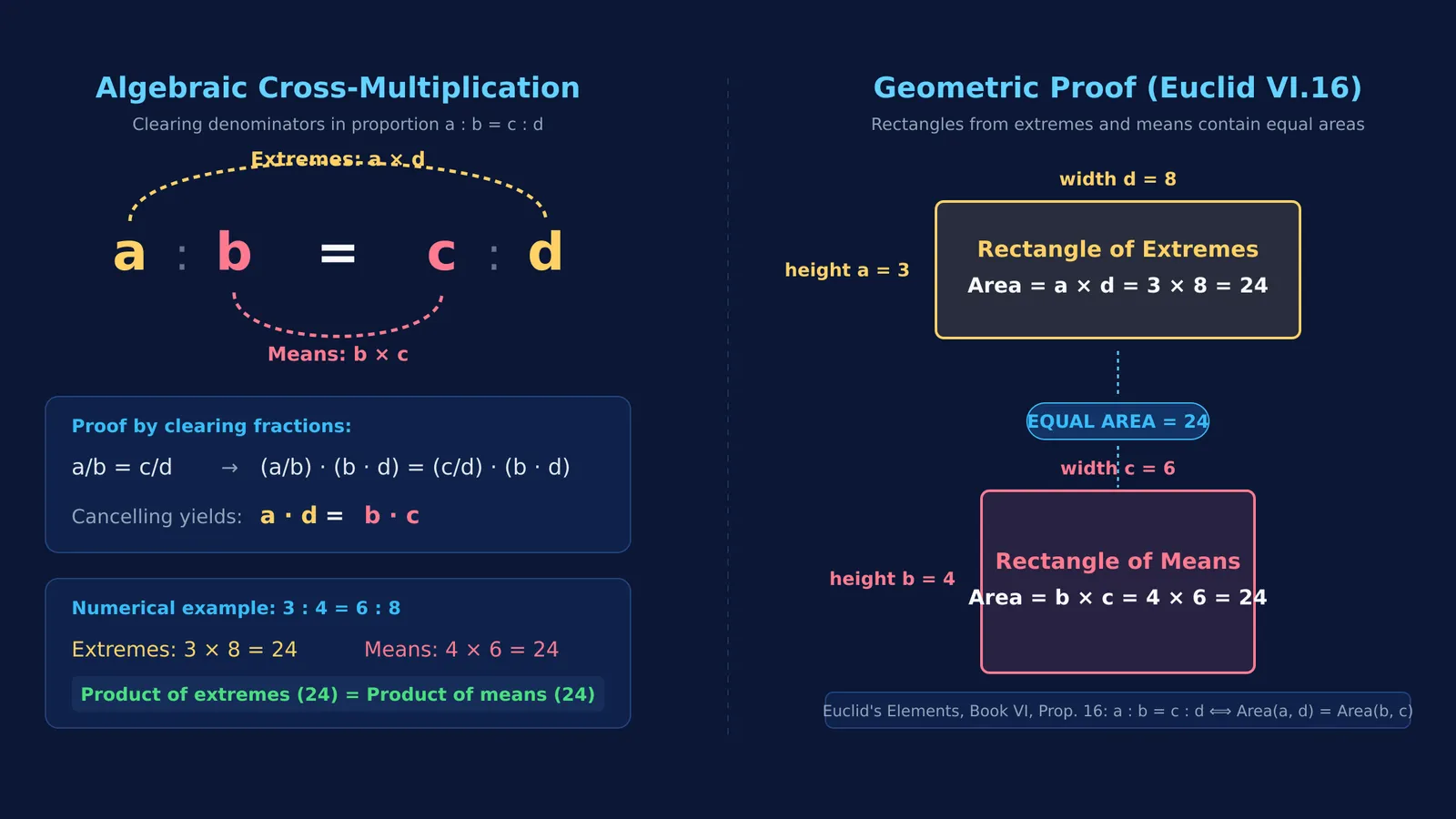
When two ratios are equal, they form a proportion. We write this equality as a : b = c : d, or in fractional notation as a/b = c/d (with b ≠ 0 and d ≠ 0). The terms carry classical names based on their positions: the outermost quantities, a and d, are called the extremes, while the innermost quantities, b and c, are called the means.
Why does the product of extremes equal the product of means?
The defining property of any valid proportion is that the product of the extremes equals the product of the means: a × d = b × c. Often taught as a memorised shortcut called cross-multiplication, this equality follows directly from clearing fraction denominators.
Starting with the proportion a/b = c/d, multiply both sides by the product of their denominators, b × d:
(a / b) × (b × d) = (c / d) × (b × d)
On the left side, b cancels, leaving a × d. On the right side, d cancels, leaving c × b, which equals b × c. Multiplying across by the common denominator bd clears both fractions simultaneously, yielding an exact linear equality between the two products.
Long before symbolic algebra, Greek mathematicians proved this relationship from first principles. In Euclid's Elements, Book VII, Proposition 19, Euclid showed that four integers are proportional if and only if the product of the first and fourth equals the product of the second and third. In Euclid's Elements, Book VI, Proposition 16, he established the geometric equivalent for line segments, proving that four proportional lines form equal rectangles from the extremes and means.
The Fermi Concept Library maps every concept across mathematics and science with its own lesson and its place in the concept map, showing how foundational ratio identities underpin geometry and physical chemistry.
How do you find a missing term with cross-multiplication?
Because the product of extremes equals the product of means, knowing any three terms isolates the fourth immediately. As shown in OpenStax Prealgebra 2e, equating cross products converts a rational equation into a linear one.
Depending on the position of the unknown term x, the formula isolates x in one step:
Missing first extreme (x : b = c : d): x = (b × c) / d.
Missing second mean (a : b = x : d): x = (a × d) / b.
Missing fourth extreme (a : b = c : x): x = (b × c) / a.
For example, to find x in 15 : 24 = 35 : x, equate the product of extremes to the product of means:
15 × x = 24 × 35
Instead of multiplying 24 × 35 = 840 first, cancel common factors beforehand: x = (24 × 35) / 15. Dividing 35 and 15 by 5 yields (24 × 7) / 3, and dividing 24 by 3 leaves 8 × 7 = 56. Cancelling early avoids large numbers and arithmetic slips.
This computational strategy has deep roots in Indian mathematics. In the *Aryabhatiya* (499 CE), Aryabhata's Ganita section codified the Rule of Three (Trairasika): to find an unknown fourth quantity, multiply the fruit (phala) by the requisition (iccha) and divide by the measure (pramana). This method remains foundational when learning ratios and proportions for Class 7 and studying properties of rational numbers.
When solving word problems, many students stumble translating verbal statements into correct proportions. The Fermi Problem Library offers worked problems with a step-by-step solver that explains the reasoning rather than printing an answer.
What is a fourth proportional and how is it calculated?
When four quantities satisfy a : b = c : d, the fourth quantity d is defined as the fourth proportional to a, b, and c.
In Euclid's Elements, Book VI, Proposition 12, Euclid gave a ruler-and-compass construction to find a fourth proportional using parallel lines. Algebraically, the calculation follows three steps:
Write the quantities in given order: a : b = c : x.
Equate the cross products: a × x = b × c.
Divide by the first term: x = (b × c) / a.
Worked example: Find the fourth proportional to 6, 14, and 15.
Set up the proportion: 6 : 14 = 15 : x.
Multiply extremes and means: 6 × x = 14 × 15.
Solve for x: x = (14 × 15) / 6 = 210 / 6 = 35.
The order of terms is critical. If asked for the fourth proportional to 14, 6, and 15, the proportion becomes 14 : 6 = 15 : x, giving x = (6 × 15) / 14 = 45/7. Rearranging the sequence changes the proportional relationship entirely.
What is a third proportional in continued proportion?
When three quantities a, b, and c satisfy a : b = b : c, they are in continued proportion. In Euclid's Elements, Book V, Definition 8, a proportion of three terms is identified as the minimal proportion possible. The repeated term b is the mean proportional (geometric mean), while c is the third proportional to a and b.
According to Euclid's Elements, Book VI, Proposition 11, the third proportional can be constructed geometrically using similar triangles. Setting the product of extremes equal to the product of means gives:
a × c = b × b, or a × c = b²
This identity yields formulas for both unknown terms:
Third proportional: c = b² / a.
Mean proportional: b = √(a × c).
Worked example: Find the third proportional to 8 and 12.
Let the third proportional be x: 8 : 12 = 12 : x.
Equate extremes and means: 8 × x = 12² = 144.
Solve for x: x = 144 / 8 = 18.
The third proportional to 8 and 12 is 18.
Continued proportions form the foundation of geometric sequences, where the square of the middle term equals the product of its neighbours—a relationship central to inserting arithmetic and geometric means.
If you are uncertain whether a problem calls for a third or fourth proportional, Fermi's AI tutor notices where you are stuck, decides whether to explain, ask or show, and works through the algebraic steps directly alongside you on a shared board.


