

On this page
Probability in Class 8 starts from one simple idea: if every outcome has the same chance, you can count your way to the answer. You list what can happen, count the outcomes you want, and divide.
What does “equally likely outcomes” mean in Class 8?
The NCERT Class 8 mathematics textbook, Chapter 4 “Data Handling” puts it in one line: outcomes of an experiment are equally likely if each has the same chance of occurring. The same chapter calls an experiment random when its outcome cannot be predicted exactly in advance.
The textbook builds the idea from a coin-tossing tally: 100 tosses gave 48 heads and 52 tails, and it observes that the two counts come closer as you keep tossing. Neither face is favoured.
How do you find the probability of an event?
The rule in the NCERT Class 8 chapter is: probability of an event = number of outcomes that make the event ÷ total number of outcomes of the experiment, when the outcomes are equally likely. An event is one outcome, or a collection of outcomes.
Here is the rule on four everyday experiments:
Coin: two outcomes, head and tail. P(head) = 1/2.
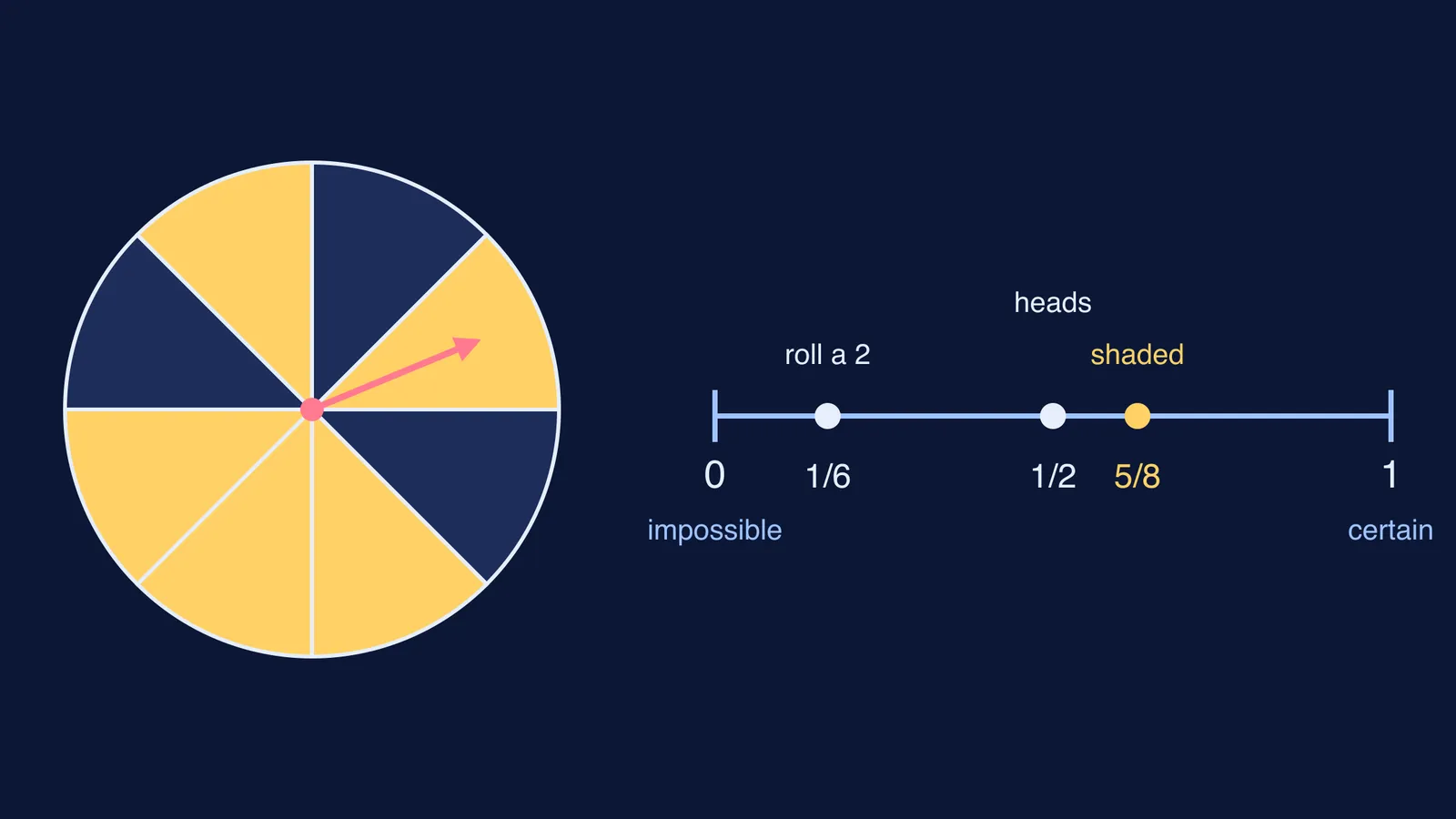
Die: six outcomes, 1 to 6. P(getting a 2) = 1/6. P(even number) = 3/6 = 1/2, because 2, 4 and 6 all make the event.
Bag of balls: 4 red and 2 yellow balls, identical except for colour. There are 6 outcomes and 4 are red, so P(red) = 4/6 = 2/3. This is NCERT's own Example 3.
Spinner: 8 equal sectors, 5 of them shaded. P(shaded) = 5/8 and P(not shaded) = 3/8.
For a spinner, the sectors must be equal in size for the outcomes to be equally likely.
Why does probability always lie between 0 and 1?
The NCERT Class 10 chapter on probability gives the reason in two lines. The favourable outcomes are always some of the possible outcomes, so the numerator can never be bigger than the denominator, which gives 0 ≤ P(E) ≤ 1.
The two ends have names. Getting an 8 on an ordinary die has no favourable outcomes, so its probability is 0/6 = 0: an impossible event. Getting a number less than 7 has all six outcomes favourable, so it is 6/6 = 1: a sure, or certain, event. Every other event sits in between.
An event and its “not” always add to 1. On a die, P(greater than 4) = 2/6 = 1/3 and P(4 or less) = 4/6 = 2/3. NCERT calls these complementary events and writes P(not E) = 1 − P(E). If your two answers do not add to 1, recount.
Why do students get two-dice questions wrong?
The formula only works when the outcomes really are equally likely. Researchers Nicolas Gauvrit and Kinga Morsanyi describe the equiprobability bias as “a tendency to believe that every process in which randomness is involved corresponds to a fair distribution, with equal probabilities for any possible outcome.” Their 2014 paper in Advances in Cognitive Psychology uses two dice as the example: a sum of 11 is twice as likely as a sum of 12, yet people tend to believe the two are equally likely.
The fix is to list outcomes at the level where they truly are equal. Two dice give 6 × 6 = 36 equally likely ordered pairs. A sum of 11 comes from (5, 6) and (6, 5), so P(11) = 2/36 = 1/18. A sum of 12 comes only from (6, 6), so P(12) = 1/36. There are 11 possible totals from 2 to 12, but they are not equally likely, so 1/11 is wrong for both.
A four-step check before you write a fraction
Write the experiment in one line, for example “one fair die, rolled once”.
List every outcome at the level where each is equally likely: each sector, each ball, each ordered pair.
Mark the outcomes that make your event and count them.
Divide and simplify, then check that the answer is between 0 and 1, and that the event and its “not” add to 1.
Try it on a question from NCERT's Exercise 4.2: ten slips numbered 1 to 10, one drawn without looking. A number less than 6 is made by 1, 2, 3, 4 and 5, so the probability is 5/10 = 1/2. A 1-digit number is made by 1 to 9, so it is 9/10.
If a problem still will not come out, the Fermi Problem Library has worked problems with a step-by-step solver that explains the reasoning rather than printing an answer, so you can see which step went wrong. If the terms themselves feel shaky, the Fermi Concept Library gives every mathematics concept its own lesson.
Next time a coin, die or spinner appears in a question, start with the list.


