

On this page
Drawing marbles from a bag is a classic way to learn probability, just like questions about cards, dice and coins in Class 10. Most problems ask for the chance of picking a certain colour. But in board exams, the question is often flipped: you are given the probability and asked to find how many marbles of a specific colour are in the bag.
According to the CBSE Class 10 mathematics syllabus (CBSE, 2024), students are tested on the classical definition of probability, which means assuming all marbles are equally likely to be drawn. A 2025 study on probability learning (Tan et al., 2025) noted that students often struggle with these abstract rules, sometimes confusing independent events with dependent ones or relying on intuitive reasoning.
What is the formula for drawing a marble from a bag?
The classical formula for the probability of an event E is the number of favorable outcomes divided by the total number of possible outcomes.
If a bag contains 3 red marbles and 7 blue marbles, the total number of outcomes is 10. The probability of drawing a red marble is 3/10. When the number of marbles is unknown, you replace that count with a variable, usually x. The total number of outcomes becomes an algebraic expression containing x.
How do you find the number of marbles from a given probability?
When a problem gives you a relationship between probabilities, your goal is to translate that into an algebraic equation. If you are unsure where to start with word problems, Fermi's AI tutor can work out what you already know and build a plan for the session.
Here is a step-by-step framework to solve these problems:
Define the unknown: Let the unknown number of marbles be x.
Find the total: Add up all the marbles, including x, to find the total number of possible outcomes.
Write the probabilities: Express the probability of each relevant event in terms of x.
Set up the equation: Use the condition given in the problem to link the probabilities.
Solve for x: Clear the denominators and solve the resulting linear equation.
If you keep setting up the wrong equation, the Fermi Problem Library has worked problems with a step-by-step solver that explains the reasoning rather than printing an answer.
Worked Example: A single unknown
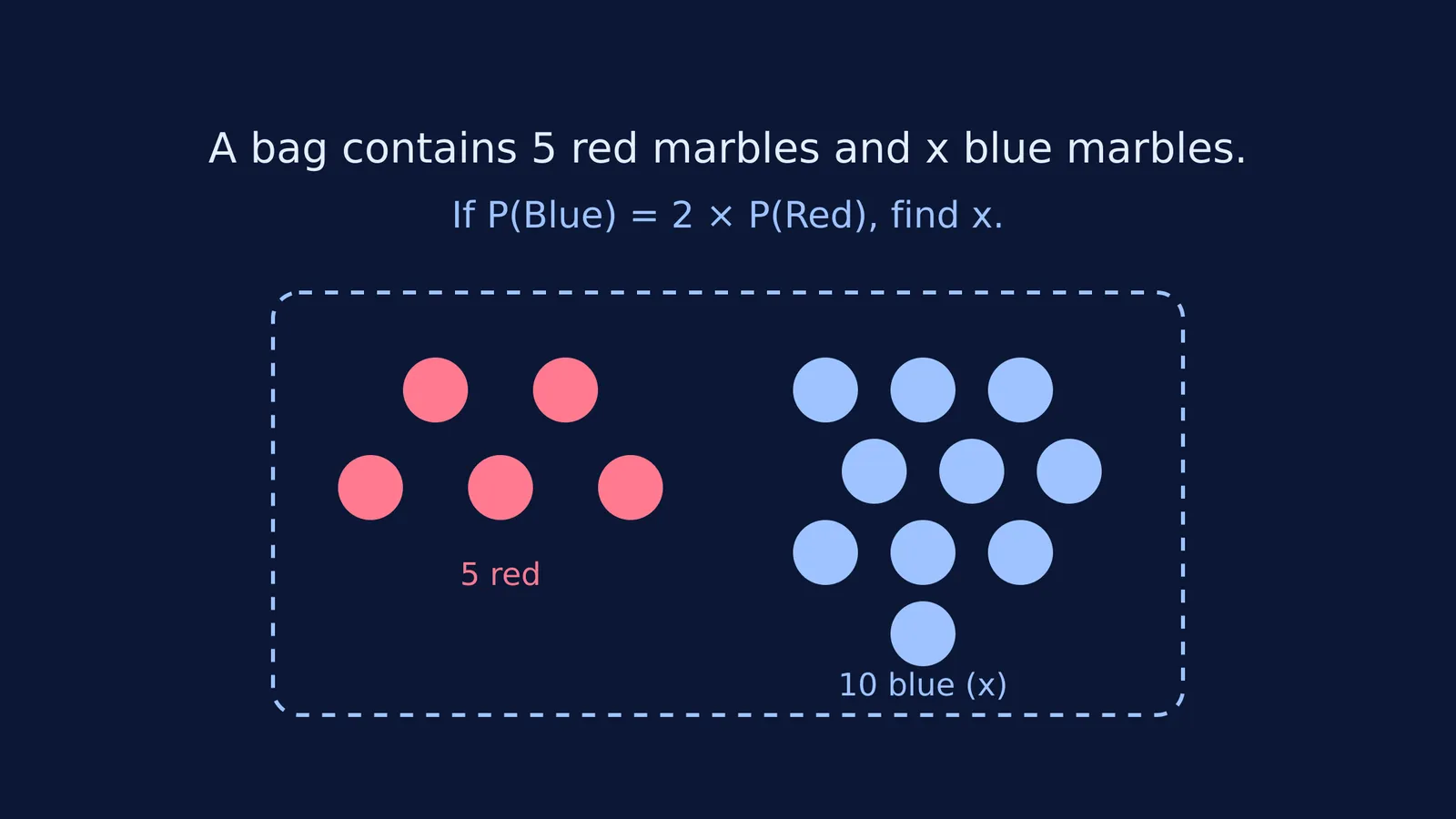
Problem: A bag contains 5 red marbles and some blue marbles. If the probability of drawing a blue marble is double the probability of drawing a red marble, find the number of blue marbles.
Step 1: Let the number of blue marbles be x. Step 2: The total number of marbles is x + 5. Step 3:
P(Red) = 5 / (x + 5)
P(Blue) = x / (x + 5)
Step 4: The problem states P(Blue) = 2 × P(Red). x / (x + 5) = 2 × [5 / (x + 5)] Step 5: Since the denominators are the same and not equal to zero, we can cancel them out: x = 2 × 5 x = 10
There are 10 blue marbles in the bag.
What if marbles are added to the bag?
Some problems involve changing the contents of the bag. This changes both the number of favorable outcomes and the total number of outcomes, similar to how probabilities change in independent vs mutually exclusive events in Class 12 probability.
Worked Example: Changing the total
Problem: A bag contains 18 balls, out of which x are red. If 2 more red balls are added to the bag, the probability of drawing a red ball becomes 9/8 times the original probability. Find x.
1. Original state:
Total balls = 18
Red balls = x
Original P(Red) = x / 18
2. New state:
Total balls = 18 + 2 = 20
Red balls = x + 2
New P(Red) = (x + 2) / 20
3. Set up the equation: The new probability is 9/8 times the original probability. (x + 2) / 20 = (9/8) × (x / 18)
4. Solve for x: Simplify the right side: (x + 2) / 20 = 9x / (8 × 18) (x + 2) / 20 = x / 16
Cross-multiply to solve: 16(x + 2) = 20x 16x + 32 = 20x 4x = 32 x = 8
There were originally 8 red balls in the bag.


