

On this page
In probability, calculating the intersection of two events, P(A ∩ B), is simple when the events are independent—you just multiply their probabilities. But in exams like JEE Main or school tests, you are often asked to find the intersection of two dependent events where the overlap is unknown.
Even without knowing the exact relationship, you can determine the strict boundaries within which the intersection must fall. These boundaries are known as the Fréchet inequalities.
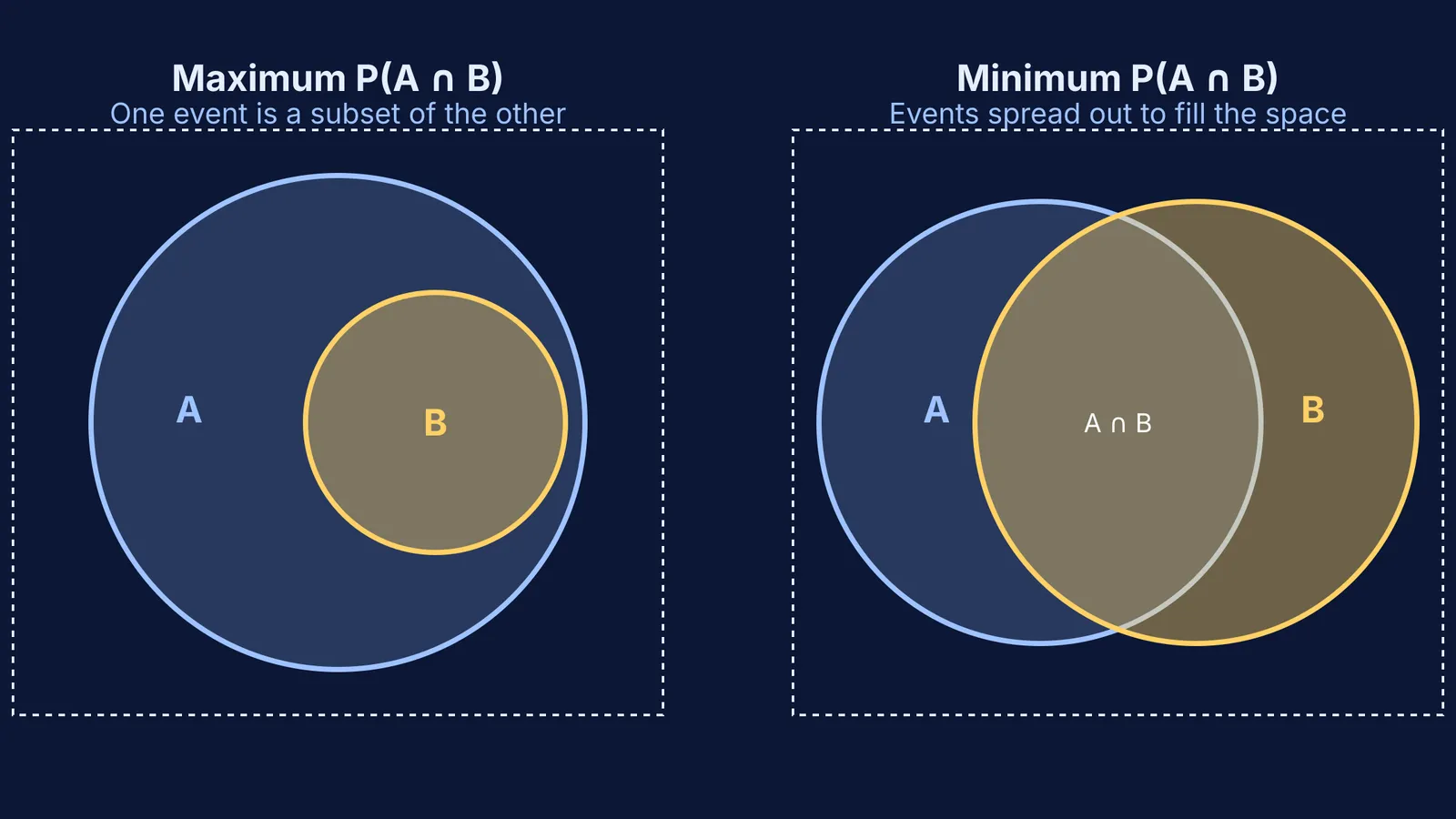
What is the maximum value of P(A ∩ B)?
The intersection of two sets cannot be larger than either of the sets themselves. Therefore, the upper bound is limited by the "weakest link," or the event with the smaller probability.
The maximum possible value of the intersection is min(P(A), P(B)) (Wikipedia).
This maximum is reached when the smaller event is completely contained within the larger event. For instance, if P(A) = 0.50 and P(B) = 0.25, the maximum overlap is 0.25. This geometric limit applies regardless of whether the events are independent or not.
What is the minimum value of P(A ∩ B)?
Finding the minimum value requires the addition theorem of probability, which states that P(A ∪ B) = P(A) + P(B) - P(A ∩ B).
Rearranging this formula gives P(A ∩ B) = P(A) + P(B) - P(A ∪ B).
To make the intersection as small as possible, we must make the union, P(A ∪ B), as large as possible. Because a probability cannot exceed 1, the maximum value of the union is 1. Substituting 1 into the equation yields the lower bound. If this calculation gives a negative number, the minimum intersection is simply 0, meaning the events can be completely mutually exclusive.
The formal minimum bound of the intersection is max(0, P(A) + P(B) - 1) (Wikipedia).
How do Fréchet bounds apply to incomplete data?
These boundaries are particularly useful when analysing reports or statistics where you are only given individual probabilities, but need to know the intersection. Because researchers do not always cross-reference every possible combination of answers, the overlap is often left unstated.
Imagine a company reports that the probability of an applicant passing the first interview is 0.75, and the probability of passing the second interview is 0.60. If you are asked for the probability of an applicant passing both, you cannot give a single exact answer without more data, because the events might be dependent. However, you can use the minimum and maximum bounds to narrow it down.
First, define the probabilities: P(First) = 0.75 and P(Second) = 0.60.
To find the minimum possible overlap, add the two probabilities together and subtract 1. The sum is 0.75 + 0.60 = 1.35. Subtracting 1 gives 0.35. This means the probability of passing both must be at least 0.35. The two groups are too large to avoid each other completely.
To find the maximum possible overlap, you look for the smaller of the two probabilities. Because the probability of passing the second interview is only 0.60, the intersection cannot possibly be larger than 0.60. This maximum would occur if everyone who passed the second interview had also passed the first.
Therefore, you can confidently state that the probability of passing both is bounded between 0.35 and 0.60. This is a powerful tool for catching statistical errors. If another report claimed the intersection was 0.20, you would immediately know their data was flawed, because it violates the lower bound.
How do you find the range of intersection in an exam?
When a question asks for the bounds of P(A ∩ B), you can follow these steps to find the exact range:
Calculate the sum of P(A) and P(B).
If the sum is less than 1, the minimum intersection is 0. If the sum is greater than 1, subtract 1 to get your minimum.
Compare P(A) and P(B) and pick the smaller number as your maximum.
Let's test this on a typical problem: If P(A) = 0.65 and P(B) = 0.45, what is the range of their intersection?
The sum is 0.65 + 0.45 = 1.10.
The minimum is 1.10 - 1 = 0.10.
The maximum is the smaller of the two probabilities: 0.45.
Therefore, the intersection is bounded between 0.10 and 0.45.
If you find yourself stuck on probability questions involving complex overlaps, you can bring the question to the Fermi Problem Library. It offers worked problems with a step-by-step solver that explains the reasoning rather than printing an answer.
To deepen your understanding of how sets interact, comparing this logic to Three-set Venn problems: counting with inclusion-exclusion or exploring With and without replacement: probability problems compared will build your intuition for probability spaces.


