

On this page
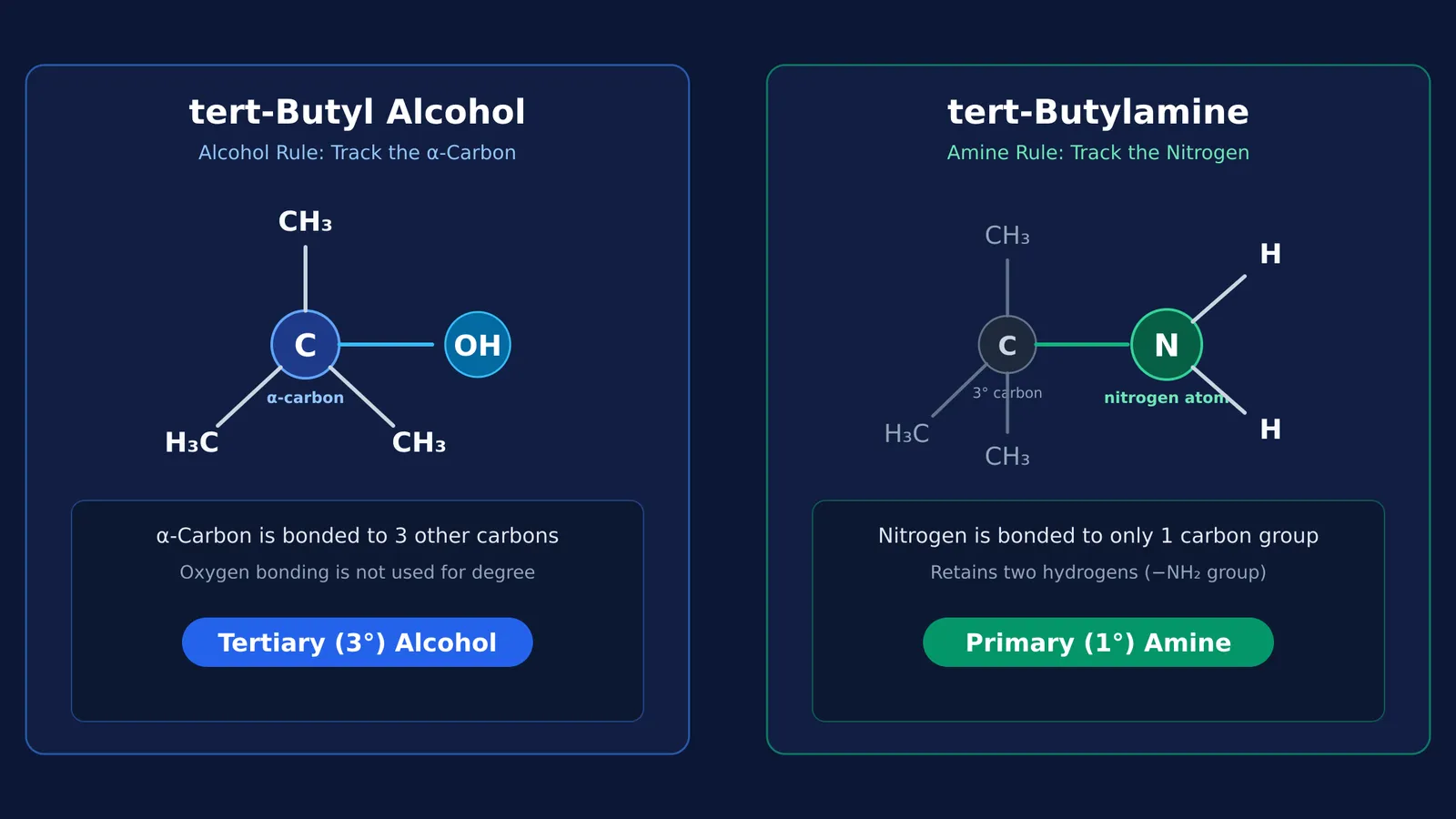
Every year, students in JEE Main, NEET-UG, and CBSE board examinations lose marks on a deceptively simple question: what is the degree of tert-butylamine? Instinct tempts many to look at the tert-butyl group, spot a carbon bonded to three methyl groups, and label the molecule a tertiary amine. That answer is incorrect. While tert-butyl alcohol is a tertiary alcohol, tert-butylamine is unambiguously a primary amine.
Why does primary mean different things for alcohols and amines?
The confusion stems from two fundamentally different reference points in organic chemistry nomenclature.
For alcohols, classification is carbon-centric. According to the LibreTexts classification of alcohols, an alcohol is classified by the degree of substitution of the alpha-carbon bearing the hydroxyl (–OH) group. Because oxygen forms only one single bond to carbon in neutral alcohols, oxygen cannot take multiple alkyl groups without becoming an ether. Thus, the degree reflects how many carbons bond to that alpha-carbon:
A primary (1°) alcohol has an –OH group on a carbon bonded to one other carbon (or zero in methanol), as in R–CH2OH.
A secondary (2°) alcohol has an –OH group on a carbon bonded to two other carbons, as in R2CHOH.
A tertiary (3°) alcohol has an –OH group on a carbon bonded to three other carbons, as in R3COH.
For amines, classification is nitrogen-centric. According to the IUPAC Blue Book Chapter P-6 and the LibreTexts classification of amines, amines are formal derivatives of ammonia (NH3) where hydrogens are replaced by hydrocarbyl groups. Because nitrogen is trivalent, it connects directly to one, two, or three carbon chains. Chemists classify an amine by counting the carbon groups attached directly to the nitrogen atom:
A primary (1°) amine has one carbon group on nitrogen, retaining two hydrogens (R–NH2).
A secondary (2°) amine has two carbon groups on nitrogen, retaining one hydrogen (R2NH).
A tertiary (3°) amine has three carbon groups on nitrogen, retaining zero hydrogens (R3N).
Why is tert-butylamine classified as a primary amine?
Comparing 2-methylpropan-2-ol (tert-butyl alcohol) with 2-methylpropan-2-amine (tert-butylamine) reveals this rule in action. Both molecules feature the same tert-butyl group, (CH3)3C–.
In tert-butyl alcohol, (CH3)3C–OH, the alpha-carbon holding –OH connects to three methyl groups. Because this alpha-carbon is tertiary, tert-butyl alcohol is a tertiary (3°) alcohol. You can see how this branched skeleton contrasts with straight-chain isomers in our guide to the constitutional isomers of C4H10O.
In tert-butylamine, (CH3)3C–NH2, you must examine the nitrogen atom instead. That nitrogen connects to two hydrogens and only one carbon atom. According to the PubChem compound classification for tert-butylamine, the molecule is a primary aliphatic amine because the functional amino group connects to a single hydrocarbyl substituent. The degree of branching in that substituent does not alter the amine's classification. Because nitrogen holds only one carbon, tert-butylamine is a primary (1°) amine.
How do chemical tests prove the classification in exams?
This structural distinction directly dictates laboratory reactivity. Because tert-butylamine carries the –NH2 functional group, it undergoes reactions characteristic of primary amines rather than tertiary amines:
The carbylamine test: Heating a primary amine with chloroform and alcoholic potassium hydroxide yields an offensive isocyanide smell. As explained in our guide to the carbylamine test for primary amines, secondary and tertiary amines fail to react. Tert-butylamine gives a strongly positive carbylamine test because it retains the intact –NH2 group.
Hinsberg's test: Primary amines react with benzenesulphonyl chloride to form an alkali-soluble sulfonamide. Tertiary amines do not react. Tert-butylamine yields a product soluble in aqueous sodium hydroxide, confirming its primary structure. Our walkthrough of Hinsberg's reagent test details this separation mechanism.
In contrast, tert-butyl alcohol behaves as a tertiary alcohol: it resists mild oxidation by potassium dichromate, but reacts immediately with Lucas reagent to yield an insoluble alkyl chloride.
How should you classify any organic compound on exam day?
When solving entrance problems under timed conditions, apply this diagnostic protocol:
Identify the heteroatom: Distinguish oxygen compounds (alcohols) from nitrogen compounds (amines).
Apply the alpha-carbon test for alcohols: Locate the carbon holding the –OH group and count how many carbons connect directly to it.
Apply the nitrogen test for amines: Count how many carbons attach directly to nitrogen, ignoring chain branching.
Verify using hydrogen count: Primary aliphatic amines carry –NH2 (two hydrogens on nitrogen), secondary amines carry –NH– (one hydrogen), and tertiary amines carry no hydrogens on nitrogen.
For exploring related functional groups and reaction pathways, the Fermi Concept Library includes every concept in chemistry, each with its own lesson and its place in the map. When practicing exam-level reaction problems, the Fermi Problem Library provides worked problems with a step-by-step solver that explains the reasoning rather than printing an answer.


