

On this page
When prices rise, household budgets and exam candidates alike face the same problem: keeping expenditure fixed. Whether the commodity is petrol, sugar or cinema tickets, the math relies on a simple inverse relationship between price and quantity.
If price increases by 25 percent by how much should consumption decrease?
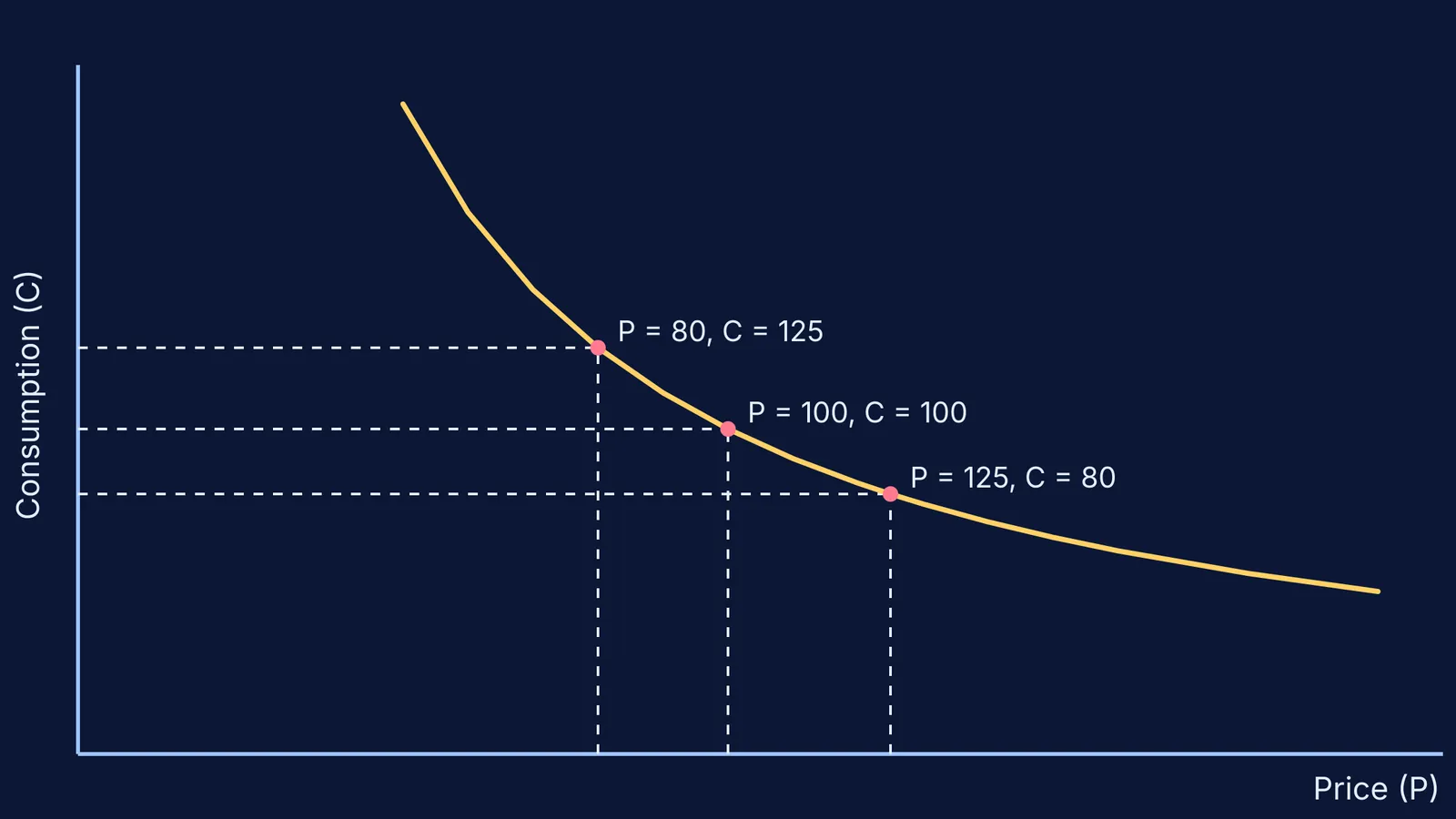
The answer is exactly 20 percent. To prove this without memorising a formula, you can plug in the number 100 to represent both your initial price and your initial consumption, an approach commonly recommended by exam platforms like Testbook.
Initial state: You buy 100 units of an item at ₹100 each. Your total expenditure is 100 × 100 = ₹10,000.
The price increase: A 25% increase brings the new price to ₹125.
The new consumption: Since you only have ₹10,000 to spend, you must divide your total budget by the new price. This gives 10,000 / 125 = 80 units.
The difference: You have dropped from 100 units to 80 units, which is a reduction of 20 units. Because your starting amount was 100, this is exactly a 20% decrease.
This logic works for any starting number. If you are practising for an aptitude test, you can review similar arithmetic logic in Percentages, discounts and interest in Class 8, worked step by step.
Where does the r/(100 + r) rule come from?
In competitive exams, writing out the ₹10,000 calculation takes too long. Instead, students use a shortcut formula like the one provided by Testbook. If the price of an item increases by *r*%, the percentage reduction in consumption required to maintain the same expenditure is:
Reduction % = [*r* / (100 + *r*)] × 100
According to the same source, you apply this by substituting 25 for *r*. The fraction becomes 25 / (100 + 25), which simplifies to 25 / 125, or 1/5. Multiplying 1/5 by 100 gives exactly 20%.
The mathematics behind this formula comes directly from the constant product of Price and Consumption. Let *P* be the price and *C* be the consumption. If *P* is multiplied by a factor of (1 + *r*/100), then *C* must be divided by that exact same factor to keep their product constant. The difference between the old consumption and the new consumption, when expressed as a percentage, yields the *r* / (100 + *r*) ratio.
If you struggle with memorising formulas, working through the underlying algebraic derivation step by step is the most reliable way to learn. The Fermi Problem Library offers worked problems with a step-by-step solver that explains the reasoning rather than printing an answer.
What if the price decreases instead?
The rule has a mathematical twin for when prices drop. If the price of a commodity *decreases* by 20%, you can afford to buy more of it without increasing your budget, as outlined by Testbook. The formula changes slightly to subtract the rate:
Increase % = [*r* / (100 − *r*)] × 100
For a 20% price drop, *r* is 20. The fraction becomes 20 / (100 − 20), which is 20 / 80, or 1/4. Multiplying 1/4 by 100 gives a 25% increase in consumption.
Notice the symmetry: a 25% price increase forces a 20% consumption decrease, and a 20% price decrease allows a 25% consumption increase. This symmetry happens because both scenarios describe the exact same two points on the expenditure curve, just travelling in opposite directions. When you move from a price of ₹100 up to ₹125, you are increasing your base by a quarter (25%). When you move back down from ₹125 to ₹100, you are decreasing your new base by a fifth (20%). Understanding this reversible relationship saves you from second-guessing yourself during an exam.
How to apply this logic in exams?
Questions about price and consumption appear frequently in quantitative aptitude tests. They often use percentages that simplify neatly into fractions. By learning these standard fractions, as suggested by Testbook, you can bypass the formula entirely:
10% increase: This is an increase of 1/10. The consumption decrease is 1 / (10 + 1) = 1/11, which is 9.09%.
20% increase: This is an increase of 1/5. The consumption decrease is 1 / (5 + 1) = 1/6, which is 16.67%.
25% increase: This is an increase of 1/4. The consumption decrease is 1 / (4 + 1) = 1/5, which is exactly 20%.
33.33% increase: This is an increase of 1/3. The consumption decrease is 1 / (3 + 1) = 1/4, which is exactly 25%.
50% increase: This is an increase of 1/2. The consumption decrease is 1 / (2 + 1) = 1/3, which is 33.33%.
You can solve these instantly by converting the percentage increase to a fraction. To find the consumption decrease, keep the numerator the same, add the numerator to the denominator, and convert the new fraction back to a percentage. If you are comfortable converting chemical compositions into proportions, you use a similar proportional logic in Empirical and molecular formulas from percentage data, step by step.


