

On this page
You set up your ideal gas equation, plug in the numbers, press equals, and your answer is off by exactly 1000. Or perhaps your answer is off by about 1.3%. In physical chemistry, these specific errors mean one thing: a unit slip.
Pressure and volume conversions are the hidden traps in thermodynamics. Knowing the formulas is only half the battle; knowing the exact definitions of a standard atmosphere, a bar, a Pascal and a litre is what gets you the marks.
What is the difference between atm, bar, and Pascal?
The Pascal (Pa) is the SI unit of pressure, defined as one Newton per square metre (1 N m⁻²). Because a Pascal is a very small pressure—roughly the pressure of a single sheet of paper resting on a table—chemists and physicists historically used larger units to describe gases.
According to the National Institute of Standards and Technology (NIST), the standard atmosphere (atm) is defined as exactly 101,325 Pa. This value represents the historical average atmospheric pressure at sea level.
However, the International Union of Pure and Applied Chemistry (IUPAC) simplified standard pressure definitions in 1982. They chose the bar, defining 1 bar as exactly 100,000 Pa.
Because 1 atm = 101,325 Pa and 1 bar = 100,000 Pa, the conversion between them is: 1 atm = 1.01325 bar.
If you mistakenly use 1 atm when a question asks for 1 bar, your final answer will be off by exactly 1.325%.
Why do volume slips change an answer by 1000?
While pressure slips cause small percentage errors, volume slips are catastrophic.
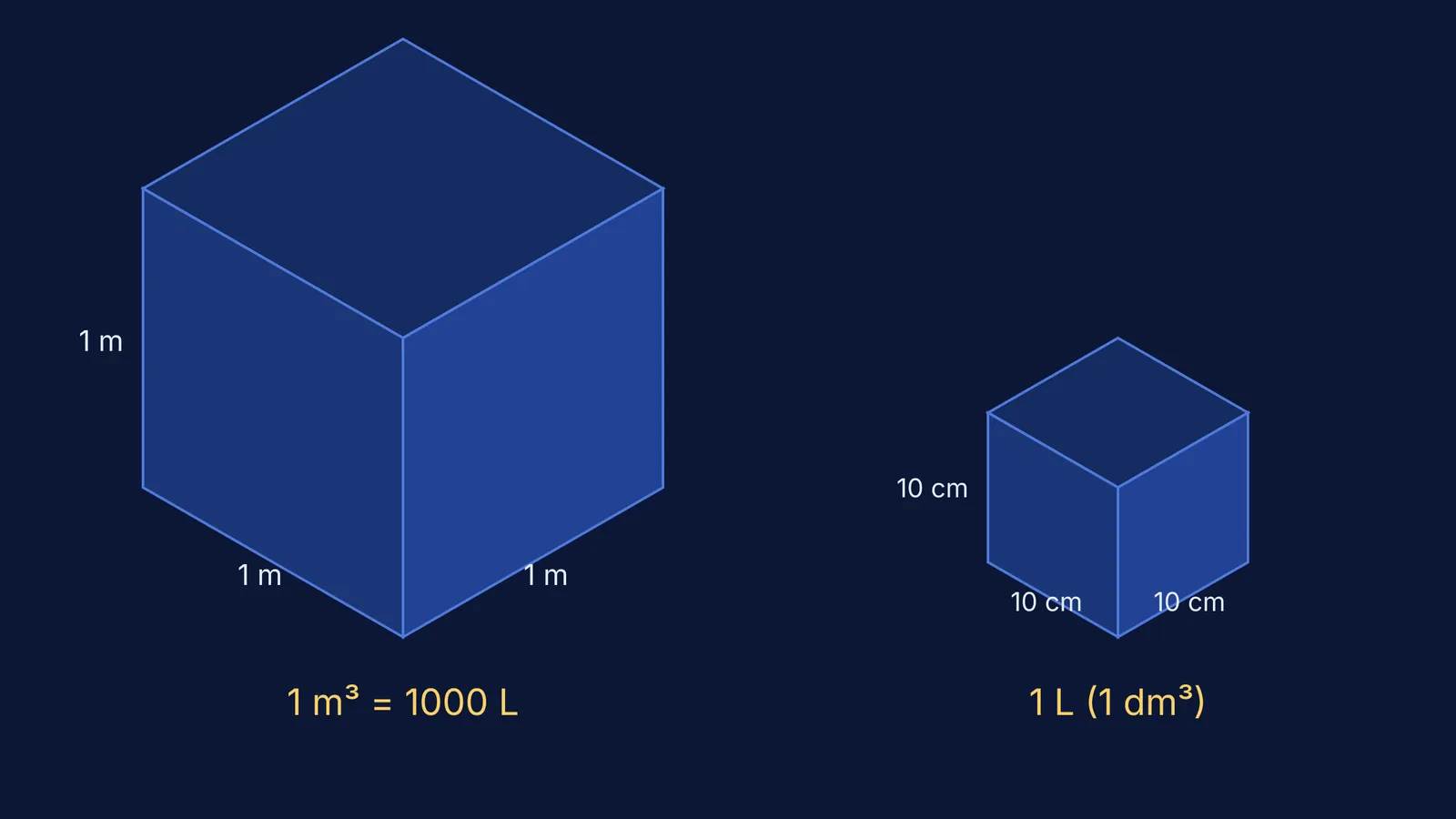
The SI unit of volume is the cubic metre (m³). A cubic metre is a massive amount of space—imagine a box that is one metre wide, one metre deep and one metre high.
A litre (L) is much smaller. It is defined as one cubic decimetre (1 dm³), which is a box measuring 10 cm on each side. Because there are 10 decimetres in a metre, a cubic metre holds 10 × 10 × 10 decimetres. Therefore, 1 m³ equals exactly 1000 L.
Similarly, a millilitre (mL) is one cubic centimetre (1 cm³). Since there are 1000 millilitres in a litre, there are one million cubic centimetres in a cubic metre (100 × 100 × 100 = 1,000,000). Remembering that 1 L = 1 dm³ and 1 mL = 1 cm³ saves you from having to memorise complex conversion tables.
When you use litres in a formula that expects SI units, your volume is 1000 times too small, making your calculated pressure or number of moles 1000 times too large (or vice versa).
How do you find molar volume?
Let's look at how mixing units ruins a calculation. Suppose you want to find the volume of 1 mole of an ideal gas at standard temperature (273.15 K) and 1 atm pressure.
If you use the SI gas constant (R = 8.314 J K⁻¹ mol⁻¹) but leave the pressure as 1 atm, your calculation becomes: V = nRT / P V = (1 × 8.314 × 273.15) / 1 = 2271
This number is meaningless. You cannot divide Joules by atmospheres and get a standard volume unit.
Now, do it correctly by converting 1 atm to 101,325 Pa: V = (1 × 8.314 × 273.15) / 101325 V = 0.0224 m³
Because 1 m³ = 1000 L, we multiply by 1000 to get 22.4 L, the famous molar volume of an ideal gas.
How do you choose the right value of R?
The ideal gas constant, R, is the bridge between pressure, volume, temperature and moles. The value of R you choose must match the units of your variables. According to the 2022 CODATA recommended values from NIST, the exact SI value of R is 8.314462618... J K⁻¹ mol⁻¹.
SI Units: If pressure is in Pa and volume is in m³, use R = 8.314 J K⁻¹ mol⁻¹. (Remember that 1 J = 1 Pa m³).
Litres and atm: If pressure is in atm and volume is in L, use R = 0.0821 L atm K⁻¹ mol⁻¹.
Litres and bar: If pressure is in bar and volume is in L, use R = 0.0831 L bar K⁻¹ mol⁻¹.
If you want to practice unit conversion using dimensions, it is a vital skill for catching these errors early. When you are stuck on an average molar mass of a gas mixture calculation or a free expansion of an ideal gas problem, the Fermi Problem Library has worked problems with a step-by-step solver that explains the reasoning rather than printing an answer, helping you spot where a unit slip happened. You can also review how these gas laws fit into the broader syllabus in the Fermi Concept Library.


