

On this page
The classic question students encounter when first studying hydrostatics or gas laws is why pressure is a scalar quantity. The standard formula, P = F/A, divides a vector (force) by a scalar (area), which should theoretically produce a vector. Yet, in physics, pressure is strictly treated as a scalar.
The distinction lies in understanding the difference between the macroscopic state of a fluid and the specific physical interaction it has with a boundary.
Why does pressure lack a direction?
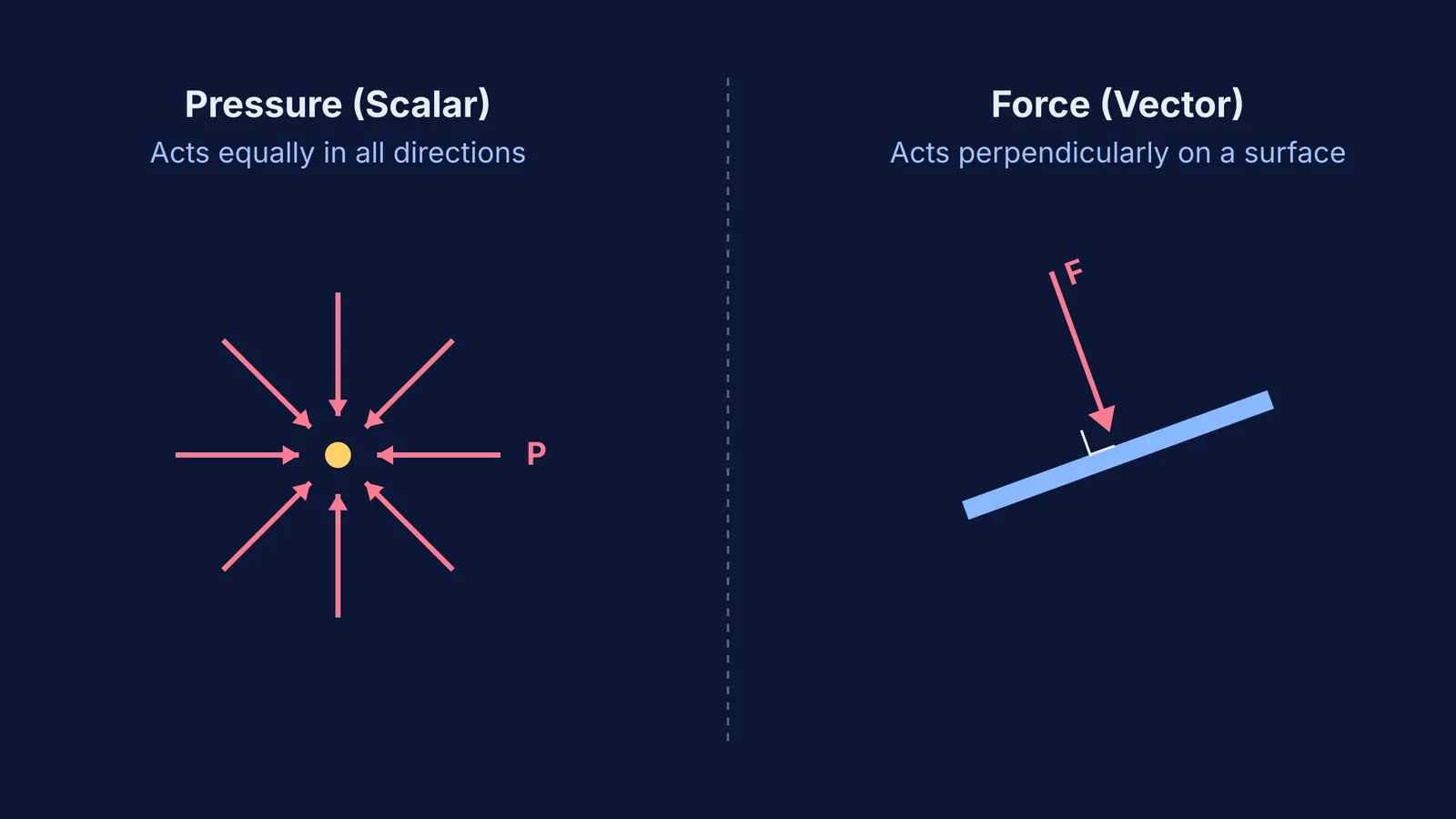
In a fluid at rest, molecules are in constant, random motion. According to the NASA Glenn Research Center, random molecular motion means that pressure acts equally in all directions at any given point inside a gas.
If you were to place a tiny, infinitely small sensor at a specific point in a fluid, it would read the exact same magnitude of pressure regardless of which way the sensor was pointing. Because there is no single "preferred" direction of action for the fluid as a whole, the pressure cannot be described as a vector. It possesses a magnitude—which tells you how intensely the fluid pushes—but no unique direction.
For example, consider a diver submerged in the ocean. The water exerts pressure on their body from the top, the bottom, and all sides simultaneously. The water pushing against the diver's chest is opposed by the water pushing against their back. The state of being "under pressure" is simply a property of that location in the water column, much like the temperature of the water at that depth. You wouldn't ask for the "direction" of the water's temperature, and similarly, you cannot assign a single direction to its pressure.
What is the difference between pressure and force?
Confusion often stems from mixing up the scalar pressure with the vector pressure force.
Pressure is the potential to exert a force. When a fluid meets a boundary, such as the wall of a container or a submerged object, that potential is realised as a physical push. The resulting pressure force is a vector, and its direction is entirely dictated by the orientation of the surface, always acting perpendicularly (normal) to it.
If you tilt a submerged plate, the direction of the force vector changes to remain at 90 degrees to the plate, but the pressure value in the fluid itself remains exactly the same. Furthermore, according to HyperPhysics, pressure is defined as a measure of energy per unit volume, also known as energy density. Because energy is a fundamental scalar quantity, pressure must be a scalar too.
Worked example: calculating the force vector
Understanding this distinction is highly practical when solving numericals. Imagine a submarine window with an area of 0.5 m² submerged at a depth where the water pressure is 200,000 Pa.
Identify the scalar: The pressure is a simple scalar value: 200,000 Pa.
Calculate the force magnitude: To find the force, we use the formula F = P × A. The magnitude of the force is 200,000 Pa × 0.5 m² = 100,000 N.
Determine the vector direction: The force vector acts exactly perpendicular to the window. If the window faces perfectly horizontally to the east, the water exerts a 100,000 N force pushing horizontally to the west. If the submarine tilts upwards by 20 degrees, the pressure value does not change, but the force vector rotates by 20 degrees to stay normal to the glass.
If resolving forces in fluids and distinguishing scalars from vectors trips you up, the Fermi Problem Library has worked problems with a step-by-step solver that explains the reasoning rather than printing an answer.
Is pressure a state variable?
Like temperature and density, pressure is a state variable that describes the macroscopic condition of a thermodynamic system. You can shrink a container down to an infinitely small point, and the pressure will still have a single, unique value at that point.
Because pressure is a state variable, it plays a starring role in the ideal gas law (PV = nRT) and other equations of state. In these equations, pressure interacts mathematically with other pure scalars, such as volume (V), temperature (T), and the number of moles (n). If pressure were a vector, these foundational equations of thermodynamics would require complex vector algebra to balance, fundamentally changing how we calculate the state of a gas. The fact that a gas expands evenly in all available directions when heated further demonstrates that its internal pressure is an isotropic, scalar property.
Understanding that pressure is an isotropic state variable is crucial for solving real-world physics problems. This principle is the foundation of Pascal's law, which states that a pressure change at any point in a confined incompressible fluid is transmitted throughout the fluid undiminished. This allows hydraulic lifts to multiply force, a concept you can review in our guide to Pascal's law in hydraulic machines: lifting a car with a small push.
When you study how liquid columns balance against each other, the scalar nature of pressure is what allows you to equate pressures at the same horizontal level, as seen in Two immiscible liquids in a manometer: finding the unknown density. You also rely on this when dealing with reservoirs, which is explained further in Pressure at depth and gauge pressure: hydrostatics problems.
If you are tackling more advanced fluid dynamics and want to explore the mathematical properties of state variables, you can map out these relationships in the Fermi Concept Library, which houses every concept in physics, chemistry, biology, mathematics and computing, each with its own lesson and its place in the map.


