

On this page
When two immiscible liquids are poured into the same vessel, the lighter liquid floats on top of the heavier one. A classic example is a layer of cooking oil sitting on top of water. If you need to find the total pressure at the bottom of the container, you cannot just use the total depth and a single density. Instead, you have to work your way down from the surface, adding the pressure from each layer as you go.
This method of summing pressures layer by layer is a standard technique in fluid mechanics. If you want to review the foundational ideas before tackling layered fluids, the Fermi Concept Library maps out the core principles of hydrostatics so you can see how they fit together in a broader physics context.
How do you calculate pressure at a depth?
The fundamental rule for any static fluid is that pressure increases linearly with depth. The fluid above a certain point exerts a downward gravitational force, and this force is distributed over the area to create pressure. According to OpenStax *University Physics*, the absolute pressure P at a depth h in a fluid of constant density ρ is given by the equation P = P₀ + ρgh, where P₀ is the pressure at the surface and g is the acceleration due to gravity.
The term ρgh is often referred to as the gauge pressure. It represents the pressure caused solely by the weight of the liquid column, independent of the atmosphere above it. The total pressure is simply this gauge pressure plus whatever external pressure is pushing down on the fluid's free surface, which is usually standard atmospheric pressure (P_atm).
How do you find the pressure at the bottom of a container with two liquid layers?
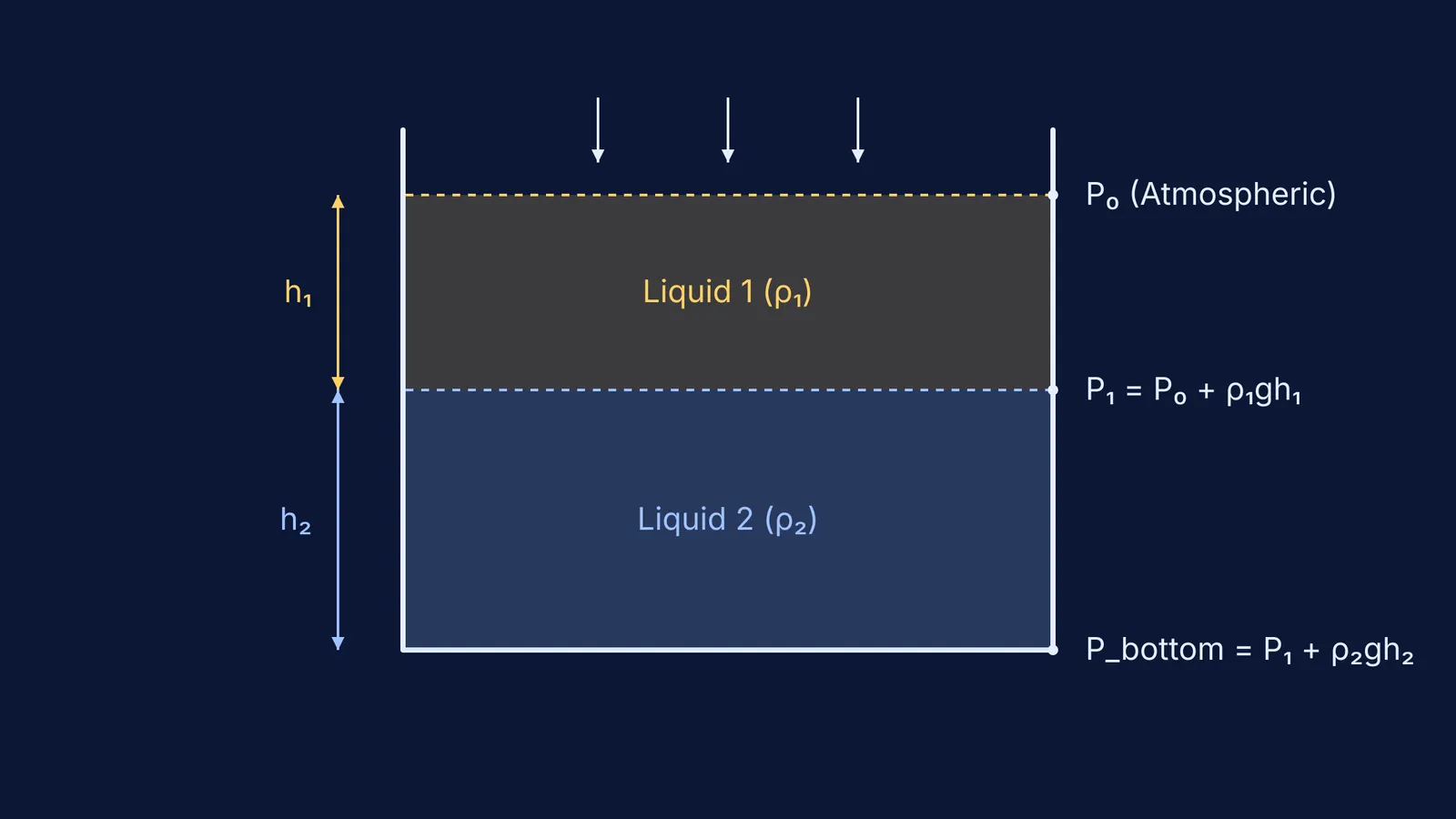
When a container holds two distinct liquid layers, the pressure at the bottom is the sum of the atmospheric pressure and the gauge pressures of both liquids. You calculate this by starting at the top and adding the contribution of each individual layer:
Start at the surface: If the container is open to the air, the pressure at the very top is P₀ = P_atm.
Find the pressure at the interface: Move down through the top layer (Liquid 1) to the boundary where the two liquids meet. The pressure here is P₁ = P_atm + ρ₁gh₁.
Find the pressure at the bottom: Continue moving down through the bottom layer (Liquid 2). The pressure at the interface (P₁) acts as the new "surface pressure" for the bottom layer. The final pressure at the bottom is P_bottom = P₁ + ρ₂gh₂.
Putting it all together, the full equation for the absolute pressure at the bottom is:
P_bottom = P_atm + ρ₁gh₁ + ρ₂gh₂
If you get stuck on problems involving multiple fluid layers or complex container shapes, Fermi's AI tutor can work out what you already know and build a plan for the session, guiding you step-by-step through the pressure additions instead of just handing you the final answer.
Worked example: Oil floating on water
Let's apply this to a practical case. Suppose you have an open cylindrical beaker containing a 0.20 m layer of vegetable oil floating on a 0.30 m layer of water. What is the gauge pressure at the bottom of the beaker?
First, identify your constants. According to the USGS Water Science School, the density of pure water is 1000 kg/m³. Vegetable oil is less dense, which is why it floats; a standard value for its density is 920 kg/m³ according to Density Calculator. We will use g = 9.8 m/s².
Since we are asked for the *gauge pressure*, we can ignore the atmospheric pressure (P_atm) and only sum the ρgh terms for the liquids themselves.
Step 1: Pressure from the oil layer
The gauge pressure exactly at the interface between the oil and the water is due entirely to the oil. P_oil = ρ_oil × g × h_oil P_oil = 920 × 9.8 × 0.20 P_oil = 1803.2 Pa
Step 2: Pressure from the water layer
The water layer adds its own pressure based on its specific depth and density. P_water = ρ_water × g × h_water P_water = 1000 × 9.8 × 0.30 P_water = 2940 Pa
Step 3: Total gauge pressure at the bottom
Add the pressures from the two separate layers together to find the combined effect at the bottom. P_bottom_gauge = 1803.2 + 2940 = 4743.2 Pa
If the problem had asked for the absolute pressure, you would simply add standard atmospheric pressure to this gauge result. You can see similar applications of these principles in our guide to Pascal's law in hydraulic machines or when reading a manometer with two immiscible liquids.
What if the container is closed?
If the container is sealed and the air above the liquids is pressurised, the calculation remains exactly the same, but the starting surface pressure P₀ is no longer the standard atmospheric pressure. You would instead replace P_atm with the given pressure of the trapped gas.
The essential rule of adding ρgh for each subsequent layer never changes. Whether you have two layers, three layers, or a closed system, you simply start at the top boundary and add the weight-induced pressure of each fluid column as you move sequentially downward.


