

On this page
When you mix two aqueous solutions of ionic compounds, they can react to form an insoluble solid known as a precipitate. A common task in quantitative chemistry is predicting exactly how much of this solid will form.
According to OpenStax Chemistry 2e, a precipitation reaction is one in which dissolved substances react to form one or more solid products. To solve these problems, you need to combine the stoichiometry of solutions with the concept of the limiting reactant.
How to find the mass of a precipitate formed when two solutions are mixed?
The process boils down to finding which reactant runs out first. You cannot simply use the mass or volume of one reactant without checking the other, because one will almost always be left over.
Here is the standard four-step plan:
Write the balanced chemical equation: Identify the solid product using solubility rules. For example, mixing silver nitrate and sodium chloride forms solid silver chloride.
Calculate the moles of each reactant: Use the formula moles = molarity × volume in litres. If you are mixing and diluting solutions, the moles depend entirely on the concentrations before the reaction starts.
Identify the limiting reactant: This is the reactant that yields the smaller amount of product.
Calculate the mass of the precipitate: Convert the moles of product formed by the limiting reactant into grams by multiplying by the molar mass.
What are the steps to identify the limiting reactant?
According to OpenStax Chemistry 2e, the limiting reactant is the substance that is entirely consumed first, limiting the amount of product that can be formed.
To find it, you divide the number of moles of each reactant by its stoichiometric coefficient in the balanced equation. The reactant with the lowest resulting ratio is the limiting reactant. In a simple 1:1 reaction, such as between Ag⁺ and Cl⁻ to form AgCl, you can just compare the moles directly. The one with fewer moles limits the reaction.
How does the limiting ion determine the amount of precipitate?
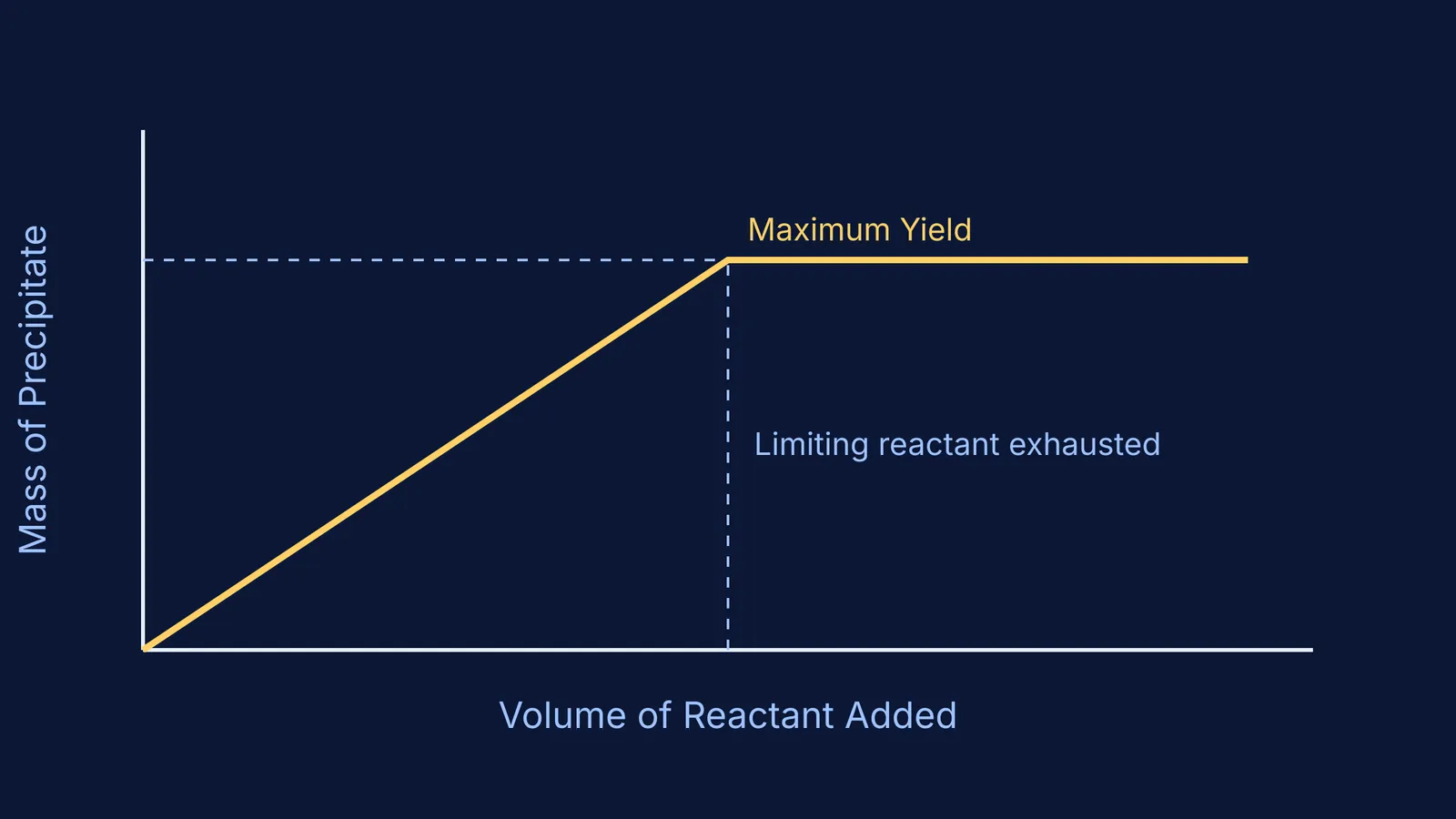
Once the limiting ion is used up, the reaction stops. The remaining ions of the other reactant stay dissolved in the solution as spectators. Therefore, the theoretical yield of the precipitate is directly proportional to the moles of the limiting reactant.
If you find yourself stuck on stoichiometry problems, the Fermi Problem Library has worked problems with a step-by-step solver that explains the reasoning rather than printing an answer.
How do you calculate the mass of silver chloride formed?
Suppose you mix 50.0 mL of 0.200 M AgNO₃ with 50.0 mL of 0.100 M NaCl. What mass of AgCl precipitate forms?
First, write the balanced equation: AgNO₃(aq) + NaCl(aq) → AgCl(s) + NaNO₃(aq)
Next, find the moles of each reactant:
Moles of AgNO₃ = 0.200 mol/L × 0.0500 L = 0.0100 mol
Moles of NaCl = 0.100 mol/L × 0.0500 L = 0.00500 mol
Since they react in a 1:1 ratio, NaCl provides the smaller amount of moles (0.00500 mol vs 0.0100 mol) and is the limiting reactant.
This means exactly 0.00500 moles of AgCl will form. To find the mass, multiply by the molar mass of AgCl (which is approximately 143.32 g/mol): Mass = 0.00500 mol × 143.32 g/mol = 0.717 g
Understanding how to read the average molar mass of a gas mixture and calculate individual yields helps ensure your laboratory predictions are spot on. For further practice on how concentrations affect yields, explore the Fermi Concept Library, which has every concept in physics, chemistry, biology, mathematics and computing, each with its own lesson and its place in the map.