

On this page
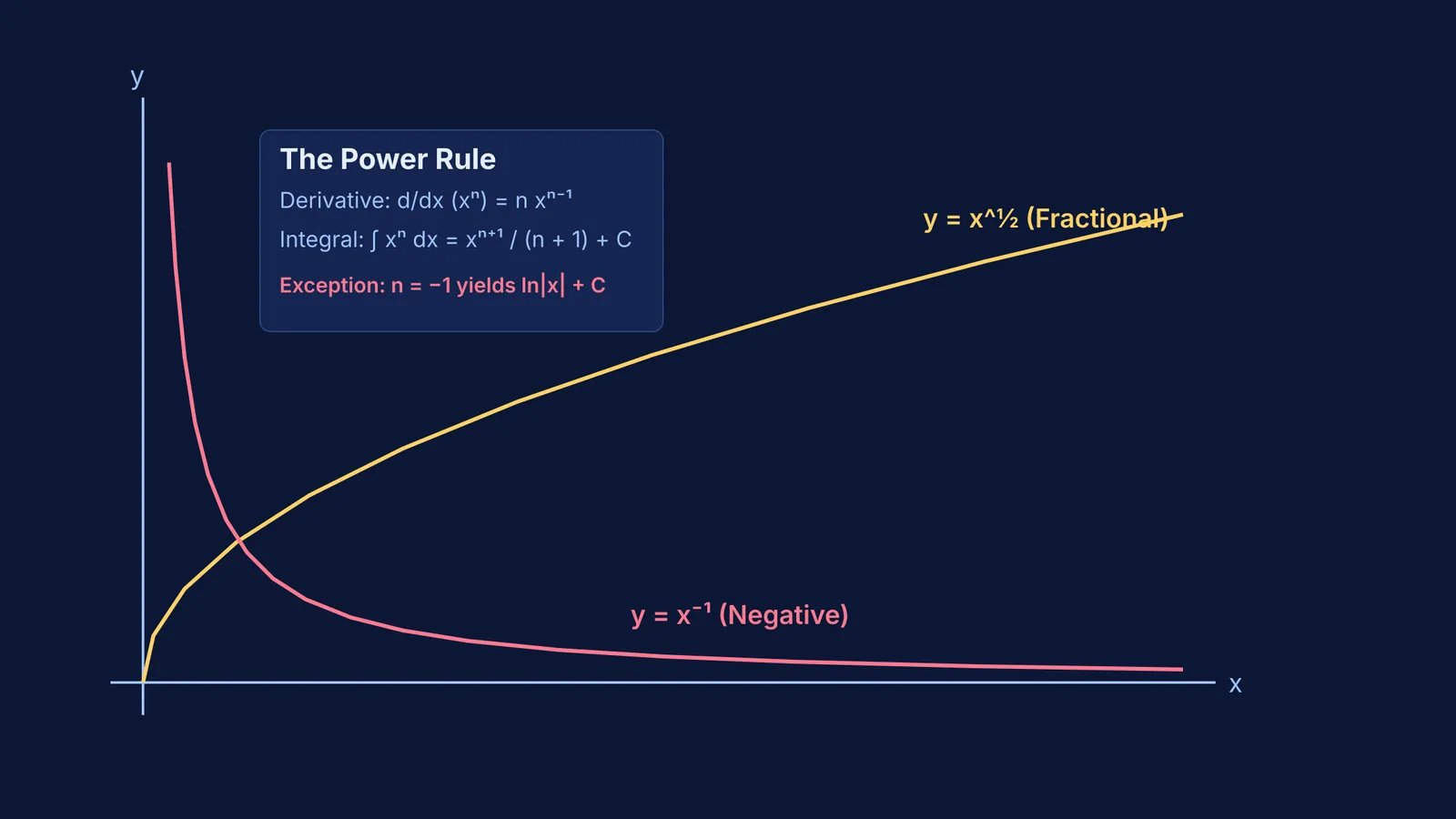
The power rule is one of the first and most useful tools you learn in calculus. It tells you that the derivative of xⁿ is nxⁿ⁻¹, and the integral of xⁿ is xⁿ⁺¹/(n + 1) + C.
While these formulas are straightforward for positive whole numbers like x² or x⁵, they often cause confusion when you encounter fractions like 1/x³ or radicals like √x. The trick is not to learn a new calculus rule, but to use the laws of indices to rewrite the expression before you begin.
Separating the algebra from the calculus reduces the number of steps you have to hold in your head. This is a practical way to manage cognitive load; as early research by G. A. Miller in 1956 highlighted, human short-term memory can typically hold only about seven items of information at once. By rewriting the function first, you free up mental space for the actual differentiation or integration.
How do you apply the power rule for negative powers?
A term with x in the denominator can be rewritten using a negative exponent. For example, 1/x³ becomes x⁻³. Once it is written in this form, the standard power rule applies exactly as it does for positive integers.
To differentiate f(x) = x⁻³:
Bring the power down to the front: −3x⁻³.
Subtract 1 from the power: −3 − 1 = −4.
The derivative is −3x⁻⁴, which you can rewrite back as −3/x⁴.
When integrating, you add 1 to the power and divide by the new power. To find ∫ x⁻³ dx:
Add 1 to the power: −3 + 1 = −2.
Divide by the new power: x⁻²/(−2).
Add the constant of integration, giving −1/(2x²) + C.
A common mistake is to subtract 1 incorrectly when dealing with negative numbers, resulting in −2 instead of −4 during differentiation. Writing out the arithmetic explicitly (e.g., −3 − 1) helps prevent this.
What is the power rule for fractional powers?
Radicals can be written as fractional exponents. The square root √x is x^(1/2), the cube root ∛x is x^(1/3), and ∛(x²) is x^(2/3).
To differentiate f(x) = x^(1/2):
Bring the power down: (1/2)x^(1/2).
Subtract 1 from the power: 1/2 − 1 = −1/2.
The derivative is (1/2)x^(−1/2), or 1/(2√x).
Integrating fractional powers involves fraction arithmetic. To evaluate ∫ x^(1/2) dx:
Add 1 to the power: 1/2 + 1 = 3/2.
Divide by the new power: x^(3/2)/(3/2).
Dividing by a fraction is the same as multiplying by its reciprocal, so the result is (2/3)x^(3/2) + C.
If you need to explore how different functions and their derivatives change shape, Fermi can help you plot and visualise these curves. You can also see similar techniques at work when differentiating parametric functions or differentiating one expression with respect to another.
Why is n = −1 an exception for integrals?
The formula for integrating xⁿ is xⁿ⁺¹/(n + 1). If you try to apply this to x⁻¹ (which is 1/x), you run into a mathematical wall.
Adding 1 to the power gives −1 + 1 = 0. Dividing by the new power means dividing by zero, which is undefined. Therefore, the standard power rule fails for this specific case.
Instead, the integral of x⁻¹ is defined by a completely different rule: ∫ x⁻¹ dx = ∫ (1/x) dx = ln|x| + C.
It is important to watch out for this exception. Whenever you simplify an expression and find yourself left with x⁻¹, stop and use the natural logarithm. For integrals of other forms that rely on standard formulas rather than the power rule, see our guide on integrals of standard forms.
A checklist for differentiating and integrating powers
When faced with a complex-looking function, follow this systematic plan to keep your working clear:
Rewrite terms: Convert all roots to fractional exponents and all denominators to negative exponents.
Check the power: Are you integrating x⁻¹? If yes, use the natural log rule.
Apply the rule: For derivatives, multiply by the current exponent, then subtract 1; for integrals, add 1 to the exponent, then divide by the new exponent.
Write out the arithmetic: For fractions and negative numbers, write the addition or subtraction out fully on the page.
Simplify: Convert negative exponents back to denominators and fractional exponents back to roots if required by the format of the question.


