

On this page
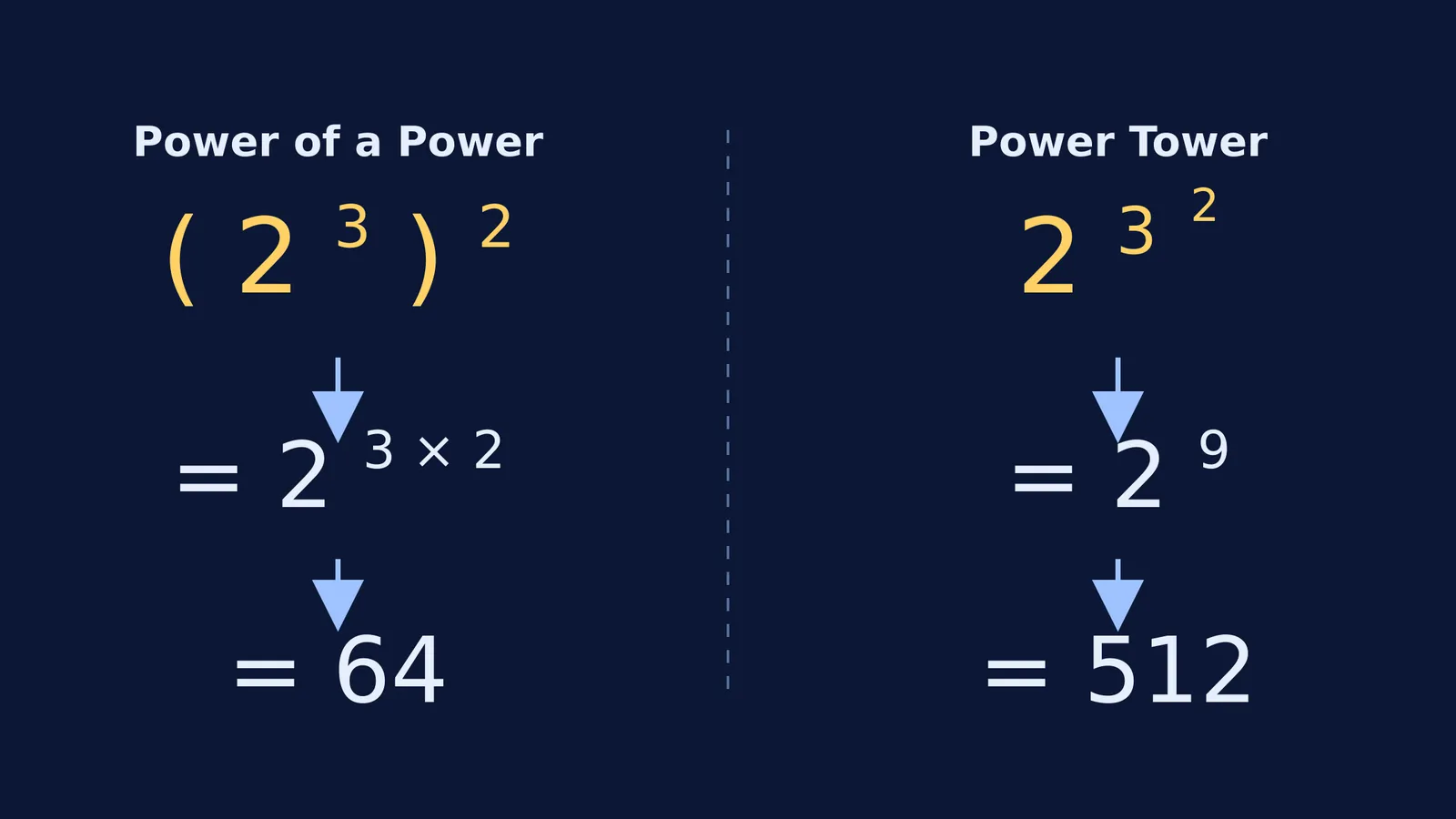
No, "2 cube squared" and "2 to the power of 9" are not the same. When you square 2³, written as (2³)², the result is 64. But when you write a stack of exponents without brackets, like a power tower 2³², mathematical convention evaluates it from the top down, yielding 2⁹, which is 512.
Let's look at why these expressions are evaluated differently and the standard rules that govern them.
How does the power of a power rule work?
When an exponentiation expression is enclosed in brackets, you work from the inside out. This follows the standard mathematical power of a power rule, which states that when taking the result of an exponent to another power, you keep the base the same and multiply the exponents.
For example, "2 cube squared" is written explicitly with brackets as (2³)².
The inner expression is 2³, which is 2 × 2 × 2 = 8.
The outer expression squares that result: 8² = 64.
Using the shortcut rule, (2³)² = 2^(3 × 2) = 2⁶ = 64.
This identity holds for all integers where the base is not zero. The power of a power rule is incredibly useful when simplifying algebraic fractions, finding binomial coefficient sums, or comparing the sizes of large numbers without a calculator.
However, it is important to remember that (bᵐ)ⁿ = bᵐⁿ is guaranteed to hold true only when the base is a positive real number or when the exponents are integers. When dealing with fractional exponents and negative bases, the rule can break down. For instance, ((-1)²)^(1/2) equals 1^(1/2) = 1, but if you incorrectly multiplied the exponents first, you would get (-1)^(2 × 1/2) = -1.
What is a power tower?
A power tower is a sequence of stacked exponents written without any brackets, such as a^(b^c).
In standard mathematics, exponentiation is right-associative. This means you evaluate the tower from the top down, grouping the exponents from right to left. The expression a^(b^c) is always interpreted as a^(b^c).
For the expression 2³²:
You evaluate the top exponent first: 3² = 9.
Then you apply that result to the base: 2⁹ = 512.
Why use this top-down convention? The primary reason is to avoid mathematical redundancy. If stacked exponents were evaluated from the bottom up, (aᵇ)^c would simply equal a^(bc) because of the power of a power rule. By defining the tower as right-associative, mathematicians created a way to represent numbers that grow incredibly fast and cannot be simplified into basic multiplication.
If you are ever stuck trying to simplify a large algebraic expression with nested exponents, the Fermi Problem Library has worked problems with a step-by-step solver that explains the reasoning rather than printing an answer.
Why do Excel and Python calculate stacked exponents differently?
Because there is no universal programming standard for the explicit caret symbol (^), you must be careful when transferring written mathematics into digital tools. While mathematicians universally agree on the top-down rule for stacked exponents, not all software applications follow it.
Right-associative (Top-down): Search engines like Google, calculation engines like Wolfram Alpha, and programming languages like Python evaluate `232` as 512.
Left-associative (Bottom-up): Microsoft Excel and MATLAB group operations from left to right, evaluating `=2^3^2` as (2³)² = 64.
What happens with negative bases?
Similar to the power tower confusion, the order of operations often trips students up when a negative sign is involved. In standard mathematics, the expression -3² is evaluated by applying the exponent before the negative sign, meaning -(3²) = -9.
If you want to square the negative number itself, you must use brackets to write (-3)² = 9. Some applications, like Excel, actually give the unary minus higher priority than exponentiation, incorrectly evaluating -3² as 9.
How do you evaluate stacked exponents correctly?
To make sure your intent is never misunderstood—whether by a teacher grading an exam or a computer evaluating a script—use brackets explicitly. It is always safer to write (2³)² or 2^(3²) than to rely on the reader remembering the right-associative rule.
Here is a practical framework to double-check your work during an exam:
Look for brackets first. If the base and an exponent are inside brackets, like (2³)², apply the power of a power rule. Multiply the inner and outer exponents to get 2⁶ = 64.
Check for a stacked power tower. If you see 2³² with no brackets, circle the top two numbers. Evaluate them first as 3² = 9, then apply that to the base to get 2⁹ = 512.
Beware of the negative sign. Treat a negative sign in front of a base like a multiplication by -1. Evaluate the exponent first, so -2⁴ becomes -16, not positive 16.
By paying close attention to brackets and the order of operations, you will easily handle limits of the form 1 to the power of infinity and spot the patterns in matrix powers without confusing a simple power of a power with a massive power tower.


