

On this page
When you push a heavy cart from a standstill across a smooth warehouse floor, the effort feels steady at first. But as the cart moves faster and faster, keeping up that exact same push takes significantly more out of you. You are delivering more and more power just to maintain the constant force you started with.
Many students assume that a constant push means you are doing work at a constant rate. That is a common trap in kinematics and mechanics, and it trips up many in exams. Let us look closely at why power delivered by a constant force increases with time, and how this scenario differs mechanically from a car engine that outputs a constant power.
Why does the power delivered by a constant force increase with time?
Yes, it grows steadily as time passes. To see why, we start with the definition of power. The NCERT Class 11 Physics textbook states that instantaneous power is the rate at which work is done, expressed as the dot product of force and velocity: P = F · v (NCERT Class 11 Physics, Chapter 5).
If a constant force F acts on an object of mass m that starts from rest, it produces a constant acceleration a = F/m. Over time t, the object speeds up according to the first equation of motion: v = at = (F/m)t
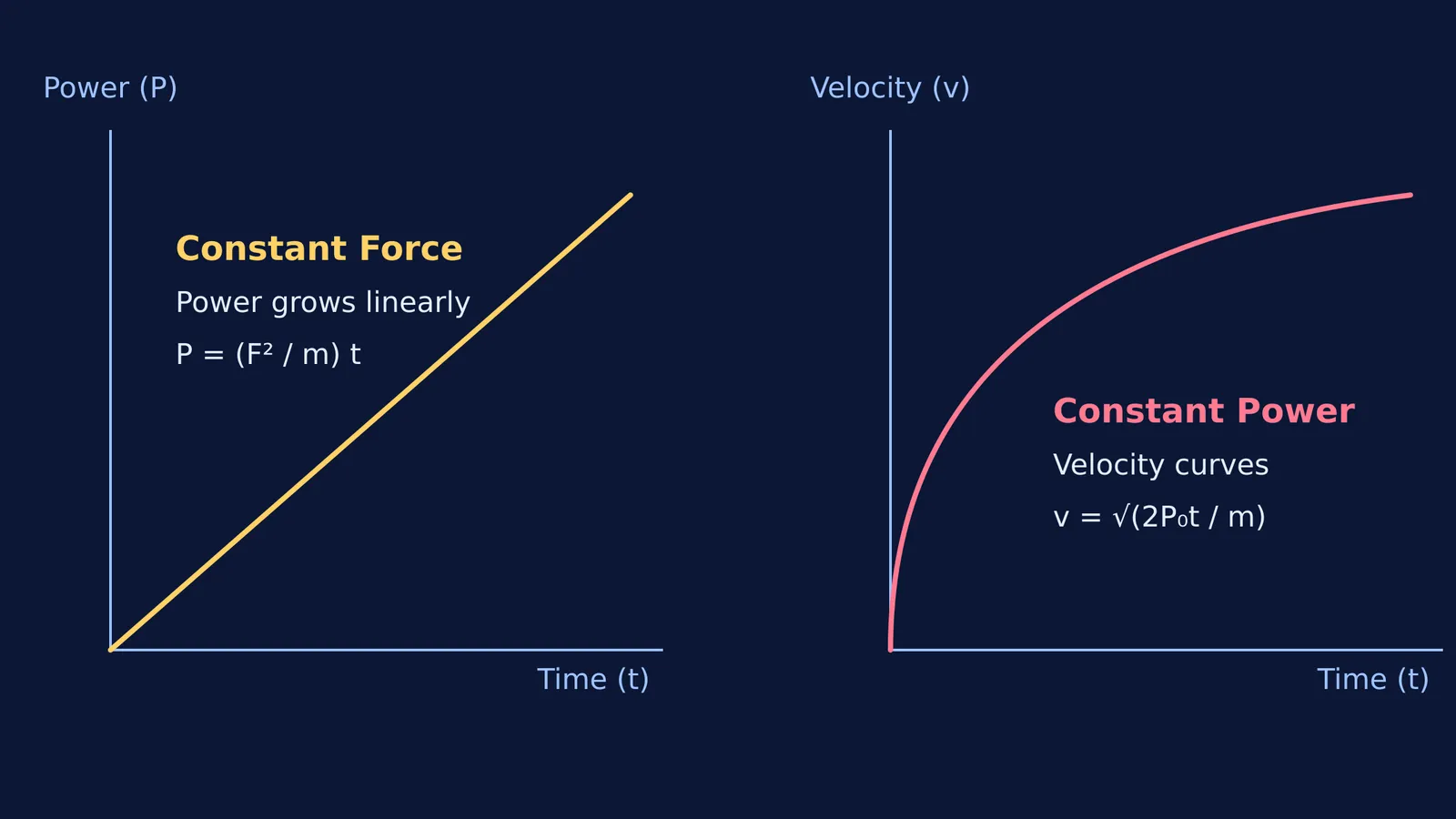
Now substitute this velocity back into the power formula: P = F × (F/m)t = (F²/m)t
Because F and m are constants, the power P is directly proportional to time t. This means if you push a block with a constant force, the power you must deliver at time 2t is exactly double the power you delivered at time t. The faster the object moves, the faster you are doing work.
What is the difference between constant force and constant power?
In everyday life, most machines are rated by their power, not by a single constant force. Car engines are commonly rated in horsepower (where 1 hp = 746 W, as noted in the NCERT Physics text).
If a machine delivers constant power P₀, the relationship between speed and time changes entirely. Since P₀ = F · v, as the velocity v increases, the force F must shrink. The machine cannot pull as hard when the object is moving fast.
Using the work-energy theorem, we know the total work done is the change in kinetic energy: P₀ × t = ½mv²
Rearranging this for velocity gives: v = √(2P₀t/m)
Under constant power, the velocity grows proportionally to the square root of time (√t). It does not increase linearly like it does under a constant force. This is why a car accelerates very quickly from a green light but struggles to gain those last few kilometres per hour on the open highway. The engine maxes out its power output, so the forward push must drop as the speedometer climbs.
How do you solve these problems in an exam?
When a problem asks how speed or distance changes, checking whether the source provides a constant force or a constant power is your first step. Here is a worked example of how to tackle a constant force question using the principles from NCERT Class 11 Physics.
Worked Example: In a typical mechanics problem, a stationary crate of mass m is pushed across a smooth, frictionless floor with a constant force F. What is the power delivered at time t?
Find the acceleration: Use Newton's second law, a = F/m.
Find the velocity at time t: Use the first equation of motion, v = at = (F/m)t.
Calculate the power: Using the instantaneous power definition, P = F · v = F(F/m)t = (F²/m)t.
You can also use the direct derived formula P = (F²/m)t to jump straight to the solution. Knowing both the step-by-step method and the derived formula helps you safely verify your reasoning during a fast-paced test.
A checklist for constant power vs constant force
Exam boards like to test if you know the difference. Here is a simple checklist to keep the relations straight:
For a constant force (F):
Acceleration is constant.
Velocity is proportional to time (v ∝ t).
Distance is proportional to time squared (s ∝ t²).
Power is proportional to time (P ∝ t).
For constant power (P):
Force decreases over time (F ∝ 1/√t).
Velocity is proportional to the square root of time (v ∝ √t).
Distance is proportional to time to the power of 3/2 (s ∝ t³/²).
When you practise with the Fermi Problem Library, you will encounter both variants in complex multi-step physics questions. The vital trick is to identify the constant immediately when reading the first sentence. Once you know whether you are working with motion at constant power or force laws of motion, you can pick the right set of equations and confidently trace how the energy flows through the system.


