

On this page
Often in electrostatics, a point in space seems "empty" of effect, but only if you ask the right question. You might wonder: can a point have zero electric potential but still push on a test charge? Yes, because potential and field follow different rules of addition.
Why do potential and field add differently?
Electric field (E) is a vector. It has both magnitude and direction, like the steepness of a hill. To find the net electric field from two charges, you must add their vectors. They only cancel out to zero if they have the same magnitude and point in exactly opposite directions.
Electric potential (V), on the other hand, is a scalar, like the altitude on that hill. It only has a magnitude (which can be positive or negative). According to OpenStax University Physics Volume 2, the total potential from a system of charges is just the algebraic sum of their individual potentials (V = V₁ + V₂). They cancel out if one is positive and the other is equally negative, regardless of where they are placed.
Where is potential zero but field is not?
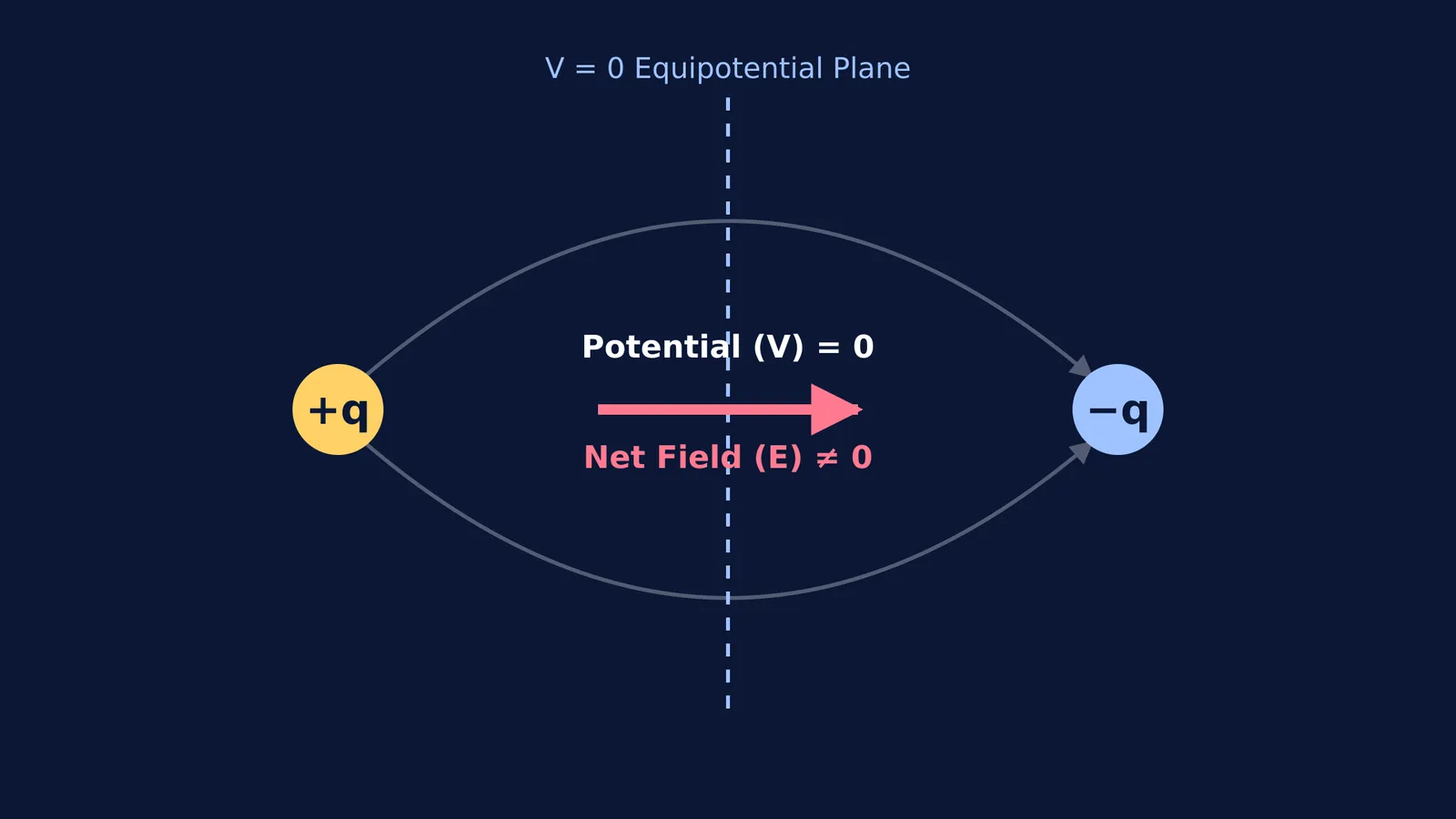
Imagine an electric dipole: a positive charge (+q) and a negative charge (−q) separated by a distance d. If you look at the exact midpoint between them, what happens?
The potential is zero: The positive charge creates a positive potential, and the negative charge creates an equal negative potential. Because they are scalars and the distances to the midpoint are equal, they sum to exactly zero.
The field is not zero: The electric field from the positive charge points away from it (towards the negative charge). The field from the negative charge points towards itself (also towards the negative charge). Both vectors point in the exact same direction, meaning they add together rather than cancelling.
Where is field zero but potential is not?
The reverse situation is also common. Take two identical positive charges (+q and +q) separated by a distance d.
The field is zero: At the midpoint, the field from the left charge points right, and the field from the right charge points left. The vectors are equal in magnitude but perfectly opposed, so the net electric field is zero. This is the spot where a third charge would sit perfectly still, a classic setup for Coulomb's law: where to place a third charge for equilibrium.
The potential is not zero: Both charges contribute a positive potential. Adding two positive numbers gives a larger positive number, so the potential at the midpoint is V = 4kq/d, which is clearly not zero.
This difference often trips up students when calculating the work to assemble point charges or searching for zero potential points near two charges. You cannot assume that because the force on a test charge is zero, the energy required to put it there was also zero.
A framework for finding zero points
When tackling a physics problem that asks you to find where the field or potential is zero, use this simple checklist before writing any equations:
Check the signs of the charges: Are they the same (like two protons) or opposite (like an electron and a proton)?
For electric potential (V = 0): You are looking for a spot where the scalar values cancel. This requires charges of opposite signs. If both charges are positive, the potential will be positive everywhere; you cannot add two positive altitudes and get zero.
For electric field (E = 0): You need the vectors to fight each other perfectly. If the charges have the same sign, this cancellation happens between them (the pushes oppose each other). If they have opposite signs and unequal magnitudes, the zero point is outside them, closer to the weaker charge, where the push from the nearby weak charge balances the pull from the distant strong charge.
Draw the vectors: Never try to solve a field problem in your head. Sketch the charges, pick a random point, and draw arrows for the electric field. If the arrows do not point in opposite directions, the field cannot be zero there.
How Fermi's AI tutor clarifies these concepts
When you are learning this for the first time, it is easy to mix up scalars and vectors. If you make a mistake calculating the net field by adding potentials instead of vectors, Fermi's AI tutor can help. The tutor teaches rather than answers: it holds a line of reasoning across a session, notices where a student is stuck, and decides whether to explain, ask, or show.
If you need a refresher on the underlying rules, the Fermi Concept Library contains every concept in physics, chemistry, biology, mathematics and computing, each with its own lesson and its place in the map.


