

On this page
A common trap in JEE and NEET physics problems is assuming that earthing a conductor always leaves it with zero charge. While grounding does drain the charge from an isolated sphere, introducing an external charge changes the rules entirely. To get these numericals right, you must track potential rather than just counting electrons.
Why does earthing set potential to zero?
The Earth is a massive conductor. By convention, its electric potential is assigned a value of zero volts (OpenStax). When you connect a charged sphere to the ground with a conducting wire, you are creating a path for charge to flow. Electrons will move between the sphere and the Earth until the two reach electrostatic equilibrium. Since the Earth's capacity to absorb or supply charge is effectively infinite, its potential does not change. Therefore, the sphere's potential is forced to match the Earth's, becoming exactly zero. This principle is key when finding where potential is zero near two charges.
What happens to the charge on an isolated sphere?
If the earthed sphere is completely isolated in space, with no other charges around it, the mathematics is straightforward. The potential of a sphere with radius R and charge Q is V = kQ/R. Since earthing forces V to be zero, the only way this equation holds is if Q is also zero. The sphere loses all its excess charge to the ground. (This is a different calculation from finding the self-energy of a charged sphere, which looks at the work done to assemble the charge in the first place).
What happens when another charge is nearby?
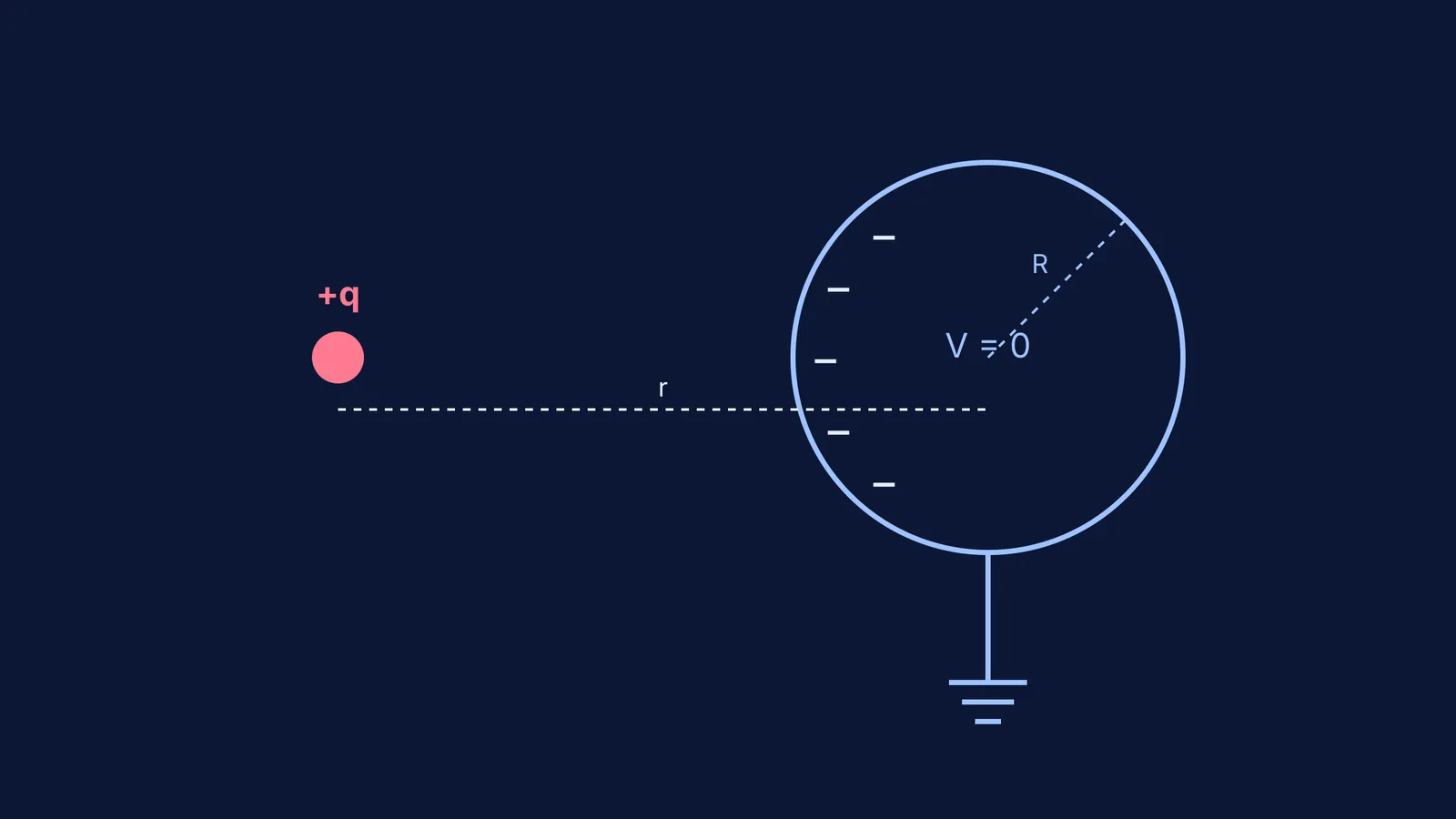
If a concept gap is causing you to misinterpret these situations, the Fermi Concept Library contains every concept in physics, each with its own lesson and its place in the map. Imagine holding a positive point charge +q at a distance r from the centre of the earthed sphere. The total potential at the surface of the sphere is now the sum of the potential created by its own charge and the potential created by the external charge +q.
Even though it is earthed, the sphere's total potential must still be zero. To achieve this, it draws electrons from the Earth, acquiring an induced charge (let's call it Q'). The equation for the potential becomes:
kQ'/R + kq/r = 0
Solving this gives Q' = −qR/r.
The sphere is no longer neutral. It holds a negative charge just large enough to cancel out the positive potential created by the nearby charge +q. The closer the external charge is brought to the sphere, the more induced charge the sphere must pull from the ground to maintain its zero potential.
Which way do the electrons flow?
When a problem asks for the final charge, it might also ask about the current that flowed to reach it. The direction of charge flow depends entirely on the initial state of the sphere before it was grounded.
Because protons are bound in the nuclei of atoms, only electrons move through the grounding wire. If the sphere initially had a positive potential, it means there was a deficit of electrons. Once the connection is made, electrons will travel from the Earth up into the sphere until the positive potential is neutralized.
Conversely, if the sphere was at a negative potential, it carried an excess of electrons. Upon earthing, these electrons will be repelled by each other and will flow down the wire into the Earth until the sphere's potential rises back to zero. Understanding this flow is crucial because the charge transferred through the wire is exactly the difference between the initial and final charge of the sphere.
What happens when you earth a concentric shell?
Questions about earthing often feature concentric spherical shells, which can appear complex but yield to the same single rule. Consider an arrangement where a smaller conducting shell is placed inside a larger one. If the outer shell is given a charge Q and the inner shell is earthed, what is the final charge on the inner shell?
This is a classic scenario you can practice in the Fermi Problem Library, which provides worked problems with a step-by-step solver that explains the reasoning rather than printing an answer. Start by establishing the geometry: let the inner shell have radius a and the outer shell have radius b. We assume the induced charge on the inner shell is q.
Because the inner shell is connected to the ground, its final potential must be zero. The total potential anywhere on the inner shell is the sum of the potential due to its own charge q and the potential due to the outer shell's charge Q.
The potential at the surface of the inner shell due to its own charge is kq/a. The inner shell also sits entirely inside the outer shell, meaning it sits in a region of constant potential kQ/b created by the outer shell.
Setting the sum of these potentials to zero gives:
kq/a + kQ/b = 0
Rearranging to solve for q:
kq/a = −kQ/b q = −Q(a/b)
The inner shell ends up holding a fraction of the outer shell's charge, carrying the opposite sign. The Earth supplied precisely this amount of charge to cancel out the influence of the outer shell.
By remembering that earthing dictates the final potential, rather than prescribing a final charge, you can reliably construct the correct equation for any arrangement of conductors and electric fields.


