

On this page
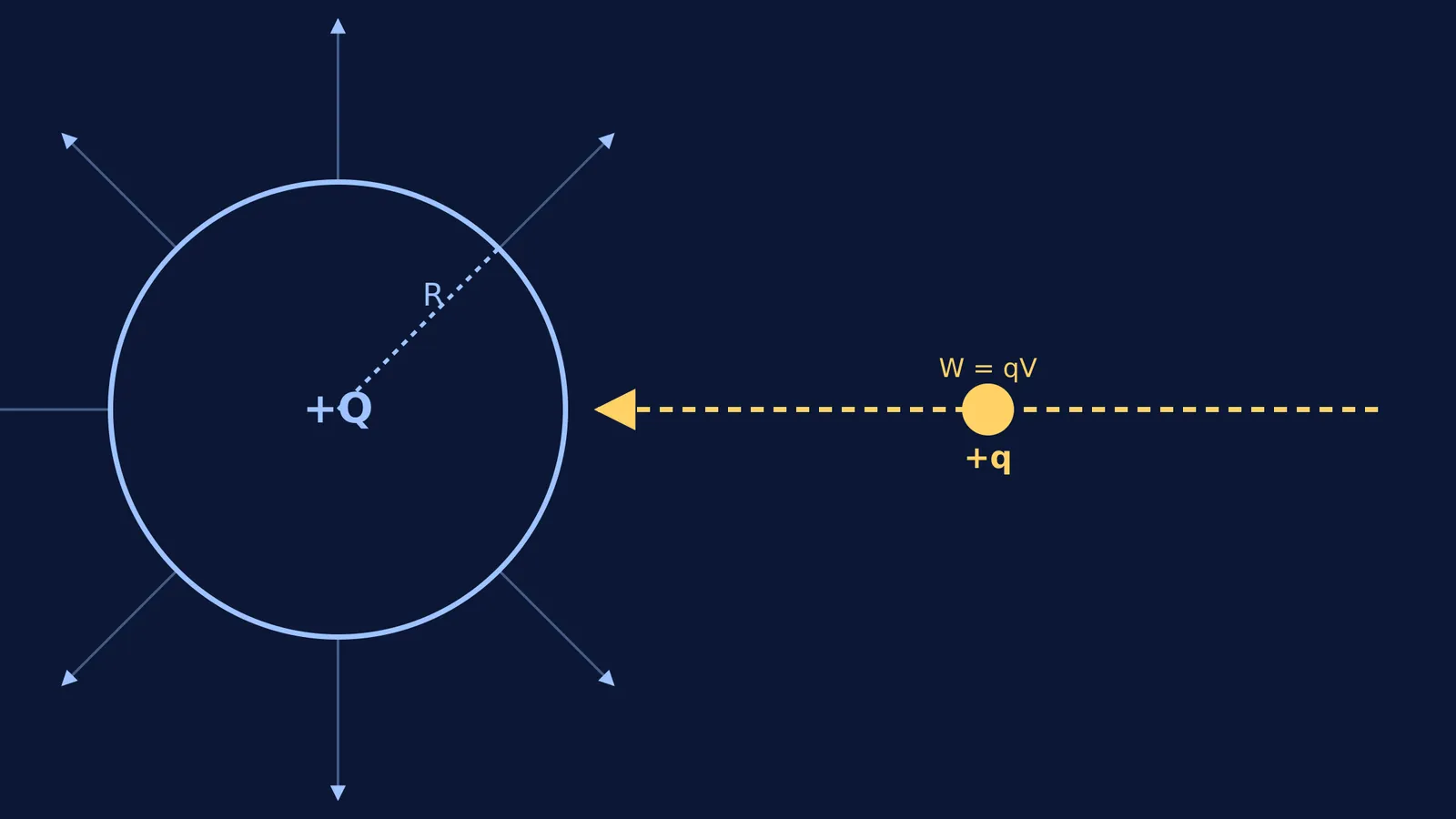
In short The work needed to bring a point charge q from infinity to the surface of a charged sphere of radius R and charge Q is W = kQq/R. This is because any spherically symmetric charge behaves like a point charge from the outside, making its surface potential V = kQ/R.
When you solve electrostatics problems, finding the work done to move a charge through an electric field comes down to understanding electric potential. The calculation is straightforward once you know how a charged sphere behaves from the outside.
How much work is needed to bring a charge to the surface of a charged sphere?
The work done (W) by an external force to move a point charge q between two points is equal to the charge multiplied by the potential difference (ΔV) between those points. University Physics Volume 2 by OpenStax defines the work done in terms of potential difference as W = qΔV.
When a charge is brought from infinity (where the potential is zero) to the surface of a sphere, the potential difference is simply the potential at the surface of the sphere (V). Therefore, the work done is W = qV.
If you need to visualise how field lines and potentials relate in these setups, the Fermi Simulation Lab provides interactive models for ideas that are easier to see than to read.
Why does a charged sphere act like a point charge?
To find the surface potential V, you need to know the electric field of the sphere. Gauss's Law shows that for any spherically symmetric charge distribution, the electric field outside the sphere is mathematically identical to the field of a point charge located at its centre, as detailed in Section 6.3 of University Physics Volume 2.
Because the electric field outside the sphere is the same as a point charge, the electric potential is also the same. The potential V at a distance r from a point charge Q is given by V = kQ/r. At the surface of a sphere of radius R, the distance from the centre is r = R, so the surface potential is V = kQ/R.
Substituting this back into the work equation gives the final result: W = kQq/R.
Does it matter if the sphere is conducting or non-conducting?
The rule that a spherically symmetric charge distribution acts like a point charge from the outside holds true whether the sphere is conducting (like a solid metal ball) or non-conducting (like a uniformly charged plastic sphere).
As long as you are finding the work needed to reach the *surface* or any point outside the sphere, the internal structure does not change the result. The work done is kQq/R in both cases.
If a problem asks you to calculate work done *inside* the sphere, the material does matter. For a conducting sphere, the electric field inside is zero, meaning the potential is constant throughout the interior. Therefore, moving a charge anywhere inside a conductor requires no additional work; the potential energy remains kQq/R. For a non-conducting sphere with a uniform volume charge, the potential continues to change inside, and more work is needed to push the charge closer to the centre.
When textbook chapters blur together and you aren't sure where to start on a problem like this, Fermi's AI tutor can work out what you already know and build a plan for the session, teaching you the reasoning behind Gauss's Law step by step.
How do you calculate work for moving a charge from infinity?
Imagine a solid conducting sphere with a radius of 0.1 m and a total charge of 2 × 10⁻⁶ C. You want to find the work done to bring a small test charge of 3 × 10⁻⁹ C from infinity to the surface of the sphere. As covered in University Physics Volume 2 by OpenStax, the calculation relies on potential difference.
Find the surface potential: Use V = kQ/R. With k ≈ 9 × 10⁹ N·m²/C², the potential is (9 × 10⁹ × 2 × 10⁻⁶) / 0.1 = 180,000 V.
Calculate the work done: Multiply the test charge by the surface potential using W = qV. The work is (3 × 10⁻⁹) × 180,000 = 0.00054 J.
The same calculation applies to a solid non-conducting sphere or a hollow shell, provided the total charge and radius are the same.
If you want to practise more examples of electrostatic potential and work, the Fermi Problem Library has worked problems with a step-by-step solver that explains the reasoning rather than printing an answer.
Explore more about potentials and spherical charges:


