

On this page
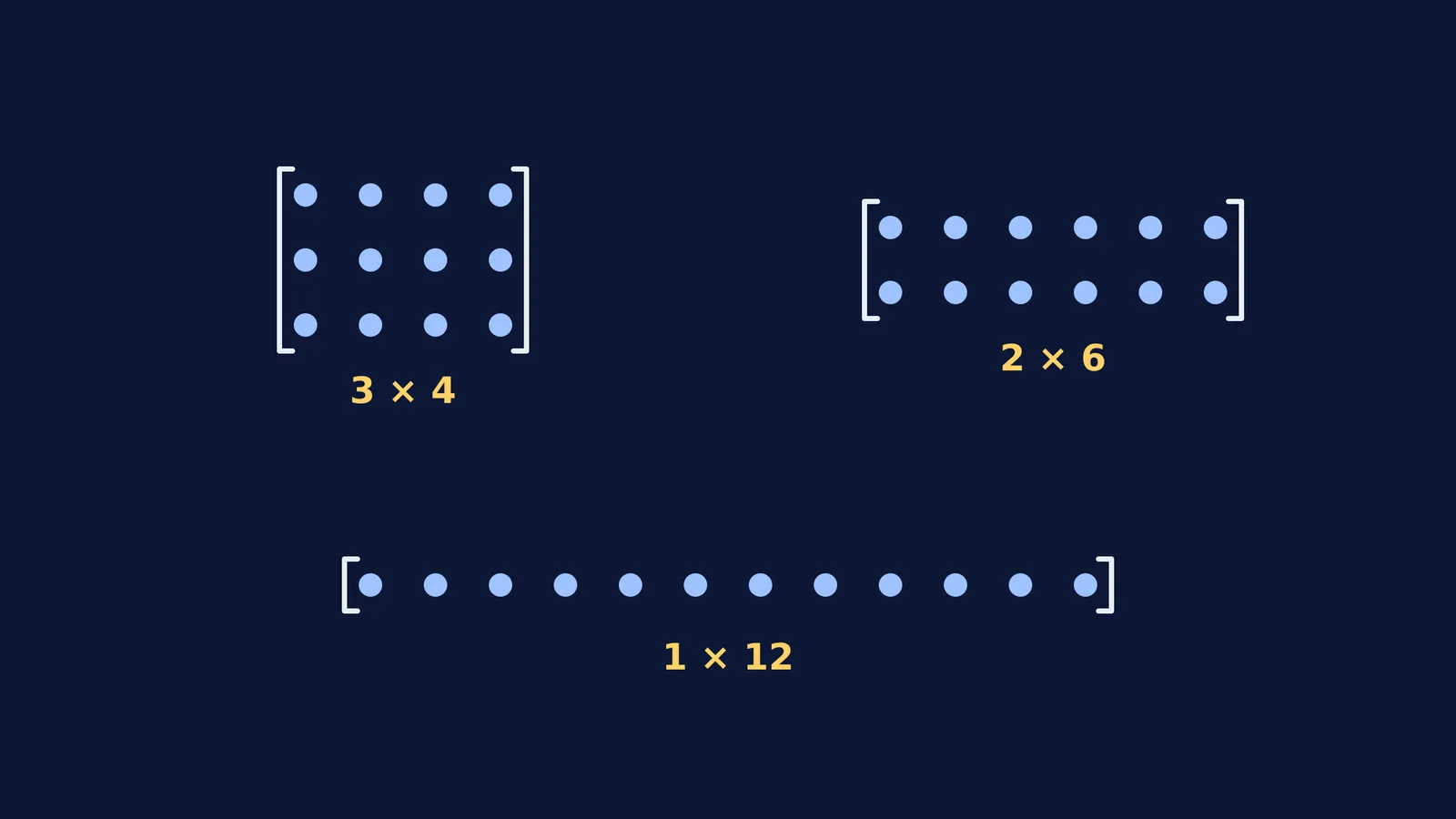
A matrix with 12 elements has six possible orders: 1 × 12, 12 × 1, 2 × 6, 6 × 2, 3 × 4, and 4 × 3. You can find the possible orders for any matrix by listing the factor pairs of its total number of elements.
A matrix is an array of numbers set out in rows and columns. They are used everywhere in mathematics and physics, from solving systems of linear equations to transforming coordinates in 3D space. When you need to build a matrix, construct a table of data, or solve problems that rely on its dimensions, you always start with its order.
The order of a matrix is written as m × n, where m is the number of rows and n is the number of columns. Because every row has the same number of elements, the size of a matrix is defined by the number of rows and columns it contains). This means a matrix with m rows and n columns has m × n elements.
If you know a matrix has exactly 12 elements, its possible orders are simply the pairs of positive integers that multiply together to make 12.
What are the possible orders of a matrix with 12 elements?
To find all the possible dimensions, you need to identify every way to divide the elements into equal rows and columns. The number 12 is highly composite because it has 6 divisors): 1, 2, 3, 4, 6 and 12. When you pair these factors up so their product is exactly 12, you get the possible dimensions for the matrix.
The six possible orders are:
1 × 12 (1 row, 12 columns)
12 × 1 (12 rows, 1 column)
2 × 6 (2 rows, 6 columns)
6 × 2 (6 rows, 2 columns)
3 × 4 (3 rows, 4 columns)
4 × 3 (4 rows, 3 columns)
While a 3 × 4 matrix and a 4 × 3 matrix both hold 12 elements, they are entirely different mathematical objects. A 3 × 4 matrix is a wide rectangle, while a 4 × 3 matrix is tall. This shape difference dictates how they behave when you add or multiply them with other matrices in matrix algebra. You cannot, for example, add a 3 × 4 matrix to a 4 × 3 matrix, because matrix addition requires the orders to match exactly.
How do you find the possible orders for any number of elements?
You can use the exact same logic to find the dimensions for any number of elements. Whether you are dealing with a small grid or a massive array of data, the process is always a matter of finding factor pairs. If an exam question asks for the possible orders of a matrix with 24 elements, follow these steps:
List all the factors of the number. For 24, the factors are 1, 2, 3, 4, 6, 8, 12, and 24.
Find the pairs that multiply to that number. The pairs for 24 are (1, 24), (2, 12), (3, 8), and (4, 6).
Write out both orientations for each pair. Reversing the numbers creates a new order, so you get eight possible orders in total: 1 × 24, 24 × 1, 2 × 12, 12 × 2, 3 × 8, 8 × 3, 4 × 6, and 6 × 4.
If the number of elements is a perfect square, one of those pairs will form a square matrix. For example, a matrix with 16 elements can be 4 × 4. Because reversing 4 × 4 still gives 4 × 4, it only counts as one order.
If you struggle to break down larger numbers, or if you frequently get stuck on algebra problems, Fermi's AI tutor works out what you already know and builds a plan for the session, writing on a board and checking your understanding as it goes. To review every concept in mathematics, explore the Fermi Concept Library, each with its own lesson and its place in the map.
What if the number of elements is prime?
Sometimes you will be asked for the possible orders of a matrix with a prime number of elements, such as 5, 7 or 13. This is a common trick question designed to test your understanding of factors.
A prime number is a natural number greater than 1 that is not a product of two smaller natural numbers. This means a prime number has exactly two factors: 1 and itself.
If a matrix has 13 elements, its only possible orders are:
1 × 13 (a row matrix)
13 × 1 (a column matrix)
A prime number of elements forces the matrix into a single continuous line. It is impossible to arrange 13 elements into a rectangular grid with more than one row and more than one column without leaving empty spaces.


