

On this page
When dividing a line segment, coordinate geometry requires memorizing three separate formulas for x, y, and z. In vector algebra, space collapses into a single relationship. By treating points as position vectors relative to an origin, the section formula locates dividing points through simple vector addition.
Whether finding a triangle's centroid or extending the section formula in 3D coordinate geometry, this formula unifies internal division, external division, and midpoints into one clean method.
What is the section formula in vector form?
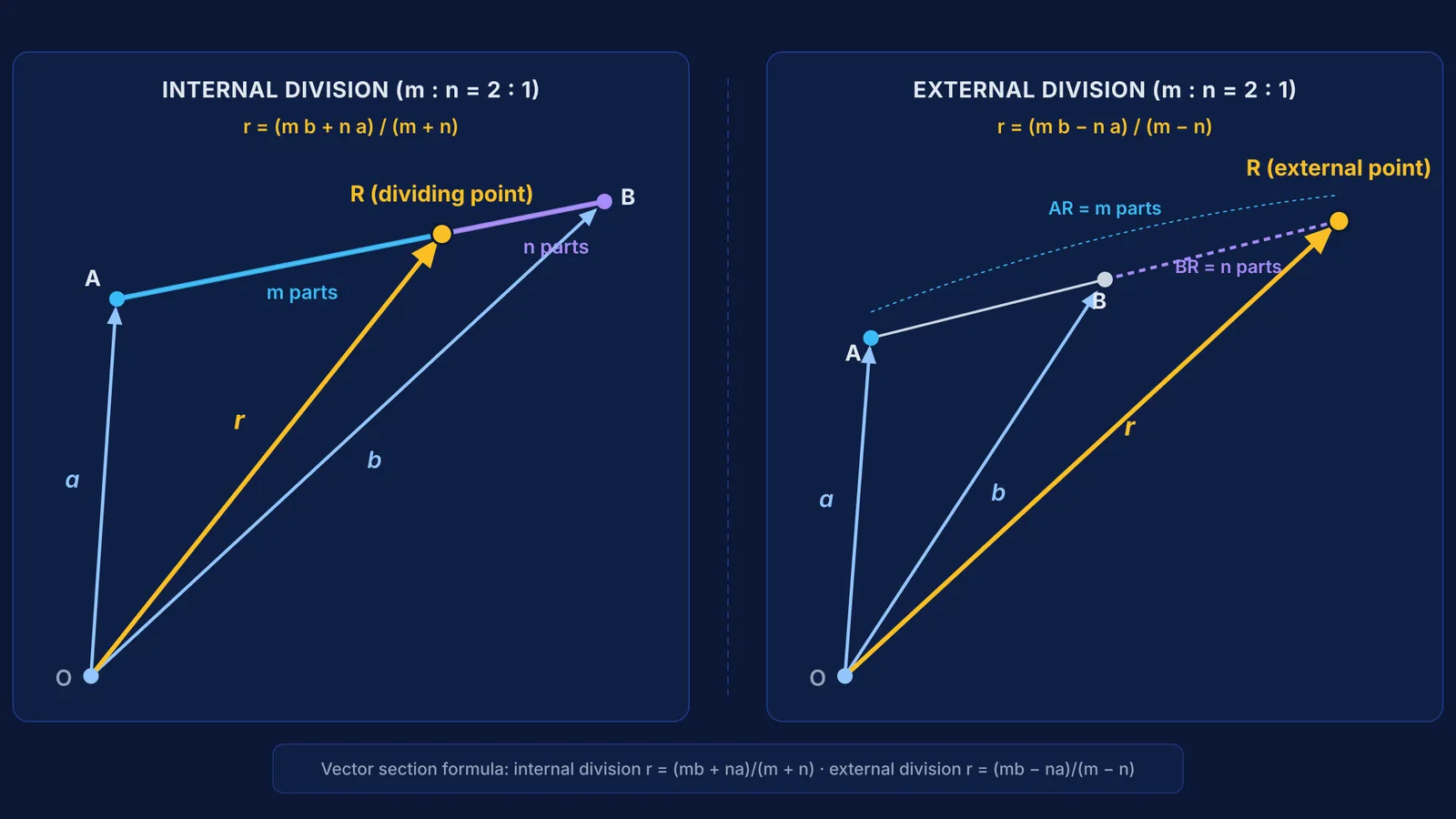
Let points A and B have position vectors a and b relative to origin O. If point R divides the directed line segment AB in the ratio m : n, its position vector r depends on whether R lies between the endpoints or on the line extended beyond them.
For internal division, where R lies between A and B such that the segment lengths satisfy AR / RB = m / n: r = (m·b + n·a) / (m + n)
For external division, where R lies on the extended line such that AR / BR = m / n: r = (m·b − n·a) / (m − n)
In the CBSE Senior Secondary Curriculum, Unit IV (Vectors and Three-Dimensional Geometry) carries 14 marks out of 80 in the Class 12 board examination. Both internal and external forms are core results tested in school boards and national entrance exams.
How do you derive internal division with vectors?
The vector section formula arises directly from vector addition. The displacement from A to B is AB = b − a.
Because point R divides segment AB in the ratio m : n, the segment contains m + n total parts. The vector displacement AR represents m / (m + n) of AB: AR = (m / (m + n)) · (b − a)
By the triangle law of vector addition, the position vector r is: r = OA + AR = a + (m / (m + n)) · (b − a) r = [(m + n)·a + m·b − m·a] / (m + n) = (m·b + n·a) / (m + n)
In a study on vector misconceptions published in *Physical Review Special Topics - Physics Education Research*, Barniol and Zavala (2014) found that students often manipulate vector symbols mechanically without grasping the underlying spatial displacements. Deriving the formula from displacements prevents rote memorization, much like analyzing motion in a plane from position vectors.
To explore how displacement rules connect across vectors and geometry, the Fermi Concept Library covers every concept in physics, chemistry, biology, mathematics and computing, each with its own lesson and its place in the map.
How does external division change the vector formula?
In external division, point R lies outside segment AB along the line through A and B, maintaining the distance ratio AR / BR = m / n. Because the displacements AR and BR share the same line: n · (r − a) = m · (r − b)
Expanding and rearranging terms gives: n·r − n·a = m·r − m·b (m − n)·r = m·b − n·a r = (m·b − n·a) / (m − n)
The external division formula is identical to the internal division formula with n replaced by −n. If m > n, point R lies beyond B; if m < n, R lies beyond A. This relation also tests collinear points with vectors, since three points are collinear if one divides the other two in a real ratio.
Why is the midpoint formula a foundational tool?
When point R divides segment AB equally (ratio 1 : 1), setting m = 1 and n = 1 yields the midpoint formula: r = (a + b) / 2
This relation speeds up standard geometric proofs:
Centroid of a triangle: Midpoint of BC is d = (b + c) / 2. Centroid G divides median AD in ratio 2 : 1, giving g = (2·d + 1·a) / 3 = (a + b + c) / 3.
Diagonals of a parallelogram: Diagonals bisect each other, so their midpoints match: (a + c) / 2 = (b + d) / 2, proving a + c = b + d.
As detailed in the NCERT Class 12 Mathematics textbook, vector midpoints transform tedious geometric deductions into two-line vector sums.
How do you solve a vector ratio problem step by step?
When approaching questions in the NTA JEE Main syllabus, use this four-step routine:
Identify position vectors: Label the initial vector a and terminal vector b.
Check division type: Use m + n in the denominator for internal division, and m − n for external division.
Cross-multiply: Multiply scalar m by vector b, and scalar n by vector a.
Simplify components: Combine i, j, and k terms to state the final vector.
Worked example: Let point A have position vector a = 2i + 3j − 4k and point B have b = −i + 2j + k. Find point R dividing AB internally in ratio 2 : 3, and R' dividing AB externally in ratio 3 : 1.
Internal division (m = 2, n = 3): r = [2(−i + 2j + k) + 3(2i + 3j − 4k)] / 5 = (4/5)i + (13/5)j − 2k
External division (m = 3, n = 1): r' = [3(−i + 2j + k) − (2i + 3j − 4k)] / 2 = (−5/2)i + (3/2)j + (7/2)k
For structured numerical practice, the Fermi Problem Library provides worked problems with a step-by-step solver that explains the reasoning rather than printing an answer.


