

On this page
How do you know if a point is inside or outside a circle?
To determine whether a point P(x₁, y₁) lies inside, on, or outside a circle, substitute its coordinates into the circle's algebraic equation. In standard curricula such as NCERT Class 11 Mathematics, a circle is expressed in general form as S ≡ x² + y² + 2gx + 2fy + c = 0, with centre (−g, −f) and radius r = √(g² + f² − c). Substituting (x₁, y₁) yields the scalar value S₁:
S₁ = x₁² + y₁² + 2gx₁ + 2fy₁ + c
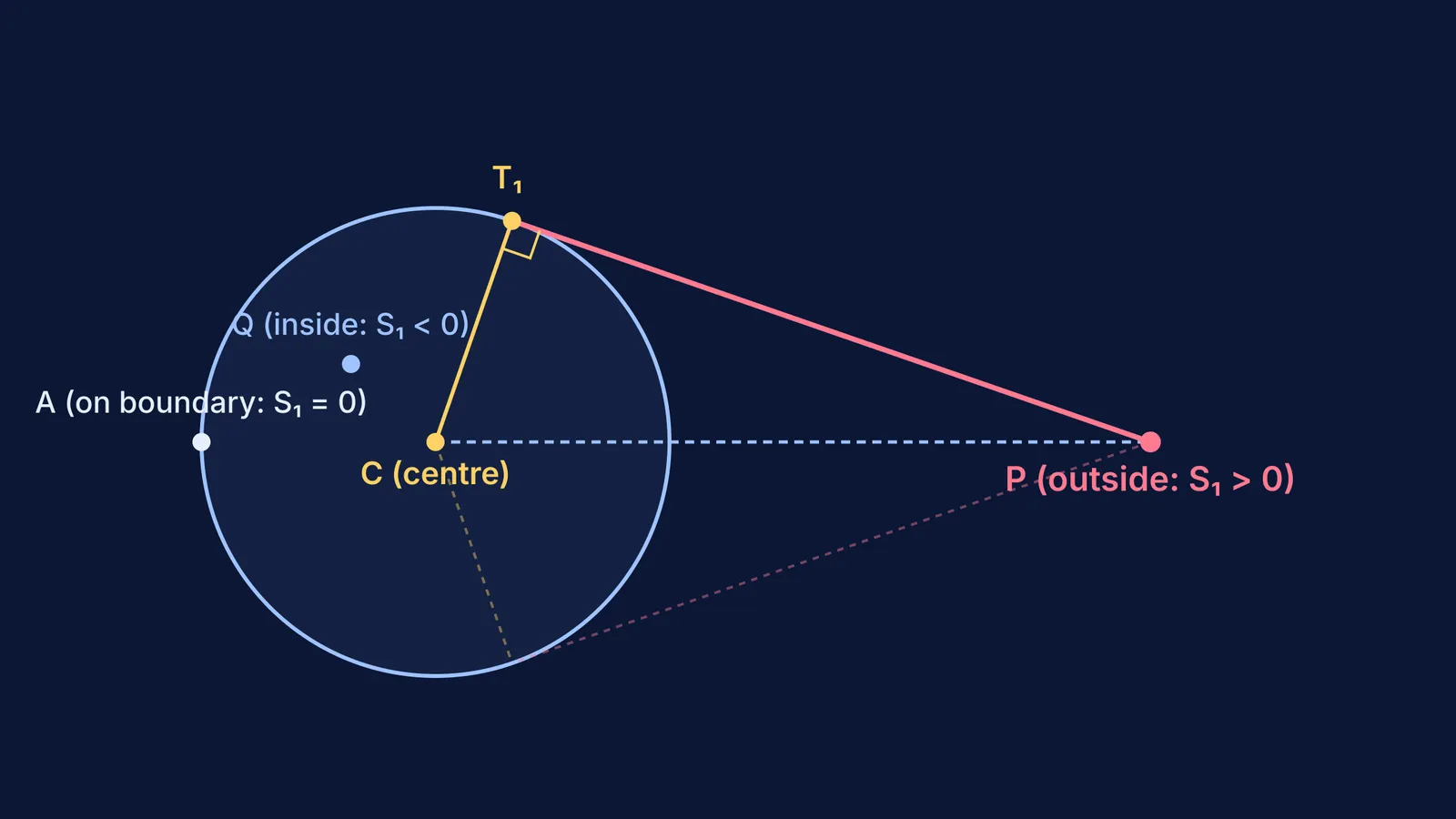
The sign of S₁ classifies the position of P:
If S₁ > 0, the point lies outside the circle.
If S₁ = 0, the point lies on the circumference.
If S₁ < 0, the point lies inside the circle.
This test measures the difference between two geometric distances. By the distance formula, the squared distance from P to the centre C(−g, −f) is d² = (x₁ + g)² + (y₁ + f)². Expanding this expression and subtracting the squared radius r² = g² + f² − c yields d² − r² = x₁² + y₁² + 2gx₁ + 2fy₁ + c = S₁. For an outside point, d > r, so d² − r² > 0. For points on the circle, d = r and S₁ = 0; for points inside, d < r and S₁ < 0. For setting up circle equations from geometry, see our guide to finding a circle through three points.
What is the power of a point with respect to a circle?
The quantity S₁ is a classical geometric invariant called the power of a point. Swiss geometer Jakob Steiner formalised this concept in 1826 in his paper "Einige geometrische Betrachtungen" in *Crelle's Journal*. Steiner defined the power of point P with respect to a circle of radius r and centre C as d² − r², where d is the distance |CP|.
Steiner's definition unified two classical results from Book III of Euclid's *Elements*. Proposition 35 showed that when two chords intersect inside a circle, the product of their segments is constant. Proposition 36 proved the tangent-secant theorem: from an outside point P, the product of secant segments PA × PB equals the squared tangent length. Steiner demonstrated that any line through P meeting the circle at A and B satisfies PA × PB = d² − r² = S₁. Inside the circle, directed segments have opposite signs, yielding a negative power; outside, they share the same sign, yielding a positive value. You can review earlier proofs in our guide to tangent theorems for circles.
Why is the tangent length equal to √S₁?
From an outside point P, two real tangent segments touch the circle at points T₁ and T₂. Because a radius is perpendicular to the tangent at the point of contact, triangle CPT₁ is right-angled at T₁.
By the Pythagorean theorem: |PT₁|² + |CT₁|² = |CP|²
Because |CT₁| = r and |CP| = d: |PT₁|² = d² − r²
Because d² − r² = S₁, the geometric length of the tangent is: Length of tangent = √S₁ = √(x₁² + y₁² + 2gx₁ + 2fy₁ + c)
If P lies on the circle, S₁ = 0 and the tangent length is 0. If P lies inside, S₁ < 0, meaning √S₁ is imaginary because no real tangents exist. To see how tangents relate to the chord joining both contact points, see our overview of tangents, chords, and families of circles.
Worked example: checking position and tangent length step by step
Consider the circle 2x² + 2y² − 8x + 12y − 10 = 0 and the point P(5, 1).
Normalise the equation:
Divide throughout by 2 so the quadratic coefficients equal 1: x² + y² − 4x + 6y − 5 = 0 Here, g = −2, f = 3, and c = −5. The centre is (2, −3), and r = √(4 + 9 − (−5)) = √18.
Calculate S₁ at P(5, 1):
Substitute x₁ = 5 and y₁ = 1: S₁ = (5)² + (1)² − 4(5) + 6(1) − 5 = 25 + 1 − 20 + 6 − 5 = 7
Interpret the sign:
Because S₁ = 7 > 0, the point P(5, 1) lies strictly outside the circle.
Find the tangent length:
The length of the tangent drawn from P is L = √S₁ = √7 ≈ 2.65 units.
Verify with centre distance:
The distance from P(5, 1) to C(2, −3) gives d² = (5 − 2)² + (1 − (−3))² = 9 + 16 = 25. Then d² − r² = 25 − 18 = 7, confirming S₁ = 7.
If you want to practice identifying positions of points, calculating chord lengths, and setting up tangents, the Fermi Problem Library provides worked problems with a step-by-step solver that explains the reasoning rather than printing an answer.
What common traps catch students in coordinate geometry?
Exam questions often test whether students apply formulas blindly or understand the geometry behind them:
Skipping normalisation: Substituting into 2x² + 2y² − 8x + 12y − 10 without dividing by 2 yields 14 instead of 7. The sign remains positive, but the tangent length becomes √14 rather than the correct √7.
Attempting tangents from inside: Evaluating S₁ for an interior point yields a negative number. Writing √S₁ is a conceptual mistake; no real tangents can be drawn from within the circle.
Confusing S₁ with T: S₁ is a scalar value produced by evaluating S at a point. In contrast, T ≡ xx₁ + yy₁ + g(x + x₁) + f(y + y₁) + c is a linear expression in x and y. When set to zero, T = 0 represents a tangent line for a boundary point, or the chord of contact for an outside point.
When you encounter complex coordinate transformations or family-of-circles questions, the Fermi Concept Library maps every concept across mathematics to help you see how definitions connect.


