

On this page
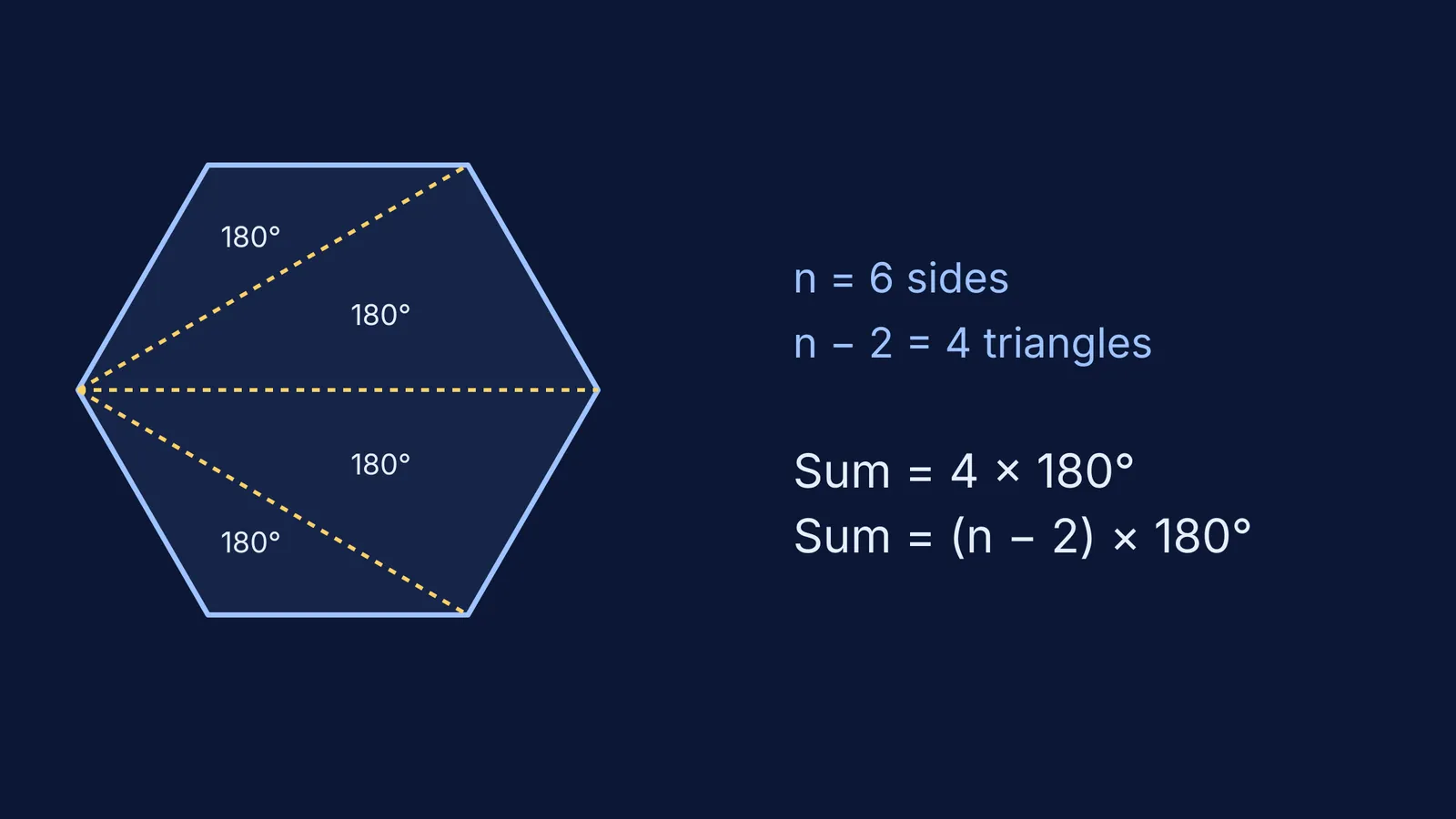
In short To find the number of sides of a polygon whose interior angles are in an arithmetic progression, equate the geometric sum formula to the progression's sum. The sum of the internal angles of an n-sided polygon is exactly (n − 2) × 180° (Wikipedia). By setting this equal to the arithmetic progression sum, Sn = (n/2)[2a + (n − 1)d] (Wikipedia), you can solve the resulting quadratic equation to find the exact number of sides.
How do you find the number of sides when the interior angles of a polygon are in AP?
This classic exam problem tests your ability to combine foundational geometry with algebraic sequences. The solution requires equating two different mathematical ways of calculating the identical sum.
First, consider the geometric property. The sum of the internal angles of any simple polygon with n sides is (n − 2) × 180° (Wikipedia). This comes from the fact that any n-sided polygon can be divided into exactly n − 2 triangles, and each triangle contains 180°.
Next, apply the rules of an arithmetic progression (AP). An arithmetic progression is a sequence of numbers where the difference between consecutive terms is constant. The sum of the first n terms of an AP is Sn = (n/2)[2a + (n − 1)d] (Wikipedia). In this context:
n represents the total number of sides, which is also the number of interior angles.
a is the smallest interior angle in the shape.
d is the common difference between each successive angle.
By equating the two expressions, you get the core identity: (n − 2) × 180 = (n/2)[2a + (n − 1)d]
This creates a quadratic equation in terms of n. Just as when you solve quadratic word problems, solving this will often yield two mathematical roots. However, finding the roots is only half the battle. You must then test whether each root makes physical sense.
What happens if an angle in a convex polygon is 180° or more?
A simple polygon is strictly classified as convex if every internal angle is less than 180° (Wikipedia). This is a foundational rule in geometry because an angle of exactly 180° would mean three points lie on a perfectly straight line, failing to form a true vertex. An angle strictly greater than 180° would result in a concave ("caved in") polygon. Standard arithmetic progression angle problems silently assume the polygon is convex.
When you solve your quadratic equation for n, you might find two positive integer values. You must test both values by finding the largest angle in the resulting polygon. The largest angle is simply the n-th term of the arithmetic progression, calculated as a + (n − 1)d.
If checking a value of n yields a largest angle that is ≥ 180°, you must reject that value. If managing these limits or setting up the quadratic equation trips you up, the Fermi Problem Library features a step-by-step solver that explains the reasoning rather than just printing an answer.
How do you solve the polygon and AP equation step by step?
Consider a typical exam problem: The interior angles of a polygon are in arithmetic progression. The smallest angle is 120°, and the common difference is 5°. Find the number of sides of the polygon.
Step 1: Set up the equation Use the two sum formulas with the known values a = 120 and d = 5: (n − 2) × 180 = (n/2)[2(120) + (n − 1)5]
Step 2: Simplify and form the quadratic Multiply both sides of the equation by 2 to eliminate the fraction: 360(n − 2) = n[240 + 5n − 5] 360n − 720 = 235n + 5n²
Rearrange all the terms to one side to form a standard quadratic equation: 5n² − 125n + 720 = 0
Divide the entire equation by 5 to make the factoring process simpler: n² − 25n + 144 = 0
Step 3: Solve for n Factor the quadratic equation by looking for two numbers that multiply to 144 and add to -25. Those numbers are -9 and -16: (n − 9)(n − 16) = 0 This gives two possible mathematical answers: n = 9 and n = 16. Just as when dealing with three numbers in AP, it is absolutely crucial to test your conditions before writing your final answer.
Step 4: Check the geometric validity Test the largest interior angle for both values using the n-th term formula, a + (n − 1)d.
For n = 9: Largest angle = 120 + (9 − 1)5 = 120 + 40 = 160°. Since 160° is less than 180°, this forms a valid convex polygon.
For n = 16: Largest angle = 120 + (16 − 1)5 = 120 + 75 = 195°. Since 195° is greater than 180°, a 16-sided convex polygon with these specific angles cannot physically exist.
The final answer is that the polygon has exactly 9 sides. Whenever you are navigating these physical constraints and geometric rules, the Fermi Concept Library explains every concept in mathematics to help you build a solid foundation.


