

On this page
When you balance chemical equations or predict what products form in a reaction, you often encounter groups of atoms that stick together. These are polyatomic ions. Unlike simple ions formed from a single atom, these are small molecules that carry an overall charge.
What are polyatomic ions?
A polyatomic ion is a group of atoms carrying a net charge that acts as a single unit in chemical reactions (NCERT). For instance, in calcium carbonate (CaCO₃), the calcium ion (Ca²⁺) is a monatomic ion, but the carbonate ion (CO₃²⁻) is polyatomic. The carbon and oxygen atoms are covalently bonded to each other, but the entire group has two extra electrons compared to the neutral atoms.
These ions stay intact through most typical double-displacement reactions. If you mix sodium sulphate with barium chloride, the sulphate unit (SO₄²⁻) transfers whole to form barium sulphate. Understanding these ions is crucial when you draw electron dot structures of covalent molecules or calculate the average bond order from resonance for the delocalised electrons across the oxygen atoms.
How do the -ate and -ite suffixes work?
You might notice that many polyatomic ions come in pairs that look similar but end differently. The suffix tells you about the relative number of oxygen atoms in the ion:
-ate is used for the ion with the greater number of oxygen atoms.
-ite is used for the ion with one fewer oxygen atom than the -ate form.
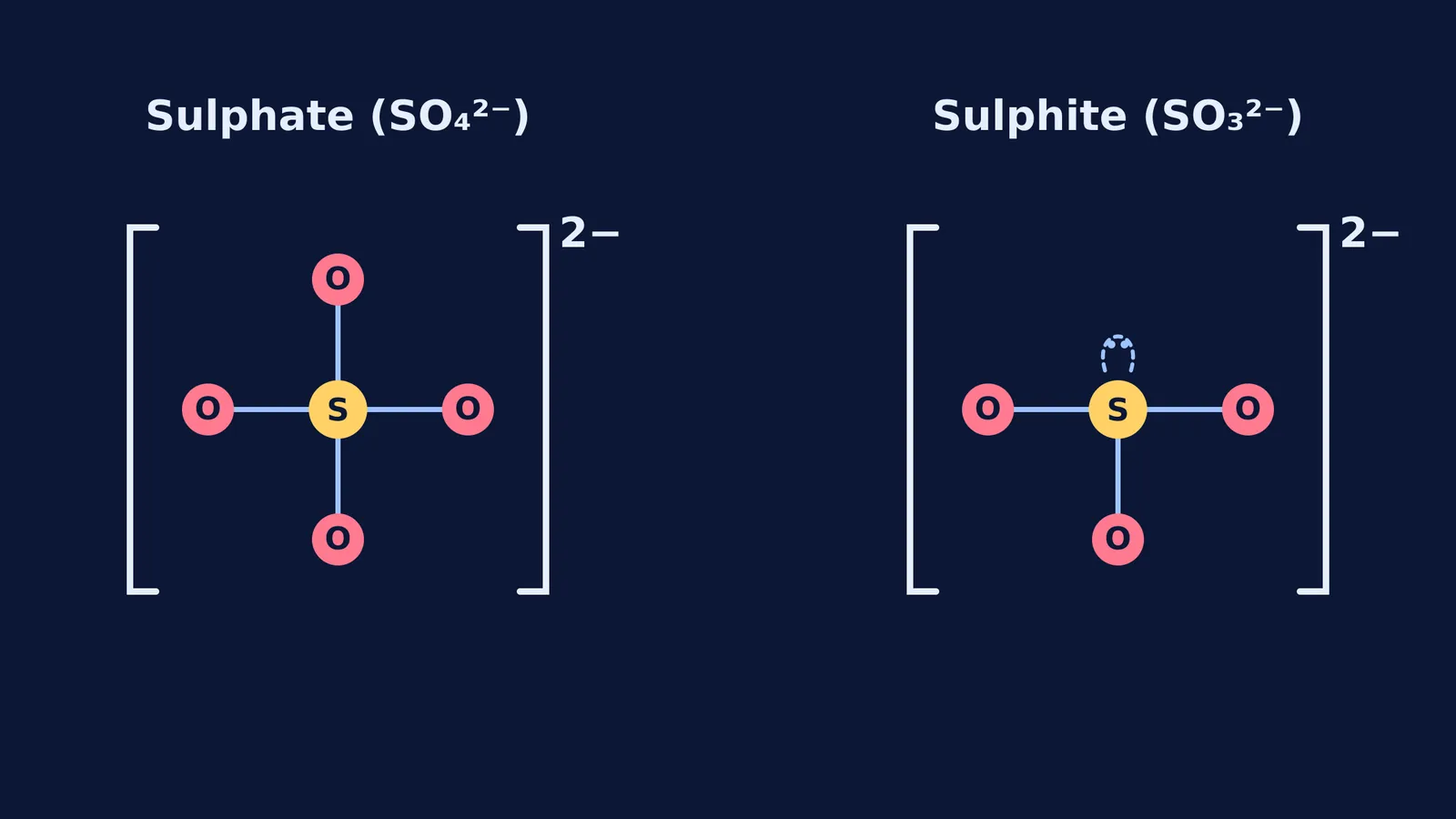
Importantly, these suffixes indicate relative amounts of oxygen, not an absolute number (IUPAC). Nitrate (NO₃⁻) has three oxygens, but sulphate (SO₄²⁻) has four. Both end in "-ate" because they represent the common higher-oxygen state for their central atom. The charge remains exactly the same across a pair because you are conceptually removing a neutral oxygen atom, not an ion. Sulphate and sulphite are both 2-.
When you are unsure how to connect these facts, Fermi's AI tutor can help you map out the patterns, checking your understanding as it goes rather than just giving you the answers.
What about per- and hypo- prefixes?
For elements like chlorine that form more than two oxygen-containing ions, the "-ate" and "-ite" system expands using prefixes:
per- means one more oxygen than the "-ate" ion. Perchlorate is ClO₄⁻.
hypo- means one fewer oxygen than the "-ite" ion. Hypochlorite is ClO⁻.
This gives a complete series for chlorine: perchlorate (ClO₄⁻), chlorate (ClO₃⁻), chlorite (ClO₂⁻), and hypochlorite (ClO⁻). The 1- charge never changes.
What are the common polyatomic ions?
Here are the standard polyatomic ions you need to know, grouped by their charge.
Ions with a 1+ charge
Ammonium: NH₄⁺
Ions with a 1- charge
Hydroxide: OH⁻
Nitrate: NO₃⁻
Nitrite: NO₂⁻
Bicarbonate (Hydrogen carbonate): HCO₃⁻
Acetate: CH₃COO⁻
Cyanide: CN⁻
Chlorate: ClO₃⁻
Permanganate: MnO₄⁻
Ions with a 2- charge
Carbonate: CO₃²⁻
Sulphate: SO₄²⁻
Sulphite: SO₃²⁻
Chromate: CrO₄²⁻
Dichromate: Cr₂O₇²⁻
Ions with a 3- charge
Phosphate: PO₄³⁻
Phosphite: PO₃³⁻
How can you memorize the polyatomic ions list?
Instead of rote memorization, group the ions logically. If you treat them as independent facts, they are easy to mix up under exam pressure.
Start with the "-ates": Memorize the formulas and charges of the four core "-ate" ions: nitrate (NO₃⁻), carbonate (CO₃²⁻), sulphate (SO₄²⁻), and phosphate (PO₄³⁻). Notice the trend: nitrogen (group 15) and carbon (group 14) have three oxygens; sulphur (group 16) and phosphorus (group 15) have four oxygens.
Apply the "-ite" rule: Whenever you need an "-ite" ion (like nitrite or sulphite), simply subtract one oxygen atom from the "-ate" formula and keep the charge exactly the same.
Use the hydrogen rule: If a name starts with "hydrogen" or "bi-" (such as bicarbonate or bisulphate), add one H atom to the front and reduce the magnitude of the negative charge by one.
If you are calculating the oxidation number from structure for these ions, remembering the base charges is the first step. You can explore every concept in chemistry, biology and physics in the Concept Library, which organizes these rules into connected ideas so you can see the whole picture.


