

On this page
What happens when a pollen grain falls on a stigma?
The process begins with pollination, when pollen grains are transferred from the anther to the sticky, terminal part of the pistil. Once a compatible pollen grain lands, the stigma secretes a sugary substance. The pollen grain absorbs this nutrient-rich moisture, which swells the grain and triggers germination.
This chemical signal prompts the pollen grain to push out a tiny extension called a pollen tube. The tube grows out of a small pore in the pollen's outer wall. Like phototropism and other tropic movements in Class 10, this is an example of a chemical response, specifically known as positive chemotropism. The chemical gradient set up by the ovule directs the tube downwards.
The tube acts as a biological tunnel to safely transport the male gametes through the solid tissues of the carpel. Pollen tubes are among the fastest-growing cells in the plant kingdom because they must reach the egg cell before the flower wilts. These tubes can grow surprisingly fast: in maize, where the style (the corn silk) is exceptionally long, the pollen tube can travel at speeds of up to 10 millimetres per hour (Journal of Experimental Botany).
How do you draw the germination of pollen on stigma diagram?
When drawing the longitudinal section of a pistil in a board exam, neatness and technical accuracy matter far more than artistic skill. Following a structured approach ensures you capture all the vital biological details without wasting time. Follow these steps to get the proportions right:
Draw the carpel outline: Start with a flattened, slightly indented oval at the top for the stigma. Continue downwards with a long, narrow neck for the style, and finish with a swollen, bulbous base for the ovary.
Add the ovule: Inside the ovary, draw a distinct oval shape to represent the ovule (the protective sac that holds the egg cell). Ensure there is a small gap at the bottom of the ovule—this represents the micropyle, the entry point for the tube.
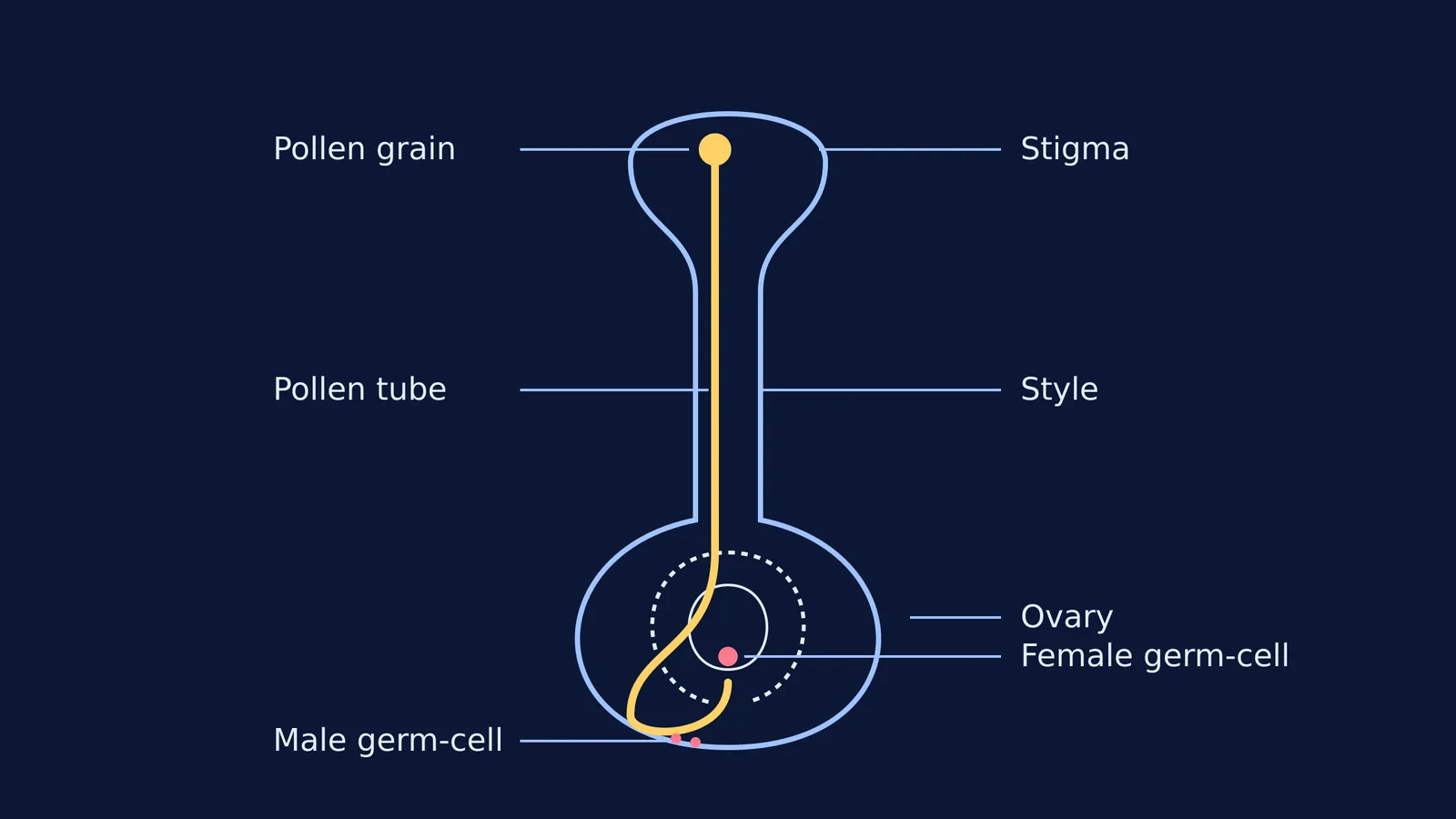
Trace the pollen tube path: Draw a pollen grain on top of the stigma. From it, run a distinct double-line down through the centre of the style. Curve the tube smoothly at the bottom so that it directly enters the ovule through the micropyle opening.
Insert the reproductive cells: Draw two small dots inside the leading tip of the pollen tube to represent the travelling male germ-cells. Draw another distinct dot inside the ovule to represent the female germ-cell (egg).
What are the seven labels for the Class 10 figure?
A diagram is only as good as its labels. For full marks, the official CBSE marking scheme expects you to correctly locate and label seven distinct parts of the pistil and the germinating pollen (NCERT Chapter 7).
Pollen grain: The tiny, protective structure resting on the stigma, containing the male reproductive material.
Stigma: The sticky top surface of the carpel designed to catch and hold compatible pollen.
Pollen tube: The elongated tunnel growing out of the grain, burrowing all the way down the style.
Style: The long, slender stalk connecting the stigma to the ovary below.
Male germ-cell: The two male gametes travelling inside the tip of the pollen tube.
Ovary: The swollen, protective base of the carpel that houses one or more ovules.
Female germ-cell: The egg cell waiting inside the ovule to be fertilised.
If you have concept gaps about plant reproduction or find it difficult to remember how these structures fit together, the Fermi Concept Library includes every concept in biology. It can help you understand the dynamic biological process rather than just memorising a static list of names for an exam.
How does the male germ-cell reach the ovary?
The journey of the male germ-cell is a tightly coordinated event. The pollen tube’s sole job is to safely transport the male gametes through the hostile environment of the carpel. It burrows aggressively through the solid tissues of the style, guided entirely by the chemical signals released from the target ovule.
As the tube grows, the contents of the pollen grain—including the two male germ-cells—move down into the tip of the growing tube. Once the pollen tube reaches the ovary, it navigates toward the micropyle of the ovule. The tip of the tube then bursts, releasing the male germ-cells directly into the embryo sac.
One of these male germ-cells fuses with the female germ-cell to form a zygote. This crucial fusion is called fertilisation. After this step, the newly formed zygote will divide multiple times to form an embryo. This sets the biological stage for megasporogenesis and the embryo sac development taught in more detail in higher classes. Over time, the protective ovule develops a tough coat and gradually turns into a seed, while the surrounding ovary grows rapidly and ripens into a fruit.


