On this page
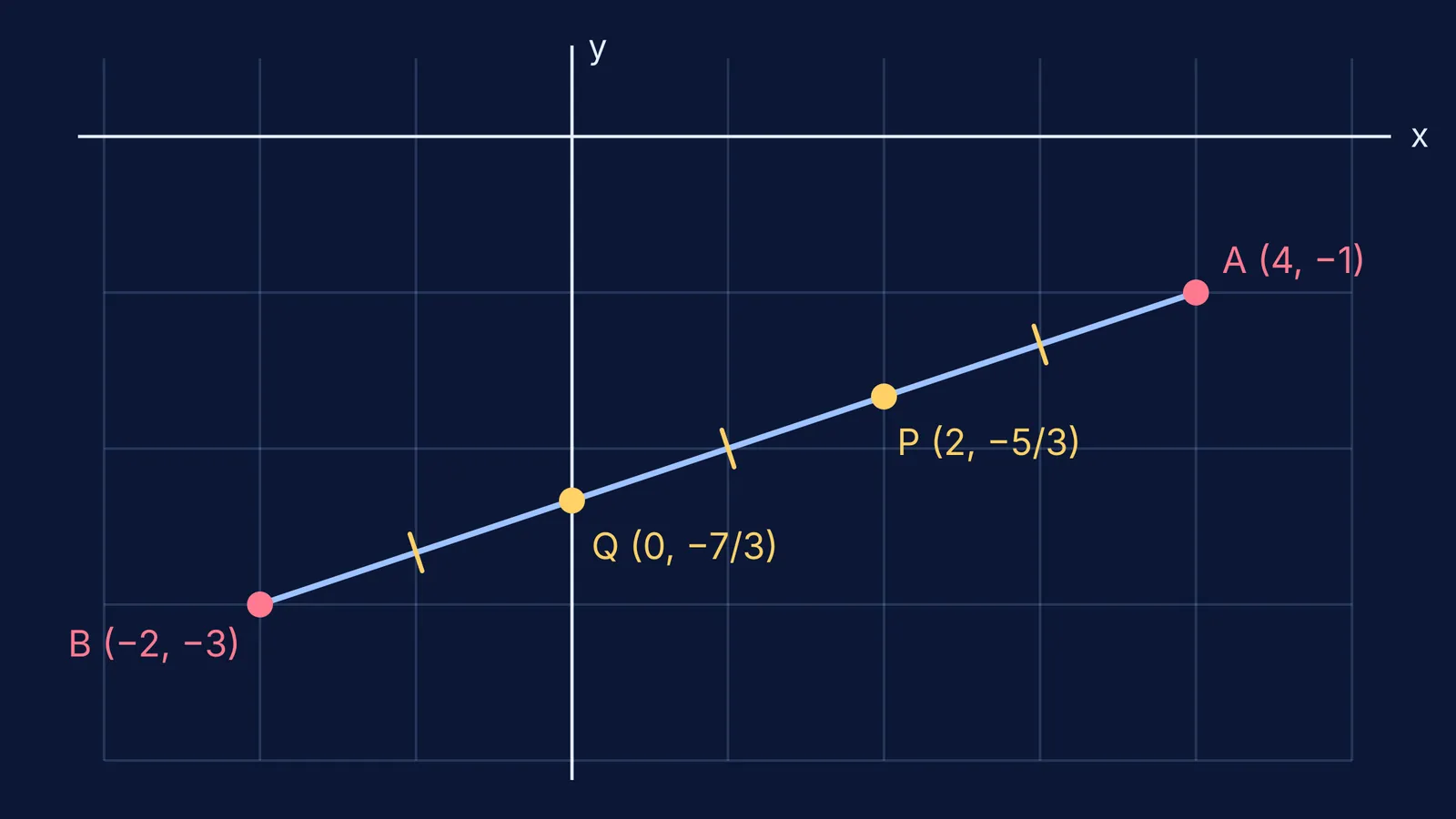
When a textbook asks you to "find the points of trisection", it wants the two points that cut a line segment into three equal pieces. You meet this in NCERT Class 10 Maths, Chapter 7 (Coordinate Geometry): question 2 of Exercise 7.2 asks for the points of trisection of the line segment joining (4, -1) and (-2, -3) (NCERT Exercise 7.2, worked solutions).
What are the points of trisection of a line segment?
Two points P and Q on a segment AB are its points of trisection when AP = PQ = QB. That gives you the two ratios you need:
P is one-third of the way from A, so it divides AB in the ratio 1 : 2.
Q is two-thirds of the way from A, so it divides AB in the ratio 2 : 1.
You find both with the section formula. A point that divides the segment from A(x1, y1) to B(x2, y2) internally in the ratio m : n is ((mx2 + nx1)/(m + n), (my2 + ny1)/(m + n)) (section formula, Wikipedia). Notice the cross-pairing: m multiplies the coordinates of B, the far end, and n multiplies the coordinates of A.
How do you find the points of trisection? A worked example
Take the NCERT question, with A(4, -1) and B(-2, -3).
Find P with m = 1, n = 2. x = (1 × (-2) + 2 × 4)/3 = 6/3 = 2. y = (1 × (-3) + 2 × (-1))/3 = -5/3. So P = (2, -5/3).
Find Q with m = 2, n = 1. x = (2 × (-2) + 1 × 4)/3 = 0/3 = 0. y = (2 × (-3) + 1 × (-1))/3 = -7/3. So Q = (0, -7/3).
These match the textbook answers, (2, -5/3) and (0, -7/3) (worked NCERT solution).
How can you check the points are equally spaced?
Any one of these checks will do:
Step check. Work out one step, (B - A)/3. Here B - A = (-6, -2), so one step is (-2, -2/3). Start at A and keep adding the step: (4, -1), then (2, -5/3), then (0, -7/3), then (-2, -3). You land on P, then Q, then exactly on B. If the last step misses B, something is wrong.
Distance check. AB = √(36 + 4) = √40. Each piece, AP, PQ and QB, is √(4 + 4/9) = √40/3, exactly one-third of AB.
Midpoint check. The midpoint of PQ should equal the midpoint of AB. Both are (1, -2).
In an exam, use the step check: it needs only addition and catches swapped weights and sign slips.
How do you divide a segment into k equal parts?
Trisection is the case k = 3 of a general pattern. To cut AB into k equal parts you need k - 1 points. The i-th point from A divides AB in the ratio i : (k - i), so the section formula gives:
P(i) = ((k - i)A + iB)/k, for i = 1, 2, ..., k - 1.
k = 2 gives the midpoint (A + B)/2, the 1 : 1 case of the section formula (section formula, Wikipedia).
k = 3 gives (2A + B)/3 and (A + 2B)/3, the two points of trisection.
k = 4 gives the ratios 1 : 3, 1 : 1 and 3 : 1, so the points are (3A + B)/4, (A + B)/2 and (A + 3B)/4.
The weights always add up to k and shift from A to B one at a time. The same weighting explains why the centroid of a triangle divides each median in the ratio 2 : 1, and its coordinates are the average of the three vertices (section formula, Wikipedia).
Which mistakes cost marks on trisection questions?
Run through this list before you move on:
Swapped weights. In m : n, m goes with B. Writing (mx1 + nx2) quietly gives you the other point of trisection, so your P and Q come out reversed.
Only one point. "Points of trisection" means two, unless the question asks only for the one nearer A or B.
Sign slips. Bracket every negative coordinate: write 1 × (-2), not 1 × -2.
Reverse questions. If a question says a given point trisects AB nearer to A, it divides AB in 1 : 2. Write the section formula with that ratio and solve for the unknown.
If a step keeps going wrong, the Fermi Problem Library has worked problems with a step-by-step solver that explains the reasoning rather than printing an answer, so you can see the exact line where your working went off track. If the section formula itself feels shaky, the Fermi Concept Library gives each concept in mathematics its own lesson and its place in the map.