

On this page
Finding a point on the x-axis that is exactly halfway in distance between two given points is one of the most common questions in high school coordinate geometry. It tests your grip on the distance formula and your ability to solve a quadratic-looking equation that suddenly simplifies.
According to the CBSE Curriculum for 2024–25, the Coordinate Geometry unit is allocated 6 marks in the Class X board examination. Mastering this problem type ensures you are ready for core applications of the distance and section formulas.
What is the point on the x-axis equidistant from two points?
The setup relies on one simple fact: if a point lies anywhere on the x-axis, its y-coordinate is exactly zero. We can write its coordinates as P(x, 0).
You are given two other fixed points, let's call them A and B. The word "equidistant" means the straight-line distance from P to A is exactly the same as the distance from P to B. In mathematical terms, PA = PB.
How to find the equidistant point step by step
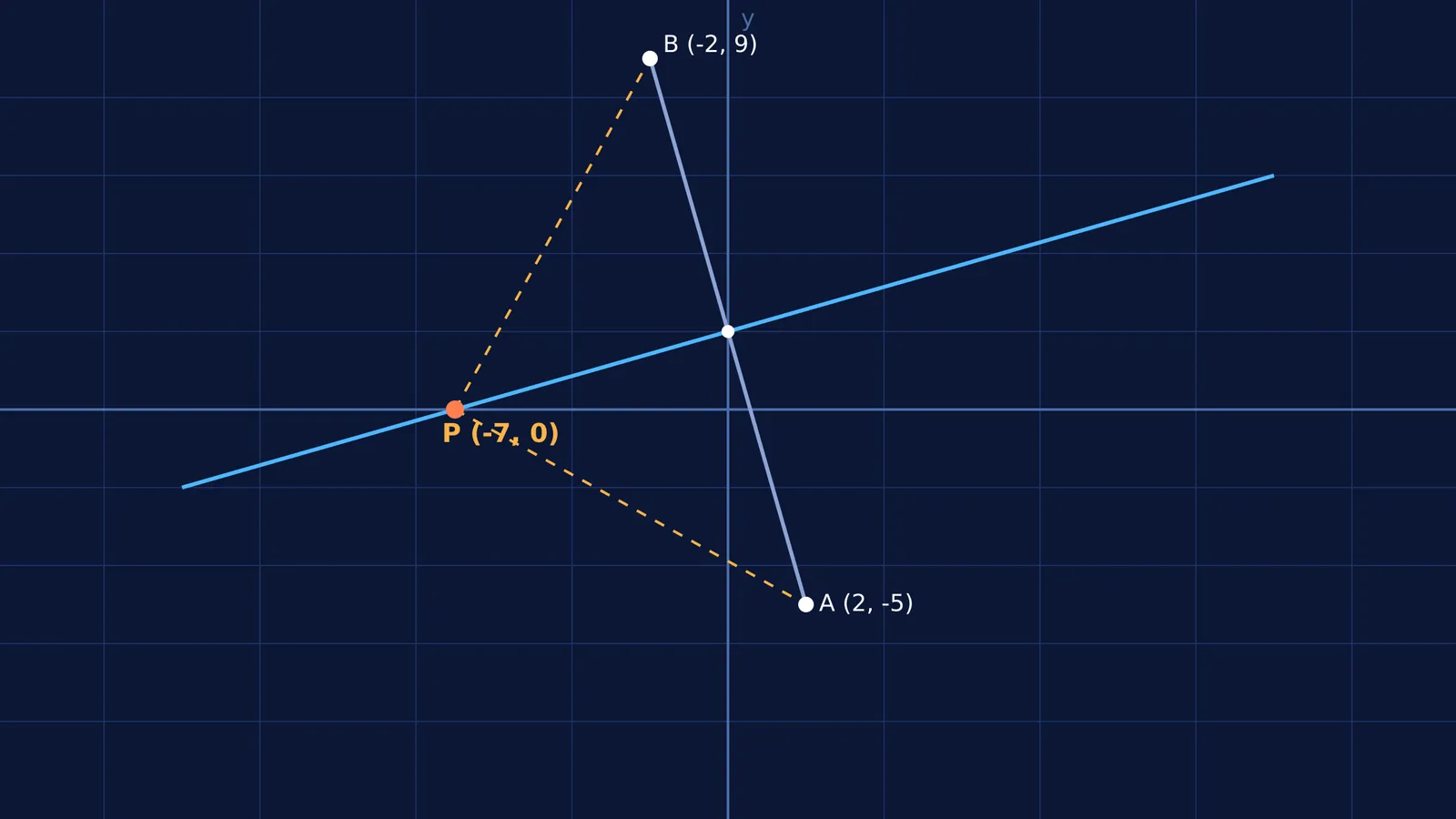
Let's work through a standard exam problem to see how the algebra unfolds: Find the point on the x-axis which is equidistant from A(2, -5) and B(-2, 9).
Set up the coordinates: Let the required point be P(x, 0).
Apply the distance formula: The distance between (x₁, y₁) and (x₂, y₂) is √(x₂ − x₁)² + (y₂ − y₁)².
For PA, the distance is √((x − 2)² + (0 − (-5))²) = √((x − 2)² + 25). For PB, the distance is √((x − (-2))² + (0 − 9)²) = √((x + 2)² + 81).
Equate and square: Since PA = PB, we can square both sides to remove the square roots entirely: PA² = PB².
(x − 2)² + 25 = (x + 2)² + 81
Expand the brackets: Use the standard algebraic identities (a − b)² = a² − 2ab + b² and (a + b)² = a² + 2ab + b².
x² − 4x + 4 + 25 = x² + 4x + 4 + 81
Cancel and solve: Notice how the x² term appears identically on both sides. It cancels out completely, leaving a basic linear equation.
-4x + 29 = 4x + 85 -8x = 56 x = -7
The point on the x-axis is therefore (-7, 0).
Why do the x² terms always cancel?
If you are worried that you might end up with a difficult quadratic equation to factorise, the geometry of the situation guarantees that you won't.
When you set the distance from P to A equal to the distance from P to B, you are asking for the set of all points that are equidistant from A and B. In geometry, this set of points forms the perpendicular bisector of the line segment joining A and B.
Because a perpendicular bisector is a straight line, its algebraic equation must be linear—it cannot contain an x² or y² term. When you write PA² = PB², you are effectively deriving the equation of this straight line and finding where it crosses the x-axis. The squared terms will always cancel out gracefully.
If you get stuck on the algebraic expansion, the Fermi Problem Library has worked problems with a step-by-step solver that explains the reasoning rather than printing an answer. It breaks down the algebra line by line so you can see where terms cancel out and where a sign error might creep in. If you have gaps in your understanding of the underlying theory, you can explore the Fermi Concept Library to review the geometry.
A checklist for distance formula problems
To avoid the most common traps when solving for equidistant points, follow this quick checklist during your exam:
Define your point correctly: If the question says x-axis, write P(x, 0). If it says y-axis, write P(0, y). Mixing these up is an immediate loss of marks.
Watch the negative signs: When substituting negative coordinates into your differences, use brackets. For example, subtracting -5 becomes (0 − (-5))², which safely simplifies to (+5)².
Square both sides early: Writing PA² = PB² straight after the substitution saves you from writing the square root symbol repeatedly and reduces the chance of copying errors.
Do not forget the middle term: Remember that (a + b)² expands to three terms. Leaving out the 2ab term is the fastest way to derail the entire calculation.
Verify your answer: Once you find x, plug it back into your expressions for PA and PB. If both sides yield the same number, your point is definitely correct.
What if the point is on the y-axis?
The method is exactly the same, but the starting coordinate changes. A point on the y-axis has an x-coordinate of zero, so you write it as P(0, y). You then plug this into the distance formula, equate PA² to PB², and solve for y. Once again, the y² terms will cancel out.
To broaden your understanding of geometry, you might want to look at how to find a circle through three given points or how the section formula divides a segment in 3D.


