On this page
Questions like "find the point on the curve nearest to a given point" come up in the Application of Derivatives chapter of the NCERT Class 12 Mathematics textbook. The method has four steps, one shortcut and one trap.
Why minimise the squared distance instead of the distance?
The distance from a point (a, b) to a point (x, y) is √((x − a)² + (y − b)²). Differentiating that directly means the chain rule on a square root.
There is a cleaner route. For a positive function f, f and √f have the same critical points, and their relative extrema occur at the same places, as Paul's Online Notes proves in its More Optimization Problems section. The reason is short: the derivative of √f is f′/(2√f), and the denominator is never zero, so the two derivatives are zero together and always have the same sign.
So let D = (x − a)² + (y − b)² and minimise D. Take the square root only at the end, when you report the distance.
How do you find the nearest point on a parabola, step by step?
Write a general point on the curve using one variable, for example (x, x² + 7).
Write the squared distance D as a function of that one variable.
Set D′ = 0 and find every real root.
Confirm it is a minimum (second derivative, sign change, or comparing values), then take √D for the distance.
How does NCERT Example 29 find the nearest point?
In NCERT's Example 29, a helicopter flies along y = x² + 7 and a soldier stands at (3, 7). Which point of the path is nearest to the soldier?
A point on the path is (x, x² + 7), so D = (x − 3)² + x⁴.
Then D′ = 2(x − 3) + 4x³ = 2(x − 1)(2x² + 2x + 3).
The quadratic 2x² + 2x + 3 has discriminant 4 − 24 = −20, so it has no real roots. The only critical point is x = 1. Also, D″ = 2 + 12x² is always positive, so this is a minimum.
The nearest point is (1, 8), and the nearest distance is √D = √(4 + 1) = √5.
How does the normal check catch mistakes?
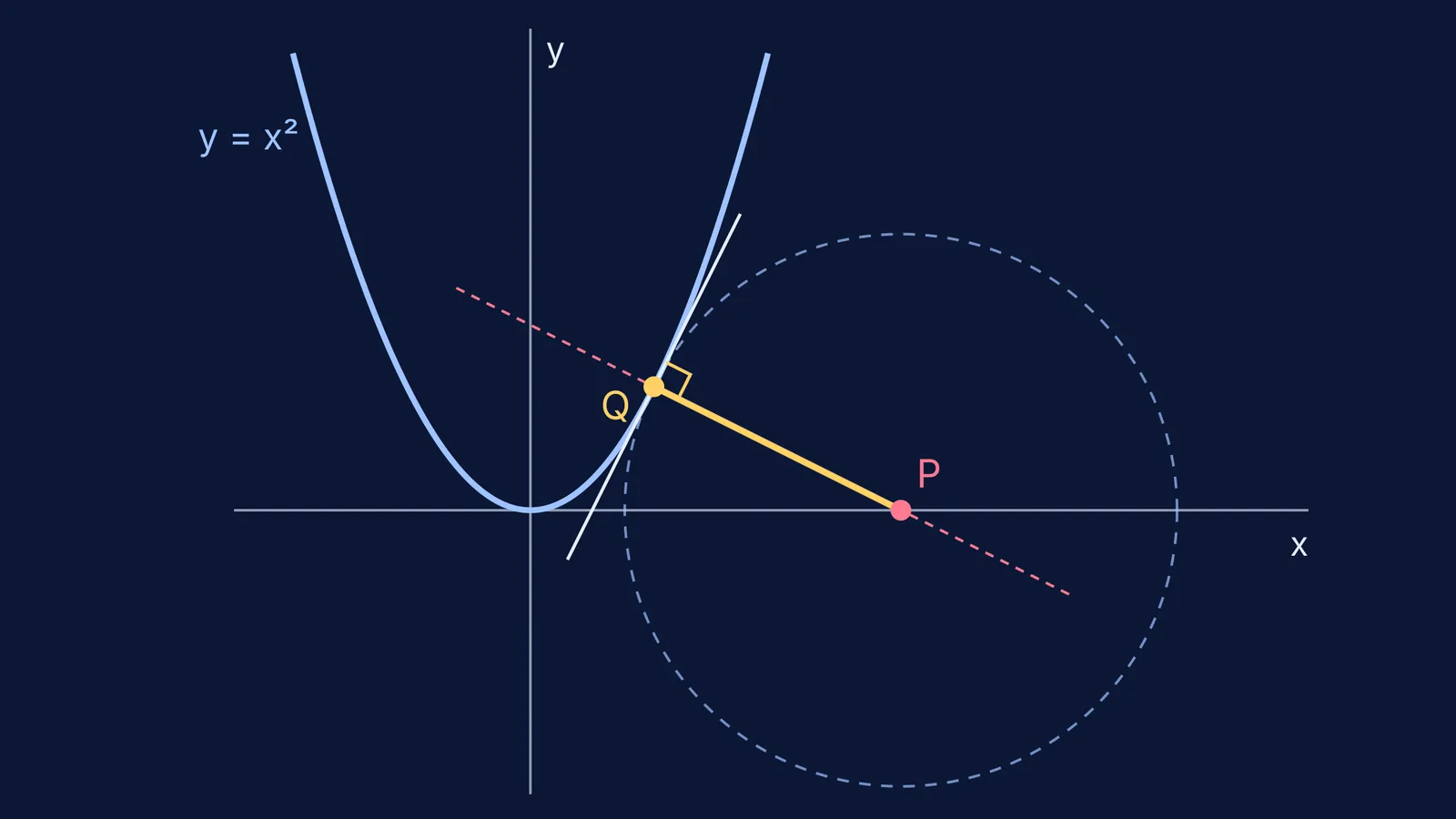
The shortest segment from a point to a smooth curve meets the curve at a right angle. In other words, it lies along the normal at the nearest point. That gives a quick check the textbook skips.
At (1, 8), the curve y = x² + 7 has slope 2x = 2, so the normal has slope −1/2. The line from (1, 8) to the soldier at (3, 7) has slope (7 − 8)/(3 − 1) = −1/2. The slopes match, so the answer passes.
If you had made a sign slip and got (−1, 8), the check would fail at once. There the normal slope is +1/2, but the line to (3, 7) has slope −1/4.
What is the vertex trap?
Question 27 in NCERT Exercise 6.3 asks for the point on x² = 2y nearest to (0, 5). One option is the vertex (0, 0), and the eye picks it because (0, 5) sits right above it.
Work it with the method instead. Here it is easier to use y as the variable: x² = 2y, so D = 2y + (y − 5)². Then D′ = 2 + 2(y − 5) = 0 gives y = 4 and x = ±2√2. The squared distance is 8 + 1 = 9, so the distance is 3. From the vertex it is 5. The nearest points are (±2√2, 4), and the vertex is wrong.
Now try the normal check on the vertex. The normal at (0, 0) is the y-axis, and that passes through (0, 5). So the vertex also passes the check. The normal condition finds the candidates, and comparing distances picks the winner. When the given point sits far enough above the vertex, the nearest points move off to both sides.
A checklist to use before you write the answer
Did you square the distance before differentiating?
Did you find every real root of D′ = 0, including ones that come in ± pairs?
Did you show it is a minimum, or compare values at all the candidates?
Does the line from your point to the given point have the normal slope, −1/(slope of the tangent)?
Did you take the square root of D at the very end?
If a step goes wrong and you can't see where, the Fermi Problem Library has worked problems with a step-by-step solver that explains the reasoning rather than printing an answer. If tangents and normals themselves feel shaky, the matching lesson in the Fermi Concept Library is a good place to rebuild that idea first.