

On this page
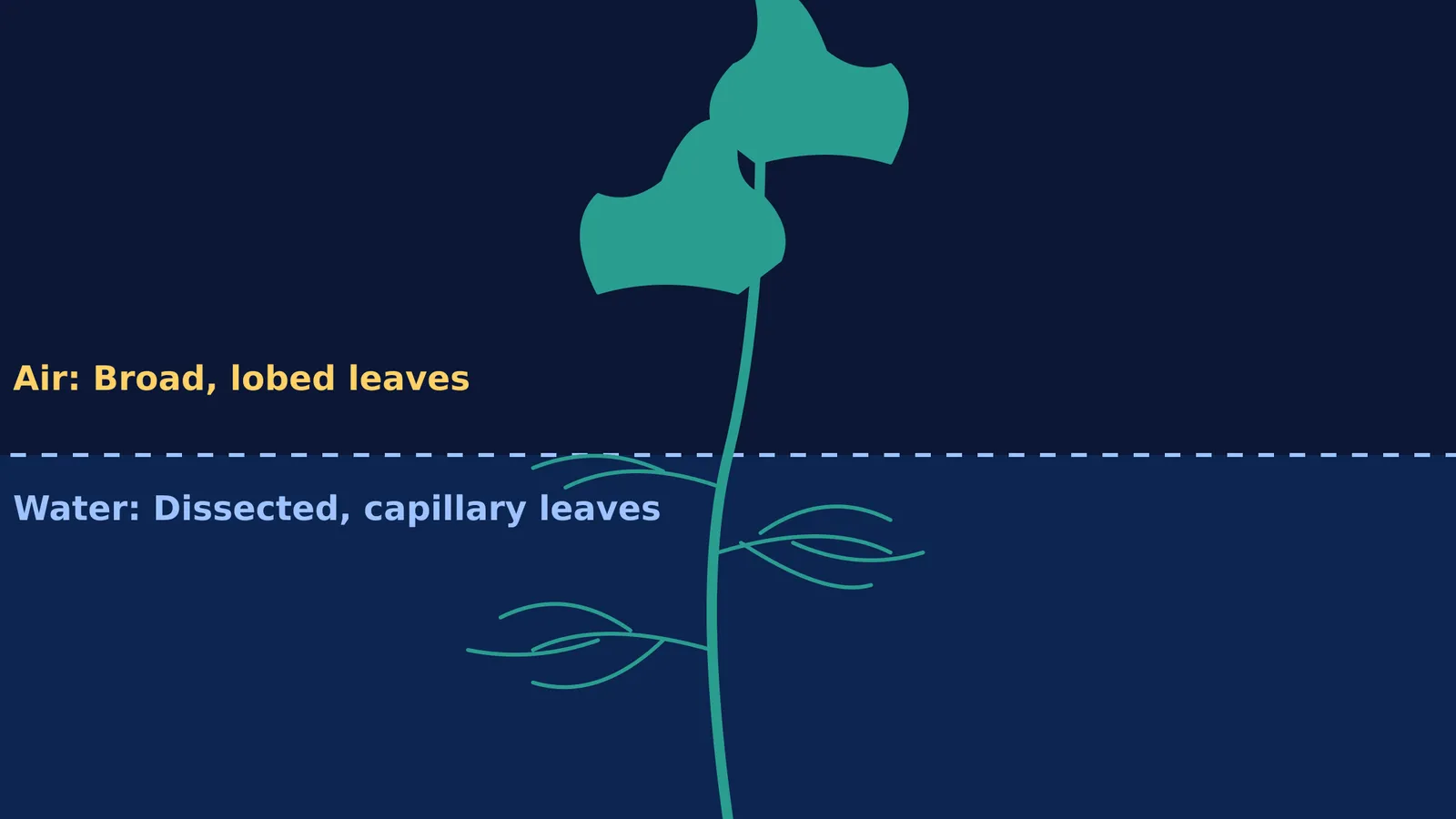
When you look at a young cotton plant and compare it to a mature one, you might notice that the leaves do not look the same at all. The same is true for a buttercup growing half in and half out of a pond: the leaves in the air are broad and lobed, while those completely underwater look like fine, tangled threads.
These physical changes are not random. They are highly programmed responses that help the plant survive changing conditions. In Class 11 biology, these phenomena introduce two fundamental ideas about how plants develop over their lifespan: open growth and plasticity.
Why is plant growth called open?
Unlike most animals, which stop growing once they reach adult size, plants retain the capacity for unlimited growth throughout their lifespan. According to NCERT Class 11 Biology, plant growth is "open" because new cells are continuously being added to the plant body by the activity of the meristems (NCERT Chapter 13: Plant Growth and Development).
These meristems—specialised regions of active cell division—sit at the tips of roots and shoots (apical meristems) and along the sides of the stem (lateral meristems). Because of them, the plant can always build new organs. If a passing animal eats a branch, the plant simply grows another one. You can read more about how plants respond to such physical and environmental cues through phototropism and other tropic movements.
Differentiation in plants is also open. This means a cell's final form is often determined by its physical position in the plant rather than a rigid destiny fixed at birth. A cell left behind by the root apical meristem might become part of the epidermis if it sits on the outside, or part of the root cap if it is pushed to the very tip.
What is plasticity in plants?
Because plants are rooted in place and cannot run away from their environment, they must adapt their bodies to survive changing conditions. Plasticity is the ability of plants to follow different pathways in response to the environment or phases of life to form different kinds of structures (NCERT Chapter 13).
This means a plant's genetic code does not dictate a single, unchangeable shape. Instead, it provides a flexible blueprint with a range of possible shapes, and the plant expresses the most advantageous one for its current situation. You can see how this continuous mathematical unfolding works over time when comparing arithmetic and geometric plant growth.
What is heterophylly in cotton, coriander and buttercup?
Heterophylly is a striking example of plasticity where a single plant produces more than one distinct type of leaf (10.1078/1433-8319-00001). The NEET biology syllabus splits this into two categories based on the trigger behind the change:
Developmental heterophylly (Cotton and Coriander): In cotton, coriander and larkspur, the shape of the leaves changes as the plant physically matures. The leaves of a juvenile plant look entirely different from those on a mature, flowering plant. This phase-driven change ensures the leaf structure matches the plant's varying metabolic needs and energy demands at different stages of its life cycle.
Environmental heterophylly (Buttercup): In the water buttercup (*Ranunculus aquatilis*), the leaf shape changes in direct response to its habitat rather than its age. A 1969 study on *Ranunculus aquatilis* showed that leaves produced in the air are broad and lobed, while leaves growing completely submerged in water are finely divided and capillary-like (10.1111/j.1469-8137.1969.tb06457.x).
This environmental plasticity is highly adaptive and necessary for survival. Broad aerial leaves have a large surface area to catch maximum sunlight for photosynthesis in the open air. Meanwhile, the thread-like underwater leaves drastically reduce water resistance, stopping the plant from being torn apart by fast-moving currents. The divided shape also increases the surface-to-volume ratio, making it easier for the plant to absorb dissolved gases like carbon dioxide directly from the water.
How do you master plant development for NEET?
Plant physiology chapters are packed with definitions that sound similar but mean different things—like plasticity versus heterophylly, or open growth versus indeterminate growth.
If you are struggling to keep these concepts straight, you can look them up in the Fermi Concept Library, where every biological concept has its own lesson and its place in the map. If you scan a past paper question about leaf shapes and find yourself stuck between two options, Fermi's AI tutor works out what you already know, builds a plan for the session, and teaches through it—checking your understanding as it goes rather than just printing the answer.
Here is a quick checklist for heterophylly questions:
Did the prompt mention age, phase, or maturity? The answer is developmental heterophylly (common examples: cotton, coriander, larkspur).
Did the prompt mention water, air, or habitat? The answer is environmental heterophylly (common example: buttercup).
Is the question asking for the broader phenomenon? Heterophylly is the specific leaf change; plasticity is the general ability to change form.
This simple breakdown helps you quickly eliminate incorrect options. Try testing your knowledge on past papers in the Fermi Problem Library.


