

On this page
Gypsum is a naturally occurring mineral with the chemical formula CaSO₄·2H₂O (calcium sulphate dihydrate). It is a hard, rock-like substance. When you heat it to a specific temperature, it transforms into a white powder known as plaster of Paris.
Plaster of Paris has been used for centuries to set fractured bones, cast sculptures, and finish walls. It takes its name from the large gypsum deposits beneath Montmartre in Paris, which supplied the builders of the city in the 18th century, according to historical accounts.
How is plaster of Paris made from gypsum?
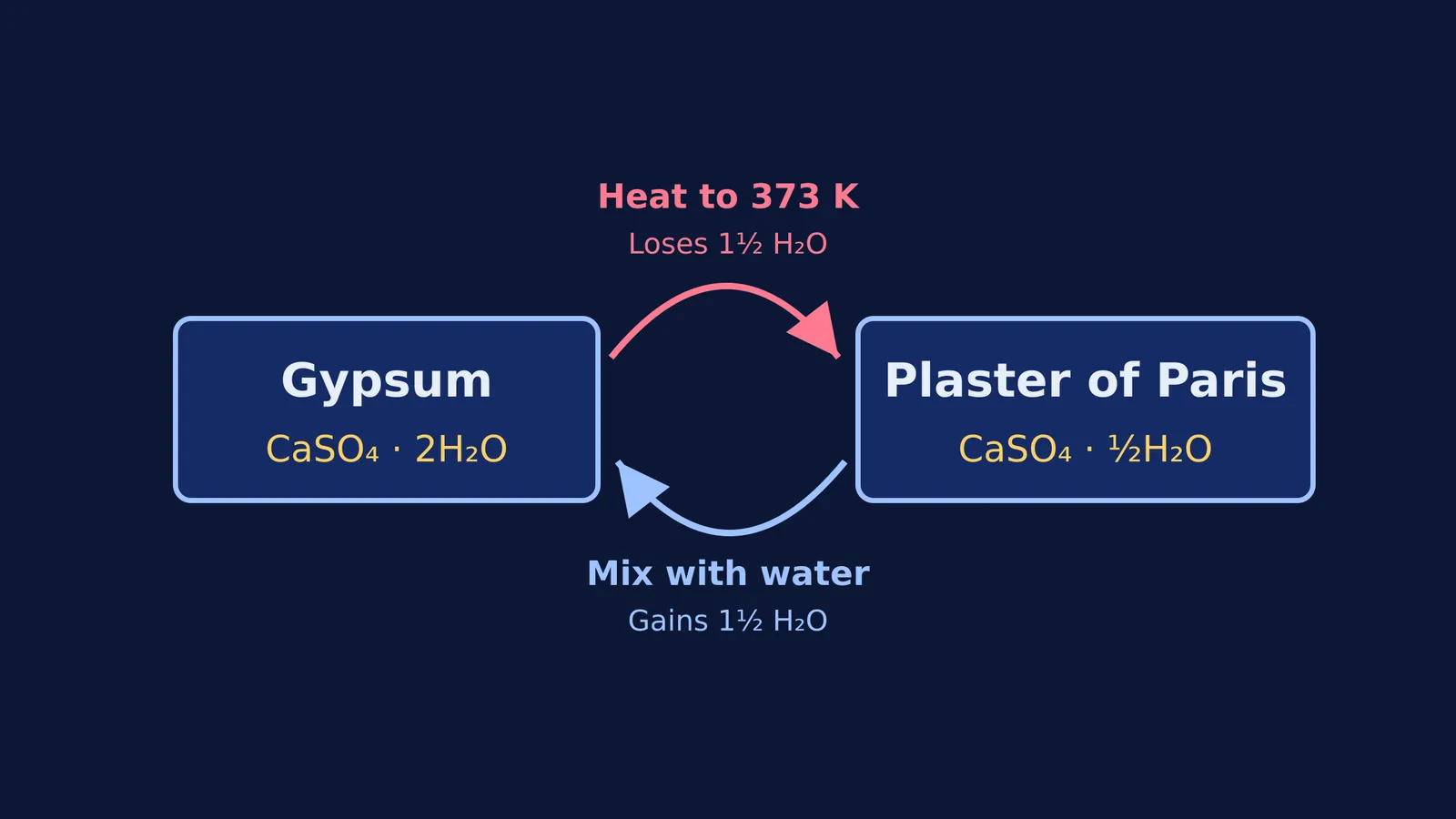
To make plaster of Paris, gypsum is heated in a kiln to 373 K (100 °C), according to chemistry resources.
At this temperature, the heat drives off three-quarters of the water of crystallisation from the gypsum. The resulting chemical is calcium sulphate hemihydrate, and the equation for the reaction is:
CaSO₄·2H₂O → CaSO₄·½H₂O + 1½ H₂O
The process requires careful temperature control. If you heat the gypsum above 523 K (250 °C), it loses all its water of crystallisation. This leaves anhydrous calcium sulphate (CaSO₄), which is known in industry as "dead burnt plaster" (Wikipedia).
Unlike plaster of Paris, dead burnt plaster has a highly stable, tightly packed crystal structure that refuses to absorb water quickly. It will not set into a hard mass when you mix it with water, making it useless for casting or setting bones.
What happens when you mix it with water?
The reaction that makes plaster of Paris is entirely reversible. When you add water to the dry powder, it immediately begins to hydrate.
The hemihydrate takes back the 1.5 water molecules it lost during heating and returns to its original rock-like form as gypsum, according to chemistry resources:
CaSO₄·½H₂O + 1½ H₂O → CaSO₄·2H₂O
As it reacts, the mixture forms a thick paste that can be shaped or poured into a mould. The powder rehydrates and sets into a hard mass of gypsum in about 15 minutes (Vedantu).
This process is exothermic, meaning the chemical reaction releases energy. If you hold a curing plaster cast, it will feel noticeably warm as it hardens. It also expands slightly as the new gypsum crystals form and lock together. This slight expansion is incredibly useful in art and industry, because it forces the plaster into the finest details of a mould and creates an exceptionally sharp cast. While it sets hard enough to hold its shape in 15 minutes, a thick cast can take a few days for the excess water to evaporate completely and reach its maximum strength (Wikipedia).
Why does the formula have half a water molecule?
A common point of confusion in chemistry is the ½ H₂O in the plaster of Paris formula. Individual molecules cannot be cut in half.
The formula is simply a mathematical ratio. In the crystal structure of plaster of Paris, two calcium sulphate (CaSO₄) units share one water molecule between them, which is accurately written as 2CaSO₄·H₂O. However, chemists write it as CaSO₄·½H₂O to keep the notation consistent. This ensures you are always looking at the hydration level for a single formula unit of calcium sulphate.
If you find stoichiometry and chemical ratios hard to picture, the Fermi Concept Library maps out every concept in chemistry, each with its own lesson and its place in the map.
What happens if you heat gypsum too much?
As mentioned earlier, heating gypsum beyond 523 K (250 °C) entirely ruins its ability to act as a setting plaster. The heat forces out the final ½ H₂O molecule, transforming it into dead burnt plaster (Wikipedia).
What are the common uses of plaster of Paris?
Because it sets quickly and expands into moulds, plaster of Paris has several everyday applications:
Medicine: Doctors use it to create orthopaedic casts, holding fractured bones rigidly in place while they heal.
Construction: Builders use it to create ornate false ceilings and cornices, and to patch holes before painting walls.
Dentistry: Dentists use high-grade plaster to make accurate models of teeth and gums.
Art: Sculptors use it to cast statues and create detailed moulds for ceramics and metalwork.


