

On this page
Plant cells are sealed within rigid cell walls made of cellulose. While these walls provide structural support, they also create a barrier. To share water, nutrients and signals, cells need a way to bypass the wall. That is the role of plasmodesmata.
What are plasmodesmata in plant cells?
Plasmodesmata (singular: plasmodesma) are microscopic channels that traverse the cell walls of plant cells and some algal cells, enabling direct transport and communication between them (Wikipedia).
Because a cell wall can be up to 90 nm thick, these channels serve as vital bridges. A single plant cell can have between 1,000 and 100,000 plasmodesmata, which equates to about 1 to 10 channels per square micrometre of the cell's surface. At their midpoint, they are approximately 50 to 60 nm in diameter.
The structure of a plasmodesma
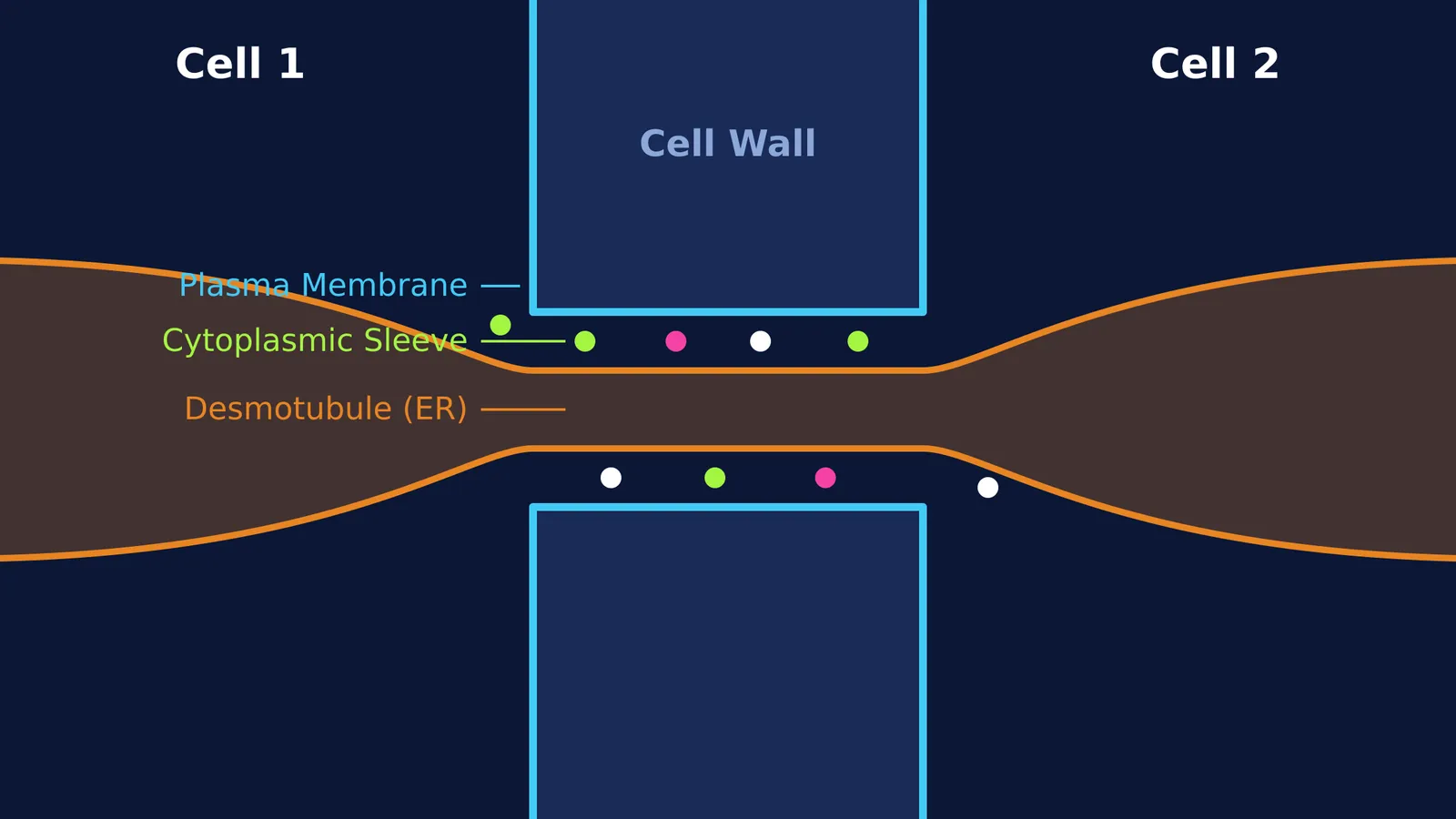
A plasmodesma is not just an empty hole in the wall. It has a complex, three-part structure that regulates what can pass through:
Plasma membrane: The outer boundary of the channel is a continuous extension of the cell membrane, seamlessly connecting the membranes of the two neighbouring cells.
Cytoplasmic sleeve: This is the fluid-filled space just inside the membrane. It is a continuous extension of the cytosol, and it is here that most of the trafficking of molecules takes place.
Desmotubule: Running down the exact centre of the channel is the desmotubule, a tightly folded tube of endoplasmic reticulum (ER). It connects the ER networks of the two cells.
If you have concept gaps when studying plant anatomy, the Fermi Concept Library explains the structure of the cell wall and the symplastic pathway.
Primary vs secondary plasmodesmata
Plant cells can form these channels at two different stages of their life cycle:
Primary plasmodesmata: These are formed during cell division. When a new cell wall is being built between two newly divided plant cells, strands of the endoplasmic reticulum get trapped across the middle lamella. These trapped strands become the desmotubules of the new primary plasmodesmata.
Secondary plasmodesmata: These are inserted into existing cell walls between mature, non-dividing cells. As a cell wall expands during growth, the density of primary plasmodesmata decreases, so the cell must produce secondary channels to maintain enough connections.
In the rapidly dividing cells of apical and lateral meristems, primary plasmodesmata form in large numbers to keep the new cells connected.
What do plasmodesmata let pass?
Small molecules such as sugars, amino acids and ions can diffuse freely through the cytoplasmic sleeve without requiring active transport or chemical energy. This free flow is crucial for distributing the products of photosynthesis and maintaining the cell's basic functions.
However, the size of molecules that can pass is controlled by the channel's size exclusion limit. Normally, this limit sits around 700 daltons (Wikipedia). Larger molecules, such as proteins and RNA, generally cannot fit unless the channel is modified.
Some viruses have evolved to exploit this system. For example, the tobacco mosaic virus produces a movement protein called MP-30, which can actively dilate the channel and increase the size exclusion limit to 9,400 daltons, allowing the viral genome to slip through and infect the next cell.
Other plant functions also rely on these intercellular connections. When phototropism and geotropism guide a plant's growth, the hormones responsible travel rapidly through these networks.
For your biology exams, remember these three key rules about plant transport pathways:
Route: The symplastic pathway goes through the cytoplasm and plasmodesmata; the apoplastic pathway goes through the cell walls.
Speed: Apoplastic transport is generally faster because it faces less resistance from organelles.
Control: Symplastic transport is highly regulated by the size exclusion limit of plasmodesmata; apoplastic flow is largely unregulated until it hits the waterproof Casparian strip in the endodermis.
How do plasmodesmata close?
A plant needs to be able to shut its doors. If a cell is damaged or infected, leaving the plasmodesmata open would allow the damage or virus to spread to the rest of the plant.
To prevent this, plants use a polysaccharide called callose. When triggered by environmental stress, cold, or high calcium levels, callose deposits accumulate around the neck region of the plasmodesma, forming a collar. This structural remodelling physically narrows the diameter of the pore, gating the channel and isolating the affected cell from its neighbours.
Even in healthy plants, callose is used to constantly adjust the permeability of plasmodesmata, ensuring that the right molecules reach the right places at the right time. For example, the distribution of enzymes involved in photorespiration relies on tightly regulated symplastic transport between specific leaf cells.


