

On this page
In short
When a moving block is placed on a stationary plank, kinetic friction slows the block and accelerates the plank until their speeds match. As defined in OpenStax University Physics, the constant kinetic friction means the time to stop slipping is directly proportional to the block's initial speed and inversely proportional to the friction coefficient.
When you place a moving block on a stationary plank on a smooth floor, the block does not slide forever. Friction slows the block while dragging the plank forward. Eventually, they match speeds and move together.
Finding the exact time they stop slipping is a classic application of Newton's laws. Here is how the physics unfolds, assuming no air resistance and constant friction.
Which forces act on the block and the plank?
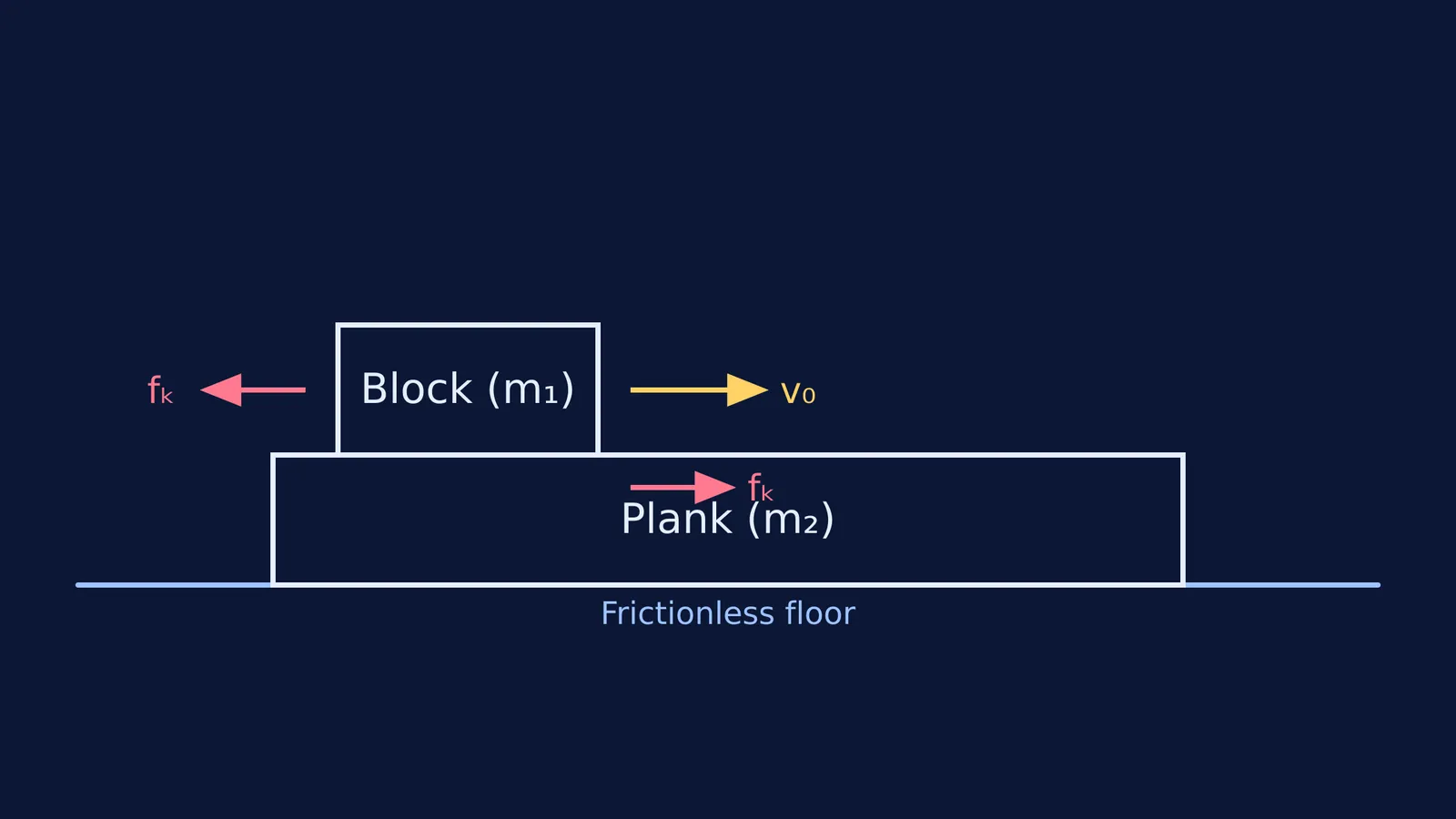
We have a block of mass m₁ moving with an initial velocity v₀ on a plank of mass m₂. The plank rests on a frictionless floor, but the surface between the block and plank is rough, with a coefficient of kinetic friction μₖ. While the block moves relative to the plank, friction opposes that motion.
Because the block is sliding over the plank, kinetic friction acts on it. According to OpenStax University Physics, the kinetic friction force has a constant magnitude of fₖ = μₖN, where the normal force N = m₁g. This constant force simplifies the kinematics to a problem of constant acceleration, making the equations straightforward to solve.
Newton's third law says forces come in pairs. The plank exerts backward friction on the block, and the block exerts equal forward friction on the plank. This pair of internal forces drives the entire process without changing the system's total momentum.
Acceleration of the block (a₁): The only horizontal force on the block is friction pointing backward. Its acceleration is a₁ = −μₖg.
Acceleration of the plank (a₂): Forward friction from the block is the only horizontal force moving the plank. Its acceleration is a₂ = μₖm₁g / m₂.
If you find it hard to keep track of which force acts on which body in friction problems, the Fermi Concept Library covers every concept in physics, chemistry, biology, mathematics and computing, each with its own lesson and its place in the map.
How do you find the time to stop slipping?
The slipping stops when the block and plank reach the same velocity. We find this exact moment by writing their individual velocity-time equations and equating them.
The velocity of the block at any time t is given by the constant acceleration formula: v₁(t) = v₀ − μₖgt
The velocity of the plank at the same time t, starting from rest, is: v₂(t) = (μₖm₁g / m₂)t
Equating the velocities gives the time t when slipping finally stops and they begin moving as one unit: v₀ − μₖgt = (μₖm₁g / m₂)t
Rearranging the terms to isolate the variable t on one side: v₀ = μₖgt(1 + m₁/m₂)
v₀ = μₖgt(m₁ + m₂) / m₂
t = m₂v₀ / [μₖg(m₁ + m₂)]
This simple expression shows that the time to stop slipping is directly proportional to the initial speed and inversely proportional to the friction coefficient. A heavier plank or a faster block will increase the time it takes for them to settle into a common velocity.
What is the final common velocity and sliding distance?
Once they stop slipping, what is their final speed? You can plug the time t back into the plank's velocity equation to find the common velocity vc: vc = (μₖm₁g / m₂) × {m₂v₀ / [μₖg(m₁ + m₂)]} = m₁v₀ / (m₁ + m₂)
This is exactly the result you get by applying conservation of momentum to the block-plank system. Since the floor is frictionless, there are no external horizontal forces, and the total initial momentum (m₁v₀) must equal the total final momentum ((m₁ + m₂)vc).
While they were slipping, the block travelled further over the floor than the plank did. The difference between their total displacements is the relative sliding distance. Substituting t into the standard kinematics equations gives the block's sliding distance across the plank: x_rel = m₂v₀² / [2μₖg(m₁ + m₂)]
This sliding distance ties directly to the system's kinetic energy. Kinetic friction converts some of the initial kinetic energy into heat, doing work exactly equal to the friction force multiplied by this relative distance. Setting up these equations from scratch can be tricky, whether for a block on a plank or a block on an incline. If you get stuck with the algebra, Fermi's AI tutor works out what you already know, builds a plan for the session, and teaches through it.
How does this work for a 2 kg block?
Let us put concrete numbers to the formulas, applying the principles from OpenStax University Physics. Imagine a 2 kg block with an initial speed of 5 m/s placed gently on a 3 kg plank. The coefficient of kinetic friction between them is 0.2, and we will use g = 10 m/s².
First, find the frictional force acting between the surfaces: fₖ = μₖm₁g = 0.2 × 2 × 10 = 4 N
The 4 N frictional force acts backwards on the block and forwards on the plank. The block slows down at an acceleration of 2 m/s², while the plank speeds up at 1.33 m/s².
Using our derived time equation, we can find out how long the sliding lasts: t = (3 × 5) / [0.2 × 10 × (2 + 3)] = 15 / 10 = 1.5 s
They stop slipping against each other after exactly 1.5 seconds. Their final common velocity at that instant is: vc = 5 − (2 × 1.5) = 2 m/s
In those 1.5 seconds, the block slides exactly 3.75 metres across the surface of the plank. The 4 N friction force acting over this relative distance converts exactly 15 joules of kinetic energy into heat, leaving the combined 5 kg system moving steadily forward at 2 m/s.


