

On this page
Pipe-and-tank questions look like fraction puzzles, but they usually end in a quadratic equation. Most lost marks come from two slips: adding times instead of rates, and keeping a root that cannot be a time. Here is the method, one worked problem and a checklist.
Why do you add rates, not times?
Two pipes together fill a tank faster than either alone, so their times cannot simply add. What adds is the fraction of the tank each pipe fills per hour. The OpenStax Intermediate Algebra 2e chapter on rational equations puts it this way: a printing press that completes a job in 6 hours completes 1/6 of the job in one hour, and the part done by the first press plus the part done by the second equals the part done together.
For tanks, that gives three rules:
A pipe that fills the tank in x hours has a rate of 1/x tank per hour.
Two pipes that fill it in a and b hours, running together, fill it in T hours where 1/a + 1/b = 1/T.
A pipe that empties the tank has its rate subtracted instead of added.
How do you set up the two-taps quadratic?
Here is a problem from older editions of the NCERT Class 10 book, listed as Exercise 4.3, Question 9 on Teachoo: "Two water taps together can fill a tank in 9 3/8 hours. The tap of larger diameter takes 10 hours less than the smaller one to fill the tank separately. Find the time in which each tap can separately fill the tank."
Let the smaller tap take x hours. The larger tap takes x − 10 hours.
Write the rates: 1/x and 1/(x − 10) tank per hour.
Together they take 9 3/8 = 75/8 hours, so their combined rate is 8/75. The equation is 1/x + 1/(x − 10) = 8/75.
Multiply every term by 75x(x − 10): 75(x − 10) + 75x = 8x(x − 10).
Simplify: 150x − 750 = 8x² − 80x, so 8x² − 230x + 750 = 0. Divide by 2: 4x² − 115x + 375 = 0.
Factorise: (x − 25)(4x − 15) = 0, so x = 25 or x = 3.75. The quadratic formula agrees: the discriminant is 115² − 4 × 4 × 375 = 7225 = 85², and (115 ± 85)/8 gives the same two roots.
Which root do you reject, and why?
Both roots here are positive, which surprises students who were told to "reject the negative one". Test x = 3.75 in every quantity, not just x: the larger tap would take 3.75 − 10 = −6.25 hours. A time cannot be negative, so 3.75 goes. The smaller tap takes 25 hours and the larger takes 15 hours.
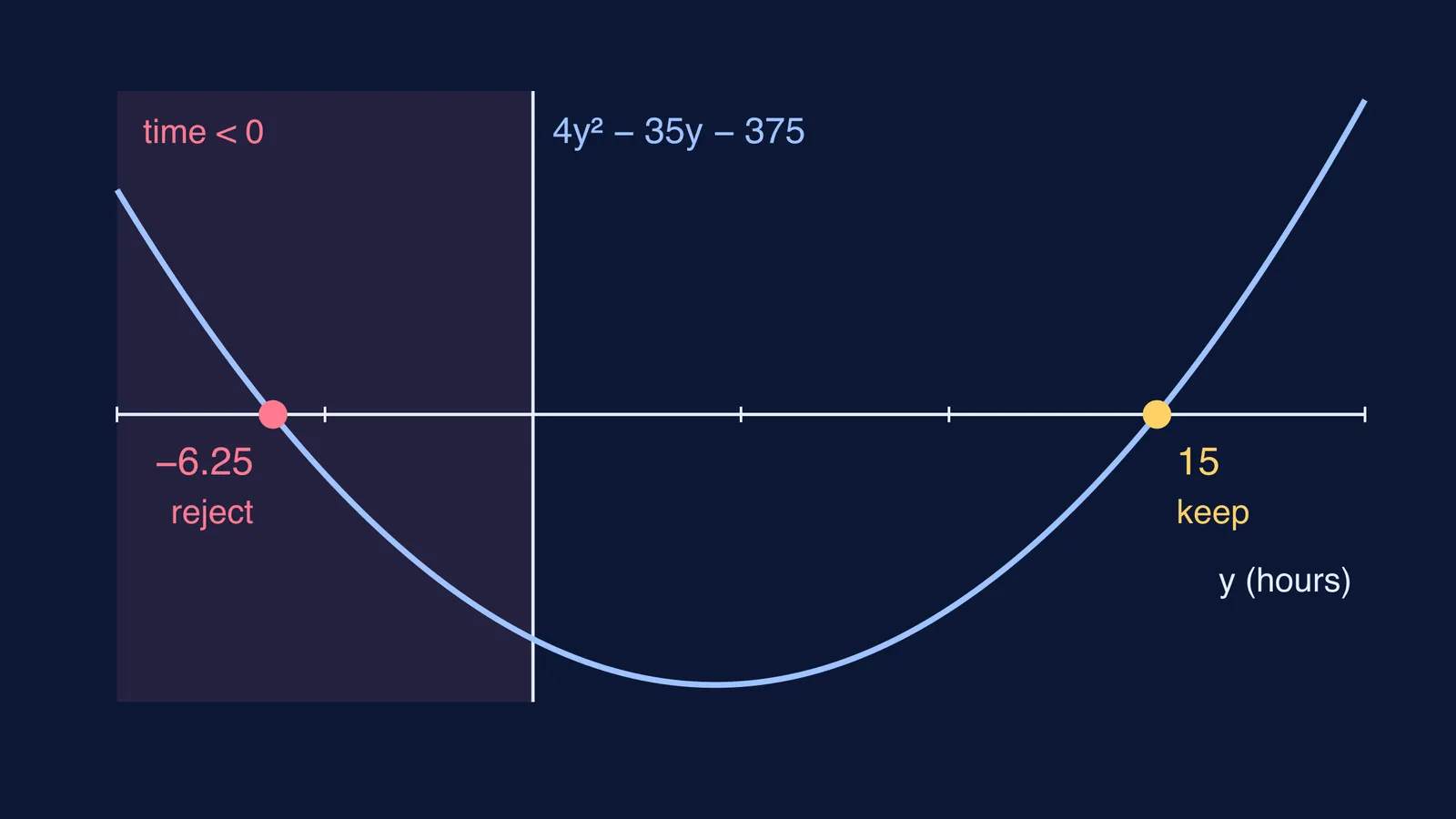
Now let the larger tap take y hours and the smaller y + 10. The same steps give 4y² − 35y − 375 = 0, or (y − 15)(4y + 25) = 0, with roots 15 and −6.25. It's the same impossible answer, now showing up as a negative root, as the graph above shows.
The current NCERT chapter uses the same reasoning. In Example 6 of the NCERT Class 10 Quadratic Equations chapter, the roots are 12 and −12.5, and the book keeps 12 because "Since x is the breadth of the hall, it cannot be negative."
Is the tap problem still in the NCERT book?
Not in this form. In the current NCERT Class 10 chapter (marked Reprint 2026-27), Exercise 4.3 has five questions, none about taps or pipes. The method still matters: the same rate equation runs every work problem with two people or two machines.
A checklist for any pipes-and-tank problem
Name one unknown time, with units: "Let the smaller pipe take x hours."
Write every other time in terms of x, using the words of the question.
Turn each time into a rate (1/time). Add filling pipes, subtract emptying pipes.
Set the total equal to 1/(time together) and multiply through by the common denominator.
Collect terms into ax² + bx + c = 0 and divide out any common factor.
Solve by factorising or the quadratic formula.
Substitute each root into every time in the problem. Reject any root that makes a time zero or negative.
Check that the rates of your answer add back to the combined rate.
If you get stuck between the word problem and the equation, the Fermi Problem Library has worked problems with a step-by-step solver that explains the reasoning rather than printing an answer. If the shaky part is clearing fractions or the quadratic formula itself, the Fermi Concept Library gives each concept its own lesson and its place in the map.
Try the y version of the two-taps problem on your own tonight, then check it against the numbers above.


