

On this page
When an air column inside a pipe vibrates, it sets up standing waves. The frequencies at which these waves naturally form are called the pipe's natural frequencies or harmonics. In competitive exams like JEE Main and NEET, you are often asked to count how many of these natural frequencies lie below a specific cut-off limit.
To solve this, you need to know two things: the pipe's fundamental frequency (its lowest possible natural frequency) and whether the pipe is open at both ends or closed at one end.
How do open and closed pipes differ?
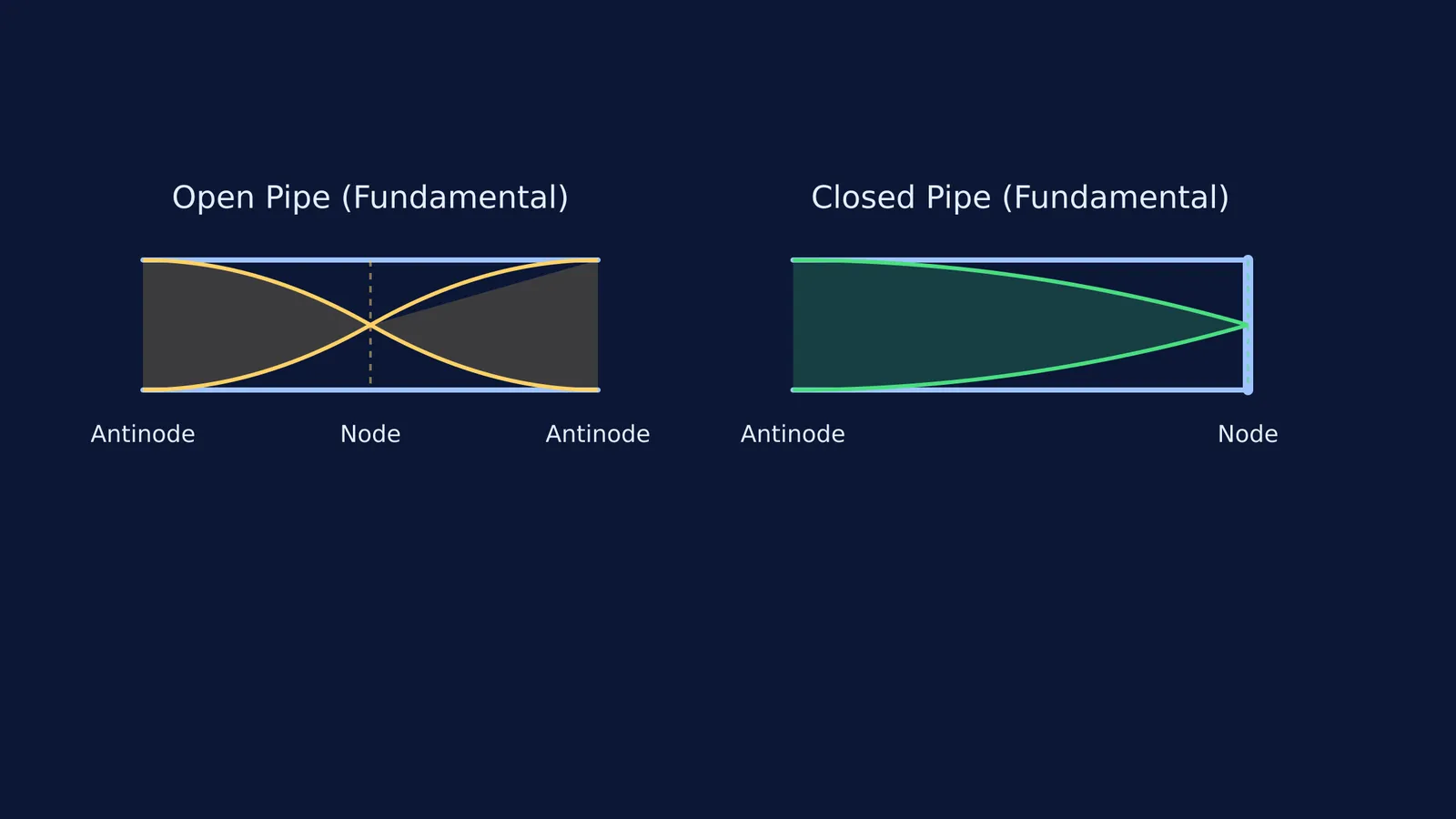
The boundary conditions at the ends of the pipe dictate which standing waves can form. The open end of a pipe always has a displacement antinode (maximum movement of air), while a closed end has a displacement node (no movement of air). This directly relates to displacement and pressure waves in sound: the 90° phase shift, as a displacement antinode corresponds to a pressure node.
Open organ pipe: Because both ends are open, antinodes form at both ends. The fundamental frequency is given by f₁ = v / 2L, where v is the speed of sound and L is the length of the pipe. An open pipe supports all harmonics. Its natural frequencies are f₁, 2f₁, 3f₁, 4f₁, and so on.
Closed organ pipe: With one end closed, the wave must have a node at the closed end and an antinode at the open end. The fundamental frequency is lower, given by f₁ = v / 4L. Because of the single node constraint, a closed pipe supports only odd harmonics. Its natural frequencies are f₁, 3f₁, 5f₁, 7f₁, etc.
When you're trying to remember which formulas go with which boundary conditions, the Fermi Concept Library breaks down the physics of standing waves. If you keep getting the odd-only rule wrong in exam questions, the Fermi Problem Library has worked problems with a step-by-step solver that explains the reasoning rather than printing an answer.
How to find the number of possible natural oscillations?
Once you have the fundamental frequency and the rule for which harmonics are allowed, finding the number of frequencies below a limit is a simple counting exercise.
Calculate the fundamental frequency (f₁): Use v / 2L for an open pipe and v / 4L for a closed pipe. Ensure all units are in metres and seconds.
List the allowed harmonics: Write out the sequence of allowed frequencies. For an open pipe, list 1 × f₁, 2 × f₁, 3 × f₁... For a closed pipe, list 1 × f₁, 3 × f₁, 5 × f₁...
Stop at the limit: Continue the list until the calculated frequency exceeds the given maximum frequency (f_max).
Count them: The number of valid frequencies on your list is your answer.
Let us see how this works in a classic JEE Main problem.
A worked example: pipe closed at one end
Consider this question from the JEE Main 2014 paper: *A pipe of length 85 cm is closed from one end. Find the number of possible natural oscillations of the air column in the pipe whose frequencies lie below 1250 Hz. The velocity of sound in air is 340 m/s.*
Step 1: Calculate the fundamental frequency. The pipe is closed at one end, so we use the closed pipe formula. The length L = 85 cm = 0.85 m. The speed of sound v = 340 m/s. (If the gas in the pipe is not pure air, you might first need to find the γ of a gas mixture: the weighted Cv method with an example to calculate the speed of sound.)
f₁ = v / 4L = 340 / (4 × 0.85) = 340 / 3.4 = 100 Hz
Step 2: List the allowed natural frequencies. Since it is a closed pipe, only odd harmonics are possible.
1st harmonic: 1 × 100 = 100 Hz
3rd harmonic: 3 × 100 = 300 Hz
5th harmonic: 5 × 100 = 500 Hz
7th harmonic: 7 × 100 = 700 Hz
9th harmonic: 9 × 100 = 900 Hz
11th harmonic: 11 × 100 = 1100 Hz
Step 3: Stop at the limit. The next odd harmonic is the 13th, which would be 13 × 100 = 1300 Hz. This is greater than the 1250 Hz limit given in the question, so we exclude it.
Step 4: Count the frequencies. We have 100, 300, 500, 700, 900, and 1100 Hz. That makes exactly 6 possible natural oscillations.
What if the pipe is open at both ends?
To see why the open and closed distinction matters, imagine the exact same pipe (length 85 cm) but open at both ends. How many natural frequencies would lie below 1250 Hz?
First, the fundamental frequency changes. For an open pipe, f₁ = v / 2L. f₁ = 340 / (2 × 0.85) = 340 / 1.7 = 200 Hz
Second, the harmonic rule changes. An open pipe allows all integer multiples. The allowed frequencies are:
1st harmonic: 1 × 200 = 200 Hz
2nd harmonic: 2 × 200 = 400 Hz
3rd harmonic: 3 × 200 = 600 Hz
4th harmonic: 4 × 200 = 800 Hz
5th harmonic: 5 × 200 = 1000 Hz
6th harmonic: 6 × 200 = 1200 Hz
The next frequency is 7 × 200 = 1400 Hz, which exceeds the 1250 Hz limit.
In this case, the count is also 6, but the actual frequencies are completely different. If you accidentally apply the open pipe formula to a closed pipe problem, you will be calculating the wrong physical modes and risk losing marks.


