

On this page
When light shines on an isolated metal sphere, it emits electrons due to the photoelectric effect. But it doesn't emit them forever.
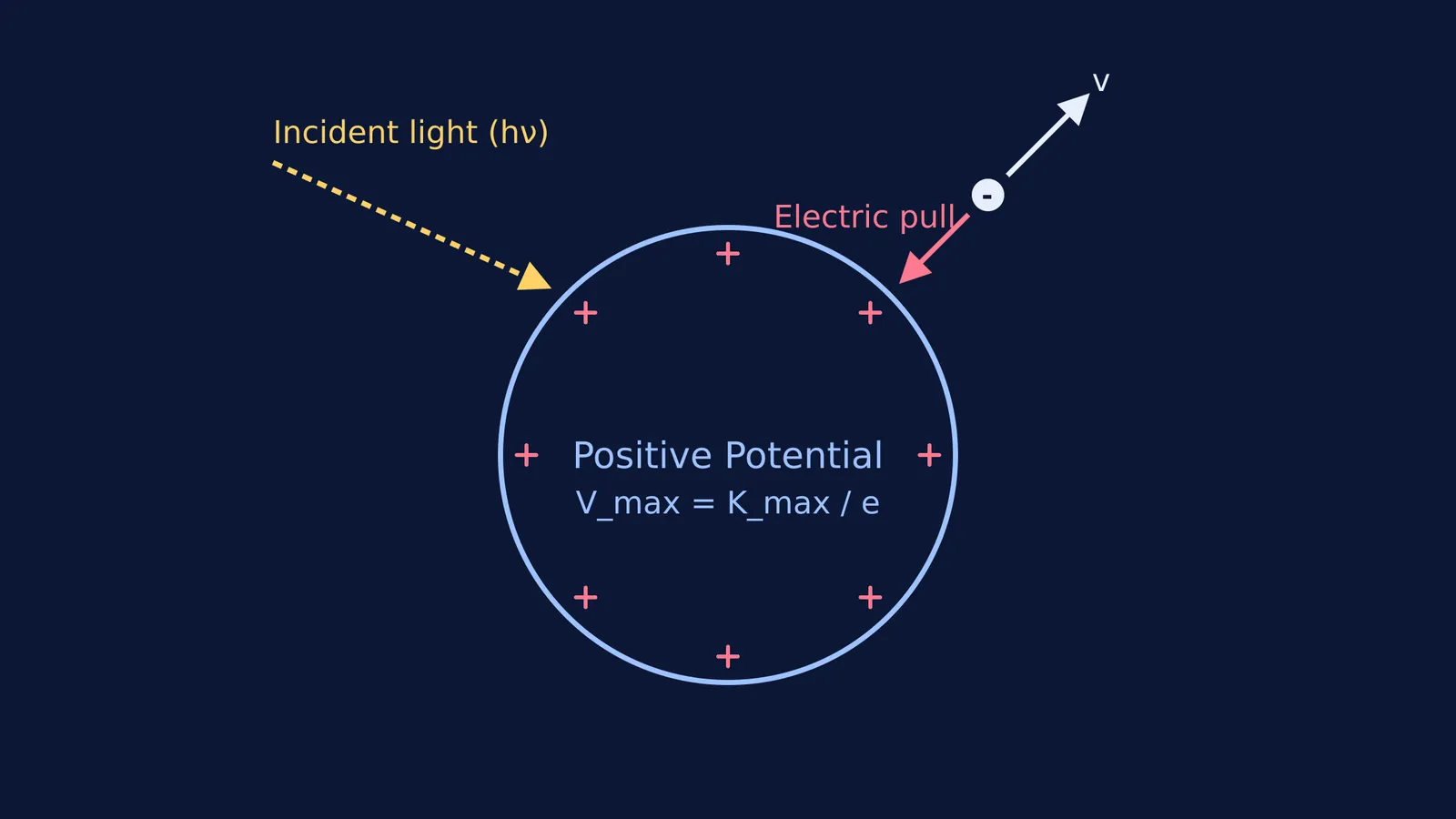
As each negatively charged electron leaves, it leaves behind a positive charge on the sphere. This built-up positive charge creates an electric potential that pulls back on the escaping electrons. Eventually, the sphere's positive potential becomes strong enough to stop even the fastest electrons from escaping, and emission stops.
This scenario frequently appears in physics exams because it combines the photoelectric effect from modern physics with electrostatics.
How does the sphere reach its maximum potential?
The photoelectric effect occurs when electromagnetic radiation strikes a material and causes it to emit electrons. According to Einstein's photoelectric equation, the maximum kinetic energy (K_max) of an emitted electron is the energy of the incoming photon (hν) minus the metal's work function (Φ): K_max = hν − Φ
For an isolated metal sphere, emitting these electrons means it loses negative charge, so it acquires a net positive charge. A positively charged sphere has a positive electric potential V.
To escape this positively charged sphere, an emitted electron must do work against the sphere's attractive electric field. The work required for an electron (charge e) to escape from a potential V to infinity is eV.
If the electron's kinetic energy K_max is greater than eV, it escapes. But as more electrons escape, the sphere's positive charge Q grows, and its potential V increases.
Emission stops exactly when the work needed to escape equals the maximum kinetic energy the electron can have: eV_max = K_max
This means the maximum positive potential the sphere can reach is: V_max = K_max / e = (hν − Φ) / e
Because V_max is driven by the fastest electrons, it is numerically equal to the stopping potential of the metal for that wavelength of light.
A worked example: ultraviolet light on a silver sphere
Let's calculate the maximum potential for a concrete case. Suppose an isolated sphere made of polycrystalline silver is illuminated by ultraviolet light with a wavelength of 200 nm.
The work function (Φ) of polycrystalline silver is 4.26 eV (Wikipedia).
First, find the energy of the incident photons. You can use the quick photon-energy formula, E = 1240 / λ (where λ is in nm and E is in eV): E = 1240 / 200 = 6.2 eV
Next, find the maximum kinetic energy of the emitted photoelectrons: K_max = 6.2 eV − 4.26 eV = 1.94 eV
The most energetic electrons leave the sphere with 1.94 eV of kinetic energy. The sphere will continue to lose electrons and build a positive charge until the energy required to escape is exactly 1.94 eV.
Since the charge of an electron is e, a potential of 1.94 volts requires exactly 1.94 eV of work to overcome. Therefore, the maximum potential the silver sphere can reach is 1.94 V.
If the light is left on, the sphere simply stays at +1.94 V. Any newly emitted electrons are immediately pulled back to the surface because they don't have enough kinetic energy to escape.
Does light intensity change the maximum potential?
No, the maximum potential depends only on the frequency (or wavelength) of the incident light and the metal's work function.
If you increase the intensity of the light, you are increasing the number of photons hitting the sphere per second. This means more electrons are emitted per second, so the sphere will reach its maximum potential faster. However, the energy of each individual photon remains the same, so K_max remains the same, and the final maximum potential V_max is unchanged.
If the incoming light's frequency is below the threshold frequency, no electrons are emitted at all, regardless of the intensity. In this case, the sphere's potential remains zero.
Tackling combined physics problems
Problems combining modern physics and electrostatics are common because they test whether you understand the underlying principles rather than just memorising formulas.
When you face questions involving moving charges and electric fields, mapping out the forces and energy changes step by step is the safest approach. If you get stuck on questions involving concentric spherical shells or moving charges, the Fermi Problem Library can help. It uses a step-by-step solver that explains the reasoning behind each jump, rather than just printing the final answer. If you find the concepts hard to picture, you can run experiments in the Fermi Simulation Lab to see how charges behave in electric fields.


