

On this page
Preparing ethyl acetate in a school laboratory is straightforward: mix ethanol with glacial acetic acid, add concentrated sulphuric acid, warm gently, and the sweet aroma of an ester quickly appears. But attempt the exact same procedure using phenol in place of ethanol, and the reaction stalls. Even after prolonged heating under reflux, you will recover mostly unreacted starting materials.
To synthesize phenyl esters efficiently, chemists replace carboxylic acids with acid chlorides, such as acetyl chloride or benzoyl chloride, in the presence of a base like pyridine. This switch is not a mere convenience; it reflects an electronic divide between aliphatic alcohols and aromatic phenols that frequently challenges students in JEE and NEET-UG examinations.
Why is phenol such a poor nucleophile in esterification?
In aliphatic alcohols like ethanol, oxygen is sp³-hybridised with two localised lone pairs of electrons. The adjacent alkyl group donates electron density through an inductive (+I) effect, keeping oxygen electron-rich and ready to attack an electrophilic carbonyl carbon.
Phenol (C₆H₅OH) behaves fundamentally differently. Oxygen's unshared p-orbital electron pair overlaps with the delocalised π-electron cloud of the benzene ring. Through resonance (the +R effect), this lone pair delocalises into the aromatic nucleus. Resonance structures place partial negative charges at the ortho and para positions while imparting a partial positive charge (δ+) to oxygen. As examined in our guide to the bromination of phenol, this delocalisation activates the aromatic ring toward electrophilic attack, but it simultaneously impoverishes oxygen's nucleophilicity. Because nucleophilic acyl substitution requires donating an electron pair, phenol acts as a much weaker nucleophile than aliphatic alcohols.
Why do carboxylic acids fail to drive phenyl ester formation?
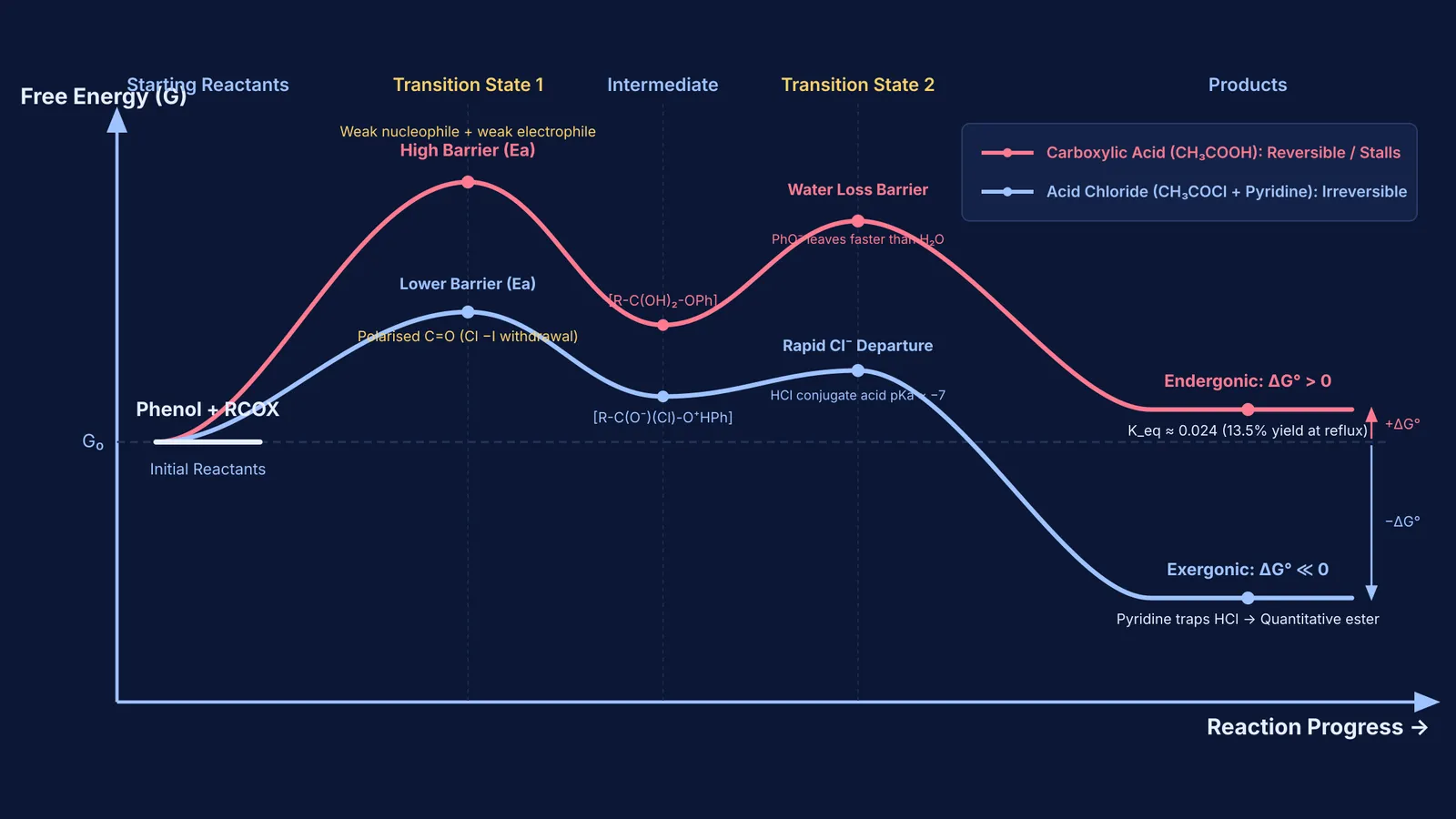
In standard Fischer esterification, aliphatic alcohols react with carboxylic acids under acid catalysis to establish a reversible equilibrium. For ethanol and acetic acid, reversible addition-elimination achieves an equilibrium constant (K_eq) of approximately 4.0, converting roughly 67% of an equimolar mixture into ester. In contrast, researcher M. B. Hocking (Hocking, 1980) demonstrated in the *Journal of Chemical Education* that an equimolar mixture of phenol and acetic acid reaches an equilibrium constant of only K_eq ≈ 0.024, yielding just 13.5% phenyl acetate at equilibrium.
Two hurdles explain why direct esterification of phenol stalls:
Sluggish nucleophilic addition: Carboxylic acids are only moderate electrophiles because resonance donation from their own hydroxyl group delocalises electron density into the carbonyl carbon. Pairing this weakly electrophilic carbonyl with phenol's electron-depleted oxygen creates a formidable activation barrier.
Unfavourable intermediate collapse: In the tetrahedral intermediate, leaving groups compete. Phenol is more acidic than ethanol, with a pKa of approximately 10.0 compared to ethanol's pKa of roughly 16.0. Because phenoxide is a weaker base and far better leaving group than hydroxide or water, the intermediate preferentially collapses backward to starting reactants.
How do acid chlorides overcome phenol's low reactivity?
To synthesize phenyl esters cleanly, chemists turn to acyl chlorides (acid chlorides, RCOCl), such as acetyl chloride (CH₃COCl) or benzoyl chloride (C₆H₅COCl). Acid chlorides alter both reaction kinetics and thermodynamic equilibrium:
Powerful carbonyl polarisation: Chlorine is highly electronegative and exerts a strong inductive electron withdrawal (−I). Because chlorine's 3p orbital overlaps poorly with carbon's 2p orbital, resonance donation into the carbonyl is negligible. The carbonyl carbon carries a pronounced partial positive charge (δ+), making it strong enough to capture phenol's reluctant oxygen.
An exceptional leaving group: When phenol attacks the acid chloride, chloride (Cl⁻) serves as the leaving group. As the conjugate base of hydrochloric acid (HCl, pKa ≈ −7.0), chloride departs effortlessly, making addition-elimination practically irreversible.
This principle underpins the classic method developed by German chemists Carl Schotten (Schotten, 1884) and Eugen Baumann (Baumann, 1886). In the Schotten-Baumann reaction, phenol is dissolved in aqueous sodium hydroxide to generate the strongly nucleophilic phenoxide ion before benzoyl chloride is introduced. Modern studies by N. N. Dutta and V. G. Pangarkar (Dutta & Pangarkar, 199490092-2)) demonstrate that phase-transfer catalysed acylation of alkaline phenoxide with benzoyl chloride achieves approximately 90% conversion to phenyl benzoate within hours, overcoming the equilibrium barrier of the unactivated reaction.
What role does pyridine play in the acylation of phenol?
In anhydrous laboratory preparations, phenol reacts with an acid chloride in an organic solvent alongside pyridine (C₅H₅N). Pyridine performs two essential mechanistic roles:
Neutralising acid byproduct: Every molecule of ester produced releases one molecule of hydrochloric acid. Pyridine (pKb ≈ 8.8) neutralises HCl immediately, precipitating pyridinium chloride ([C₅H₅NH]⁺ Cl⁻). Under Le Chatelier's principle, removing the acidic byproduct drives the equilibrium irreversibly toward the ester product.
Nucleophilic catalysis: Pyridine attacks the acid chloride faster than phenol does, forming a transient N-acylpyridinium intermediate ([R-CO-NC₅H₅]⁺). The positive charge on nitrogen amplifies the electrophilicity of the carbonyl carbon, accelerating attack by phenol.
When solving acylation problems across alcohols, phenols and ethers in competitive exams, remember that nucleophile strength and leaving group ability govern the pathway. Aliphatic alcohols react smoothly with carboxylic acids because their localized lone pairs attack effectively. Phenols require activated acyl chlorides and base scavengers to compensate for resonance delocalisation and ensure irreversible product formation.
The Fermi Concept Library maps every concept in chemistry, from resonance stabilization to nucleophilic acyl substitution, showing how fundamental electron distributions dictate reaction pathways. For exam practice, the Fermi Problem Library provides worked problems with a step-by-step solver that explains the reasoning rather than printing an answer, giving students structured practice with complex mechanisms.


