

On this page
When you have a mixture of metal ions in solution, you can separate them by taking advantage of their different solubilities. By slowly adding a base (such as sodium hydroxide or an ammonia buffer) to raise the pH, you can force one metal to precipitate out as a solid hydroxide while the other remains dissolved.
To find out exactly when a solid will form, we compare the reaction quotient, Q, to the solubility product constant, Ksp. Precipitation begins the moment the ionic product exceeds the Ksp.
At what pH does a metal hydroxide start to precipitate?
A metal hydroxide with the formula M(OH)ₙ dissociates in water according to the equation:
M(OH)ₙ (s) ⇌ Mⁿ⁺ (aq) + n OH⁻ (aq)
The equilibrium expression for this process is:
Ksp = [Mⁿ⁺][OH⁻]ⁿ
If you know the initial concentration of the metal ion, [Mⁿ⁺], you can rearrange this equation to find the minimum hydroxide ion concentration, [OH⁻], needed to trigger precipitation:
[OH⁻] = (Ksp / [Mⁿ⁺])^(1/n)
Once you have [OH⁻], you find the pOH, and then the pH using the relationship pH + pOH = 14 at 25 °C (as explained in Conjugate acid-base pairs: Ka × Kb = Kw and what it tells you). Keep in mind that pure solids drop out of the equilibrium expression, a rule we cover in Heterogeneous equilibria: why solids and pure liquids drop out of K.
Let us look at a classic example: separating iron(III) from magnesium.
How do you find the pH for iron(III) hydroxide?
Suppose you have a solution containing 0.1 M of Fe³⁺. Standard reference tables list the Ksp of iron(III) hydroxide, Fe(OH)₃, as 2.79 × 10⁻³⁹ at 25 °C (Wikipedia_hydroxide)).
To find the precipitation point, we write the Ksp expression:
Ksp = [Fe³⁺][OH⁻]³ = 2.79 × 10⁻³⁹
Substitute the known metal concentration:
0.1 × [OH⁻]³ = 2.79 × 10⁻³⁹
[OH⁻]³ = 2.79 × 10⁻³⁸
Taking the cube root of both sides gives:
[OH⁻] ≈ 3.03 × 10⁻¹³ M
Now, convert this to pOH:
pOH = −log(3.03 × 10⁻¹³) ≈ 12.52
pH = 14 − 12.52 = 1.48
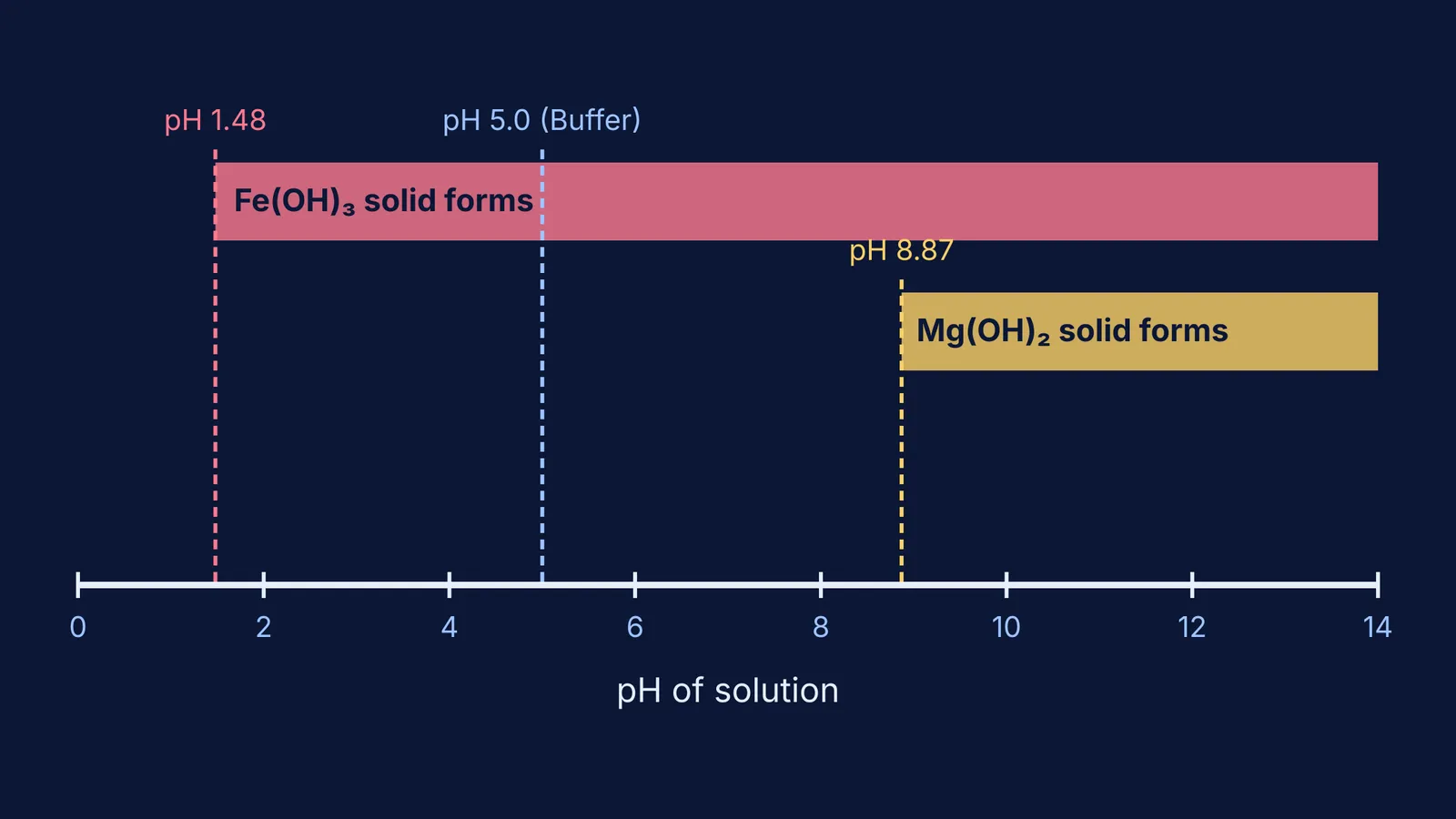
Because its Ksp is exceedingly small, Fe(OH)₃ begins to precipitate in highly acidic conditions, at a pH of just 1.48.
If you are practising these calculations and get stuck on taking roots of very small numbers, the Fermi Problem Library has a step-by-step solver that explains the reasoning for Ksp algebra.
How do you find the pH for magnesium hydroxide?
Now consider the magnesium in the same solution, also at 0.1 M. The accepted Ksp of magnesium hydroxide, Mg(OH)₂, is 5.61 × 10⁻¹² (Wikipedia).
The expression is:
Ksp = [Mg²⁺][OH⁻]² = 5.61 × 10⁻¹²
Substitute the Mg²⁺ concentration:
0.1 × [OH⁻]² = 5.61 × 10⁻¹²
[OH⁻]² = 5.61 × 10⁻¹¹
Taking the square root:
[OH⁻] ≈ 7.49 × 10⁻⁶ M
Convert to pOH:
pOH = −log(7.49 × 10⁻⁶) ≈ 5.13
pH = 14 − 5.13 = 8.87
Magnesium hydroxide requires a much higher concentration of hydroxide ions and will not begin to precipitate until the solution turns basic at a pH of 8.87.
How do you separate the two metal ions?
Because there is a wide gap between pH 1.48 and pH 8.87, you can cleanly separate the two metals. If you add a buffer (such as an acetic acid and sodium acetate mixture) to hold the pH steady at around 5.0, the [OH⁻] will be fixed at 1.0 × 10⁻⁹ M.
At this pH, let us check the reaction quotient Q for each metal.
For iron(III): Q = (0.1)(10⁻⁹)³ = 1.0 × 10⁻²⁸ Here, Q is much greater than the Ksp (2.79 × 10⁻³⁹), so nearly all the Fe³⁺ precipitates as a reddish-brown solid.
For magnesium: Q = (0.1)(10⁻⁹)² = 1.0 × 10⁻¹⁹ Here, Q is much smaller than the Ksp (5.61 × 10⁻¹²), meaning the Mg²⁺ ions stay dissolved in the liquid.
You can then simply filter the mixture. The iron is trapped on the filter paper, and the magnesium passes through with the filtrate.


