

On this page
Draw a line from the centre of a circle straight down to a chord so that it hits at a right angle, and you will always cut that chord perfectly in half. This is one of the foundational geometry theorems taught in schools. But why does it work, and how can you use it in your exams?
What does the perpendicular from the centre to a chord do?
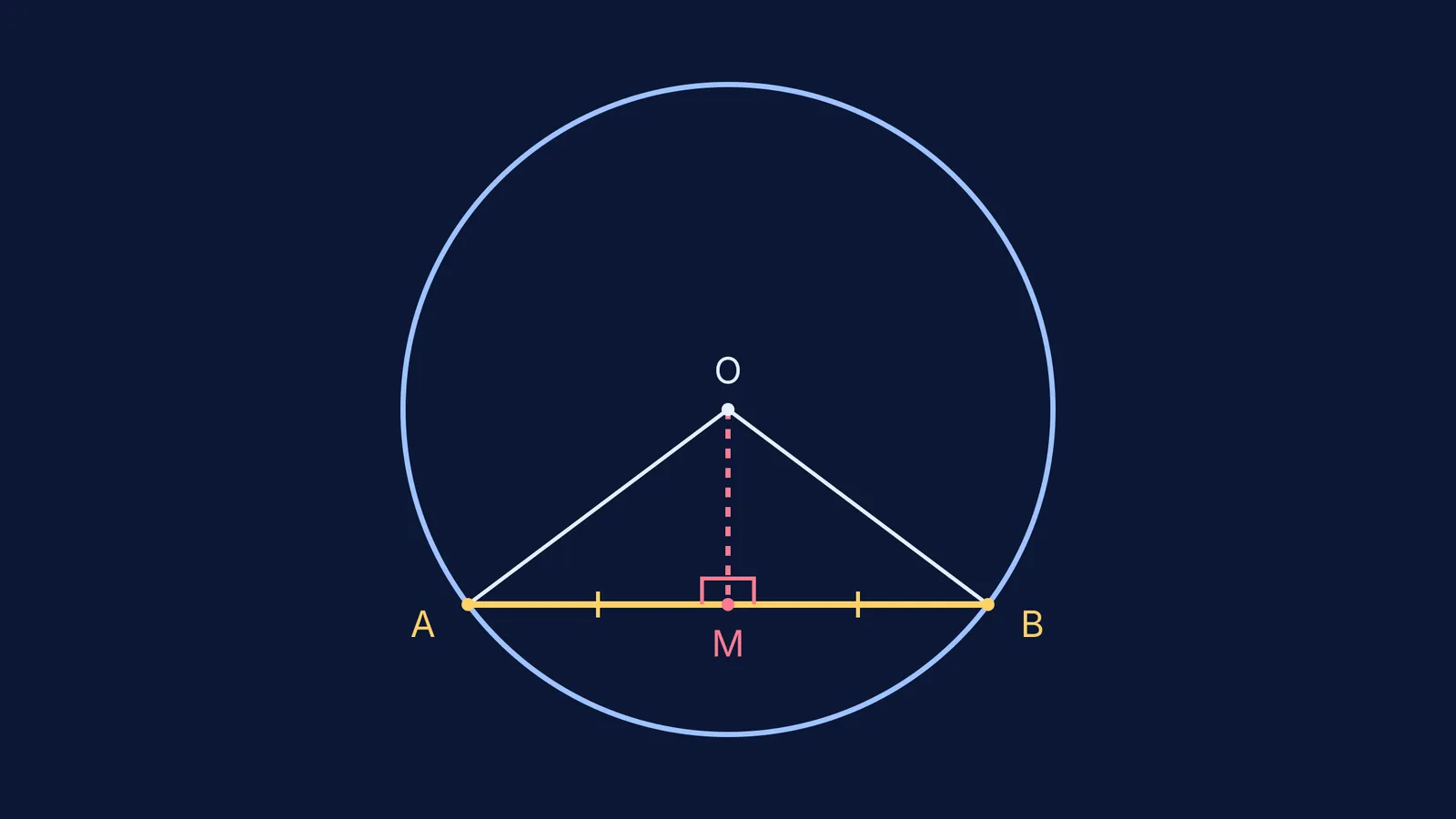
Theorem 9.3 in the NCERT Class 9 Mathematics textbook states that the perpendicular from the centre of a circle to a chord bisects the chord. This means that if you take any chord (a straight line connecting points on a circle) and drop a line from the centre so that it meets the chord at a right angle, the chord is divided into halves of identical length.
This rule is a staple in geometry because it creates symmetrical right-angled triangles inside the circle. Once those triangles are formed, you can use basic trigonometry and Pythagoras' theorem to calculate missing measurements. When you know the radius of the circle and the distance from the centre to the chord, finding the length of the chord becomes a straightforward calculation rather than a complex geometric puzzle.
How do you prove the perpendicular from the centre bisects the chord?
The proof relies on the RHS (Right angle-Hypotenuse-Side) congruence rule. This rule states that right-angled triangles are identical if their hypotenuses and one other corresponding side are equal in length.
Here is how you set up the proof for a circle with centre O and a chord AB:
Draw the perpendicular: Drop a line from the centre O down to the chord AB. Let it meet the chord at point M. We know that angle OMA and angle OMB are both right angles.
Draw the radii: Join the centre O to point A, and the centre O to point B. This creates right-angled triangles: triangle OMA and triangle OMB.
Compare the hypotenuses: The hypotenuse of triangle OMA is OA, and the hypotenuse of triangle OMB is OB. Because OA and OB are both radii of the same circle, they are perfectly equal.
Compare the sides: The side OM is shared by both triangles, so it is equal to itself.
Apply the RHS rule: Because both triangles have a right angle, equal hypotenuses, and a shared side, triangle OMA is congruent to triangle OMB.
The conclusion: Since the triangles are identical in every way, their base sides must also be equal. Therefore, AM equals MB. The chord has been bisected.
If you have gaps in your geometry fundamentals, the Fermi Concept Library contains every concept in physics, chemistry, biology, mathematics and computing, each with its own lesson and its place in the map. If you struggle to know where to start on a proof, Fermi's AI tutor can draw the figure and hold a line of reasoning across the session until the RHS proof clicks.
What happens if you bisect the chord first?
The theorem also works in reverse. The converse theorem states that a line drawn through the centre of a circle to bisect a chord is always perpendicular to the chord.
If you start by finding the exact midpoint M of the chord AB and connect it to the centre O, you again form triangles: OMA and OMB. This time, you know that AM = MB, OA = OB (because they are both radii), and OM is a shared side. By the Side-Side-Side (SSS) congruence rule, the triangles are identical.
Because they are identical, angle OMA must equal angle OMB. Since they form a flat line, they must each be exactly a right angle. This converse theorem is just as useful as the original, especially when you need to prove that a line is perpendicular without having the angle given to you.
How do you use this to find chord lengths?
In exams like the CBSE boards, you are rarely asked just to recite the proof. Instead, you will need to apply it alongside Pythagoras' theorem. Let us look at a standard problem structure where you are given the radius and the distance to the chord.
Here is a worked example: a circle has a radius of length five, and a chord is located at a distance of three from the centre. How long is the chord?
Identify the triangle: The distance from the centre (OM) is three. The radius (OA) is the hypotenuse, which is five. The half-chord (AM) is the base.
Apply Pythagoras: AM² + OM² = OA².
Solve for the base: AM² + 3² = 5², which becomes AM² + 9 = 25.
Find the half-chord: AM² = 16, so AM = 4.
Find the full chord: Because the perpendicular bisects the chord, the total length AB is AM + MB. Since AM = 4, the full chord is 8 in length.
This triangle method is a core technique covered in Circles in Class 9. It is also how you approach finding a circle through three given points, because the perpendicular bisectors of the chords meet at the centre.
Why is this theorem important for harder problems?
As you move on to more advanced mathematics, such as coordinate geometry in Class 11, the property of the perpendicular bisector remains essential. It allows you to find the equation of a circle if you are given the coordinates of a chord. The perpendicular bisector of any chord must pass through the centre of the circle, which provides a reliable algebraic path to finding the centre's coordinates.
If you get stuck applying Pythagoras to circle problems during revision, the Fermi Problem Library has worked problems with a step-by-step solver that explains the reasoning rather than printing an answer.


