

On this page
When a permutations problem restricts the placement of certain letters—such as requiring a word to start and end with specific characters—the most effective strategy is to handle the restrictions first. By locking the fixed letters into their places, you reduce a complex puzzle into a straightforward calculation of the remaining empty spots.
With intense competition in engineering and medical entrance exams, candidates must solve standard combinatorics questions quickly and accurately. Establishing a reliable framework for restricted permutations ensures that you do not overcount or miss vital steps under exam pressure. Instead of trying to imagine the whole word at once, breaking it down into fixed and floating positions simplifies the logic.
How do you find arrangements with some letters in fixed positions?
The most reliable approach is the Fixed-Position Framework. Just as with equations and inequalities with modulus, following a strict, step-by-step procedure prevents careless errors and keeps your reasoning on track.
Count the total letters and repetitions: Note the length of the given word and identify any letters that appear more than once.
Pin down the fixed letters: Place the restricted letters into their required positions (for example, the first and last slots).
Count the remaining empty spots: Subtract the fixed positions from the total length.
Calculate permutations for the empty spots: Find the factorial of the number of remaining spots, and divide it by the factorial of any repeated letters left in the pool.
This logic applies whether you are fixing two letters at the ends, or fixing vowels in even positions. The rule remains the same: deal with the strict conditions first, then arrange whatever is left over.
Worked example: The PERMUTATIONS problem
A classic problem from the NCERT Class 11 Mathematics textbook (Chapter 7: Permutations and Combinations) asks: *In how many ways can the letters of the word PERMUTATIONS be arranged if the words start with P and end with S?*
Applying the framework: First, the word PERMUTATIONS has 12 letters in total.
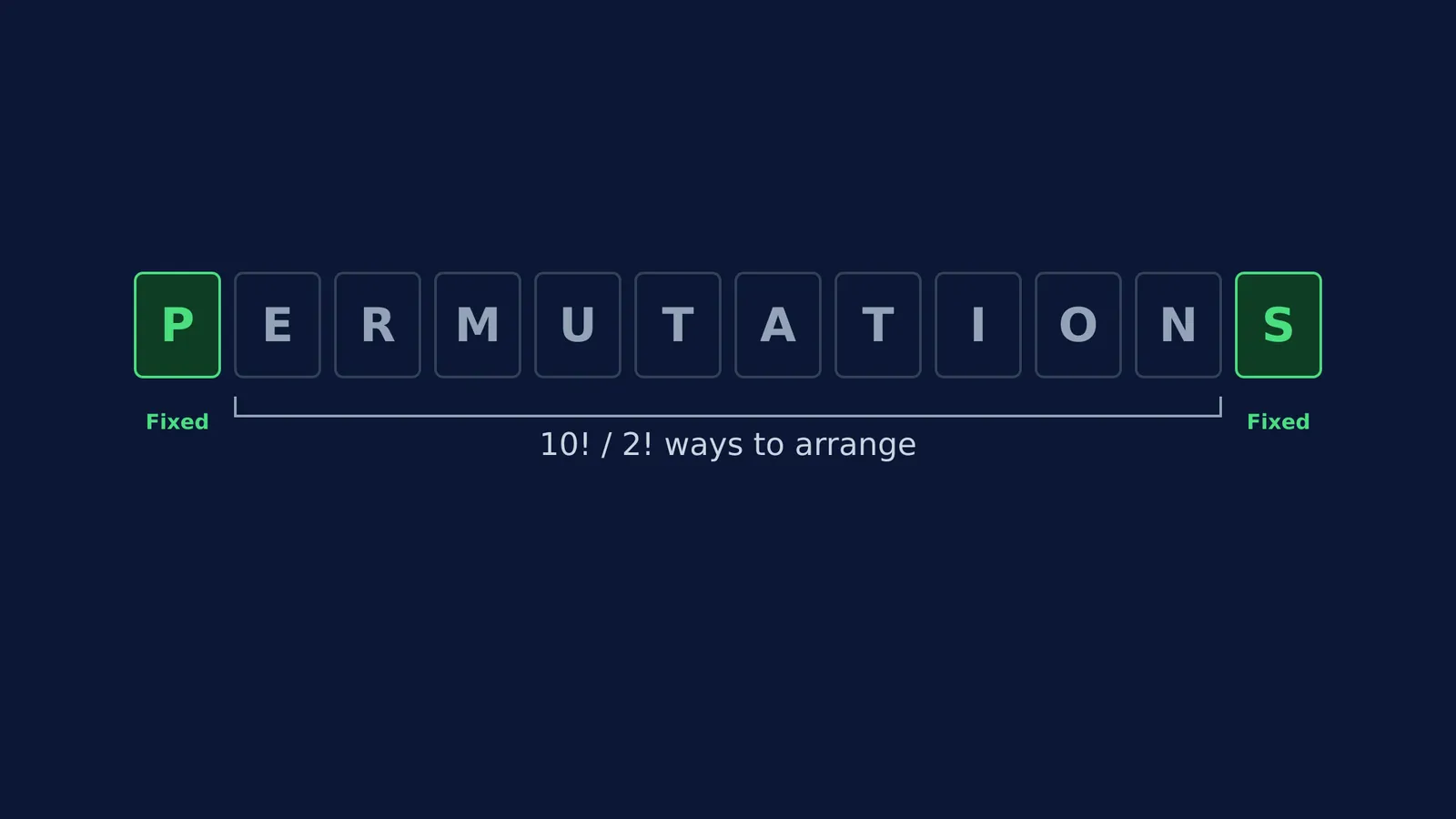
Next, we fix the letter P in the first position and the letter S in the twelfth position. This satisfies the strict condition of the problem.
Since 2 positions are now permanently occupied, there are exactly 10 empty positions remaining in the middle of the word.
The letters left to arrange in those middle spots are E, R, M, U, T, A, T, I, O, N.
What happens when letters are repeated?
When arranging a set of objects where some are identical, you must divide the total permutations by the factorial of the repetition count. If you fail to do this, you will overcount identical arrangements as if they were distinct words. For a deeper look at words with multiple identical letters, you can review the arranging letters with repeats method.
In our pool of 10 remaining letters (E, R, M, U, T, A, T, I, O, N), the letter T appears twice.
The number of ways to arrange these 10 letters is 10! / 2!.
Let us calculate the final answer: 10! = 3,628,800.
Dividing by 2! (which is simply 2) gives: 3,628,800 / 2 = 1,814,400.
So, there are 1,814,400 different words that can be formed starting with P and ending with S.
How do you arrange letters with a fixed gap between them?
Sometimes the restriction is not a specific slot (like the first or last position), but a specific distance between two letters. The same NCERT textbook asks a follow-up question: *In how many ways can the letters of the word PERMUTATIONS be arranged if there are always 4 letters between P and S?*
Here, P and S are not locked to spots 1 and 12, but their relative positions are restricted. We still handle them first.
To keep exactly 4 spaces between them in a 12-letter word, P and S must occupy one of these specific pairs of positions: (1, 6), (2, 7), (3, 8), (4, 9), (5, 10), (6, 11), or (7, 12).
Counting these up, there are 7 possible pairs of positions. However, for each pair, P could come first, or S could come first. This gives us 2 ways to place the letters for each pair. Total ways to place P and S = 7 × 2 = 14 ways.
Once P and S are pinned down into one of those 14 configurations, we are left with the exact same 10 letters (E, R, M, U, T, A, T, I, O, N) to fill the 10 empty spots.
As we calculated earlier, there are 1,814,400 ways to arrange these remaining letters.
To find the total arrangements, multiply the ways to place P and S by the ways to fill the rest of the word: 14 × 1,814,400 = 25,401,600.
By sorting out the restrictive condition first, a complex gap problem turns into a simple multiplication step.
When you get stuck on the reasoning
Similar to recovering aₙ from a formula for Sₙ, mastering permutations requires you to see the underlying logic rather than just memorising a formula. If you hit a roadblock—perhaps forgetting why you divide by 2! or how to count the position pairs—Fermi's AI tutor can step in.
Most learning tools answer questions. Fermi teaches — it holds a line of reasoning across a whole session, notices where you are stuck, and decides whether to explain, ask, or show. It works out what you already know and builds a plan for the session. To try more combinatorics questions with a step-by-step solver that explains the reasoning rather than printing an answer, visit the Fermi Problem Library.


