

On this page
When you add two periodic functions together, their sum is usually periodic. The standard method for finding this new period is the Least Common Multiple (LCM) rule.
But trigonometric functions can be deceptive. A periodic function is formally defined as one that repeats its values at regular intervals (Wikipedia). Because sine and cosine waves share deep symmetries, combining them often creates a function that repeats much faster than the LCM rule predicts.
How does the LCM rule work?
If a function f(x) is made by adding two functions g(x) and h(x), the period of f(x) is generally the least common multiple of their individual periods.
For example, sin(2x) has a period of π, and cos(3x) has a period of 2π/3. The smallest interval that contains full cycles of both is their LCM, which is 2π. After 2π, both waves return to their starting positions together.
What is the period of sin^4 x plus cos^4 x?
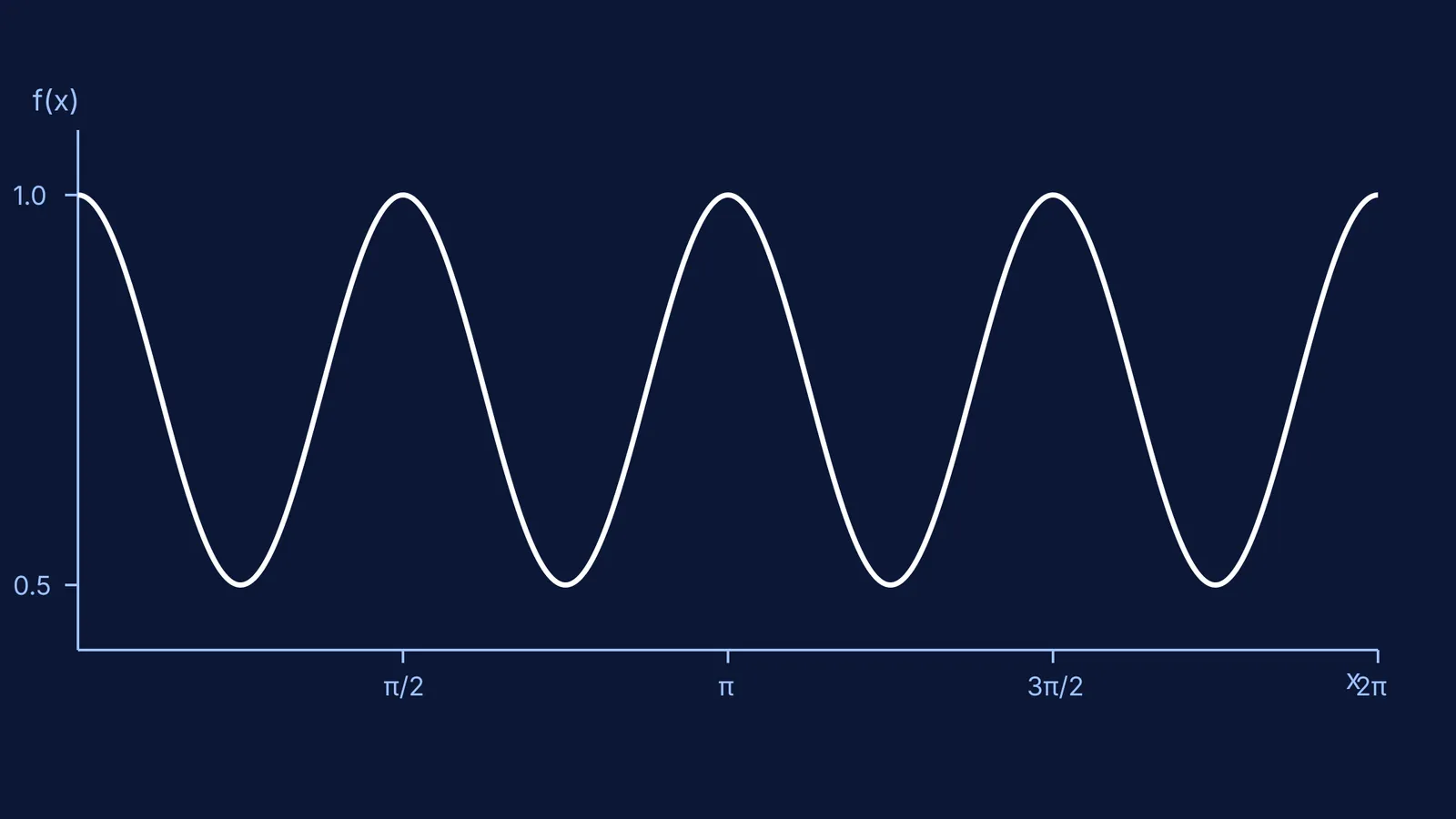
The fundamental period of sin⁴ x + cos⁴ x is π/2 (Stack Exchange).
If you strictly follow the LCM rule, you might get a different answer. Raising a trigonometric function to an even power halves its period, so both sin⁴ x and cos⁴ x have a period of π. Their LCM is π.
Why does the function repeat twice as often? The answer lies in their complementary symmetry. Because sin(x + π/2) = cos x and cos(x + π/2) = −sin x, shifting the sum by π/2 just swaps the two terms:
f(x + π/2) = sin⁴(x + π/2) + cos⁴(x + π/2) = cos⁴ x + (−sin x)⁴ = cos⁴ x + sin⁴ x
The function lands perfectly back on itself in half the expected time.
What is the rigorous derivation?
If you are unsure whether a combined function has a hidden symmetry, simplifying the expression with identities is the most reliable method. Here is the step-by-step reduction:
Start with the algebraic identity a² + b² = (a + b)² − 2ab.
Substitute a = sin² x and b = cos² x to get f(x) = (sin² x + cos² x)² − 2 sin² x cos² x.
Apply the Pythagorean identity (sin² x + cos² x = 1) to get f(x) = 1 − 2 sin² x cos² x.
Multiply and divide by 2 to use the double-angle identity (2 sin x cos x = sin 2x), giving f(x) = 1 − 1/2 (4 sin² x cos² x) = 1 − 1/2 sin²(2x).
Finally, use the power-reduction identity (sin² θ = (1 − cos 2θ)/2) to get f(x) = 1 − 1/2 ((1 − cos 4x)/2) = 3/4 + 1/4 cos 4x.
The period of cos(kx) is 2π/k. With k = 4, the period is exactly 2π/4 = π/2.
If you find yourself stuck halfway through reductions like this, the Fermi Problem Library has worked problems with a step-by-step solver that explains the reasoning rather than printing an answer.
How can you test for a hidden period?
When you face a sum of periodic functions in an exam, follow this sequence to avoid the LCM trap:
Find individual periods: Identify the fundamental period of each separate term.
Apply the LCM rule: Calculate the least common multiple of these periods. This is your candidate period, T.
Check for symmetry: Does the expression contain complementary pairs like |sin x| + |cos x| or even powers like sin⁶ x + cos⁶ x?
Test half the LCM: If you suspect symmetry, evaluate f(x + T/2). If it equals f(x), then T/2 is your fundamental period.
This rule of testing half the period is highly useful when integrating over n periods, where choosing the wrong base period changes the bounds. Similarly, products of cosines like cos A cos 2A cos 4A use identity reductions that reveal underlying periodic behaviour.


