

On this page
When you are taking a time-pressured exam, you often need to check if a large number is a perfect square. Instead of trying to calculate the square root the long way using prime factorization or the long division method, you can use a few simple mathematical rules to instantly rule out most numbers.
The quickest method is the last digit test. By looking at the final digit of a number, you can often determine immediately that it is not a perfect square, saving you the effort of a full calculation.
What is the 2, 3, 7, 8 rule?
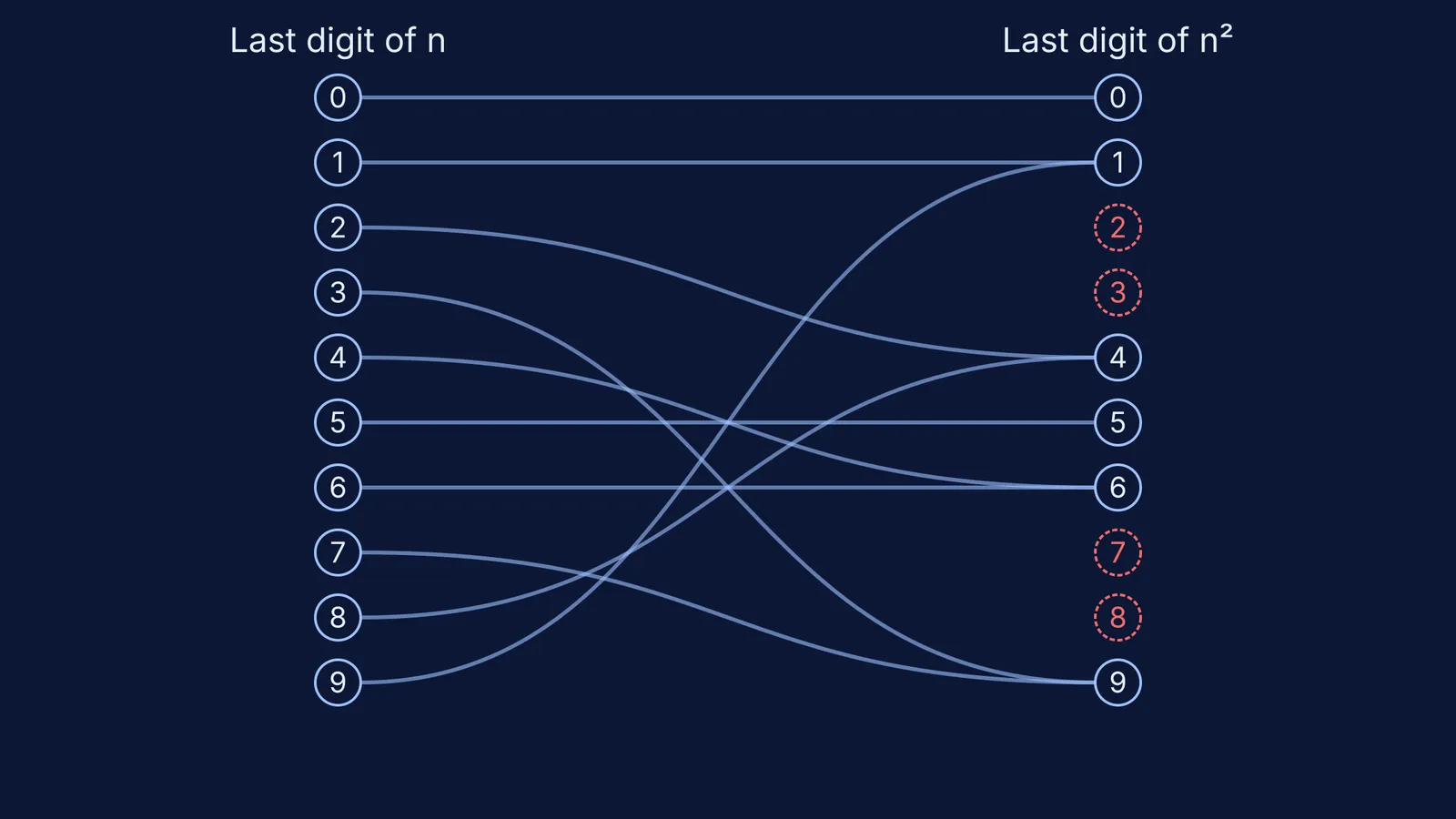
A perfect square is created when an integer is multiplied by itself. If you write out the squares of the numbers from 0 to 9, you will notice a repeating pattern in their final digits. The square of 1 is 1, the square of 2 is 4, the square of 3 is 9, the square of 4 ends in 6 (16), and the square of 5 ends in 5 (25). As you continue, the pattern of last digits mirrors itself: 6 ends in 6 (36), 7 ends in 9 (49), 8 ends in 4 (64), 9 ends in 1 (81), and 0 ends in 0 (00).
According to the mathematical properties of base-10 numbers detailed on Wikipedia, a perfect square can only ever end in 0, 1, 4, 5, 6, or 9. Consequently, any number that ends in 2, 3, 7, or 8 is never a perfect square.
For example, imagine a multiple-choice question asks you to identify the perfect square among the options 14,592, 8,993, 11,237, and 12,544. You do not need to calculate anything to know that the first three are not perfect squares—their last digits (2, 3, and 7) give them away instantly. The only possible answer is 12,544.
However, you must remember that if a number ends in 1, 4, 5, 6, or 9, it *might* be a perfect square, but you still have to verify it. The last digit test is a tool for elimination, not for confirmation. The number 14 ends in 4, but it is not a perfect square.
How do trailing zeros help?
The rule for trailing zeros is just as strict as the last digit test, and it gives you another way to quickly eliminate numbers. If an integer ends in a zero, its square must end in a double zero (00).
In general, in the prime factorization of a perfect square, every prime number must appear with an even exponent. This means that a perfect square must always have an even number of trailing zeros. A number ending in an odd number of zeros, such as 250, 3,000, or 16,000, cannot possibly be a perfect square.
Even if a number has an even number of zeros, the digits preceding the zeros must also form a perfect square. For instance, 400 is a perfect square because there are two zeros and 4 is a perfect square. But 500 is not, because 5 is not a perfect square.
If you find these number properties fascinating and want to see how they fit into the bigger picture, the Fermi Concept Library has every concept in physics, chemistry, biology, mathematics and computing, each with its own lesson and its place in the map.
How many numbers lie between two squares?
Another extremely useful property helps you understand the gaps between perfect squares. As you move up the number line, the distance between consecutive squares grows larger.
As detailed on Wikipedia, there are exactly 2n integers between the square of a number n and the square of the next number, (n + 1)². For example, if you take n = 3, the square is 3² (which is 9), and the next square is 4² (which is 16). Between 9 and 16, there are exactly 2 × 3 = 6 non-square numbers: 10, 11, 12, 13, 14, and 15.
If you take a larger example, like n = 10, the gap between 100 (10²) and 121 (11²) contains exactly 2 × 10 = 20 non-square numbers. This gap property is incredibly useful when you are estimating square roots or trying to bound a large number between two known squares during an exam. It tells you exactly how many numbers you have to check if you are looking for an integer that is not a perfect square.
These shortcuts can save you precious minutes when you are working through a dense mathematics paper. If you want to learn more about avoiding common pitfalls in your board exams, read our guide on Class 10 CBSE maths: board answer mistakes and how to show working. And if you are mapping out your overall exam strategy, our CBSE Class 10 maths paper: a section-by-section plan can help you prioritize your time effectively.


